
 20 August 2026
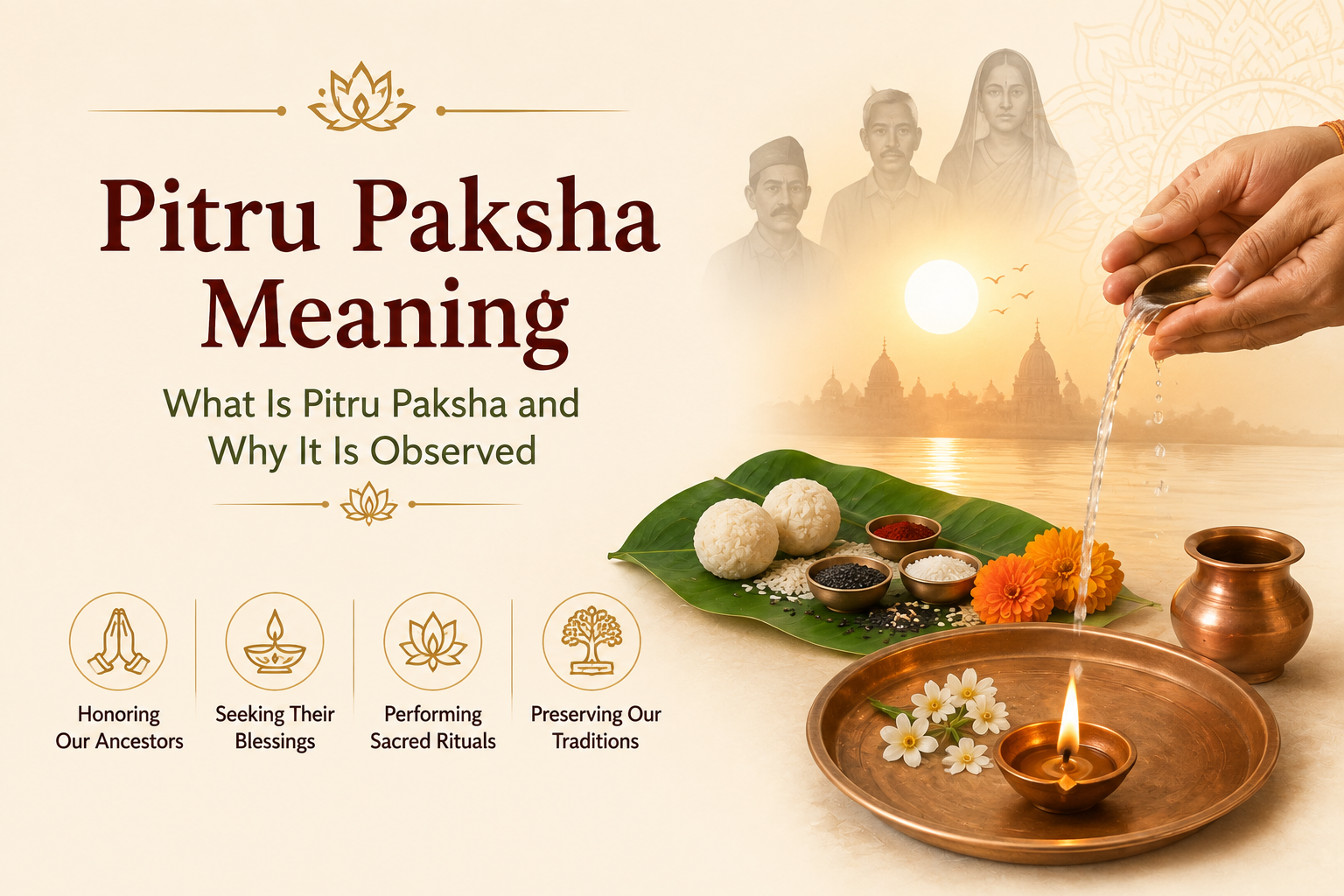
Pitru Paksha meaning is simple in its words and profound in its depth: pitru means ancestors or forefathers, and paksha means a lunar fortnight, so Pitru Paksha means the fortnight of the ancestors. It is a sacred sixteen-day period in the Hindu calendar dedicated to remembering departed ancestors, offering them gratitude, and performing Shraddha and Tarpana in their memory. In pitru paksha 2026 it falls from 26 September to 10 October. This guide explains what Pitru Paksha is, what it means in the deeper philosophical sense, and why our tradition sets aside an entire fortnight of the year for those who came before us.
What Is Pitru Paksha?
Pitru Paksha is the fortnight of the waning moon, the Krishna Paksha, during which Hindu families honour three generations of departed ancestors through Shraddha rituals, offerings of water, til and food, and acts of charity. It is also known as Mahalaya Paksha, Shraddha Paksha, and Kanagat in various regions.
Unlike almost every other observance in the calendar, Pitru Paksha is not a festival. There is no celebration, no decoration, and no festivity. It is a period of solemn remembrance, respect, reverence, gratitude and this distinction shapes everything about how it is observed.
Pitru Paksha Kya Hota Hai? The Meaning of the Words
The term itself carries the whole idea:
- Pitru: the ancestors, the departed forefathers of a family, traditionally reckoned across three generations
- Paksha: a fortnight, the fourteen or fifteen day half of a lunar month
Together, Pitru Paksha means the fortnight belonging to the ancestors. It is understood as the time of year when the ancestors are closest to the world of the living and most receptive to the offerings made in their name.
Why Pitru Paksha Is Observed: The Debt to Our Ancestors
The deeper reason lies in the concept of Pitru Runa, the debt owed to our ancestors. Our tradition holds that every person is born carrying three great debts: to the rishis for knowledge, to the devas for the order of the world, and to the pitrus for the very fact of existence. That we have been born at all, into a particular family and lineage, is because of those who came before us.
Pitru Paksha is the annual opportunity to acknowledge that debt. The offerings are not transactional; they are an expression of gratitude, remembrance, and continuity. The tradition holds that when ancestors are remembered with sincerity, their blessings extend to the family’s progeny, prosperity, and peace, and that neglect of this duty can manifest as Pitru Dosha, the affliction associated with unresolved ancestra obligation, tp avoid this pitru dosha shanthi pooja is performed
The Story Behind Pitru Paksha
The Mahabharata offers the account most often told. When the great warrior Karna died and reached the celestial realm, he was offered gold and jewels to eat rather than food. When he asked why, he was told that throughout his life he had donated gold and wealth in abundance but had never offered food in the name of his ancestors, because he had not known his true lineage.
Karna was granted a return to earth for a fortnight so that he might perform the shraddha rituals and offer food and water in the memory of his forefathers. That fortnight is remembered as Pitru Paksha, and the story carries its own instruction: it is not wealth given generally, but remembrance offered specifically to one’s own ancestors, that fulfils this particular duty.
Who Is Remembered During Pitru Paksha
Shraddha is traditionally performed for three generations of departed ancestors on the paternal side, and in many traditions on the maternal side as well. Beyond the immediate lineage, the fortnight also includes remembrance of:
- Ancestors whose date of passing is unknown or forgotten
- Departed women of the family, honoured especially on Matri Navami
- Family members who died young, or in accidents or unusual circumstances, for whom particular tithis are prescribed in some traditions
- All ancestors collectively, on Sarva Pitru Amavasya, the final day
Pitru Paksha Across Regions
The observance runs across India with considerable regional variation. In Bengal, Odisha, and Assam, the closing Amavasya is observed as Mahalaya, which also marks the ceremonial beginning of the Durga Puja season. In Tamil Nadu it is known as Mahalaya Paksha, with many families travelling to Rameswaram for the rituals. In North India, Gaya in Bihar is regarded as the most sacred site for Pinda Dana.
In the North Indian Purnimanta calendar the fortnight falls in Ashwin Krishna Paksha, while in the South Indian Amavasyant calendar it is described as Bhadrapada Krishna Paksha. The month name differs but the days observed are broadly the same.
The Spirit of the Fortnight
It is worth ending on what the tradition considers the heart of the matter. The rituals of Pitru Paksha carry their full meaning when they are accompanied by the values they represent: gratitude towards previous generations, care and dignity in the treatment of living parents and elders, charity towards those in need, and the preservation of family memory. A ritual performed for departed ancestors becomes far more meaningful when the living members of the family are also treated with kindness and respect.
Frequently Asked Questions
What is the meaning of Pitru Paksha?
Pitru Paksha means the fortnight of the ancestors. Pitru refers to departed forefathers and paksha means a lunar fortnight. It is the sixteen-day period dedicated to remembering ancestors and performing Shraddha and Tarpana in their memory.
What is Pitru Paksha?
Pitru Paksha is the Krishna Paksha fortnight during which Hindu families honour three generations of departed ancestors through Shraddha rituals, offerings of water and food, and charity. It is also called Mahalaya Paksha or Shraddha Paksha, and falls from 26 September to 10 October in 2026.
Pitru paksha kya hota hai?
Pitru Paksha is a solemn fortnight of ancestral remembrance rather than a festival. Families perform Shraddha on the tithi corresponding to an ancestor’s passing, offer Tarpana and Pinda Dana, feed those in need, and avoid celebrations and auspicious ceremonies during this period.
Why is Pitru Paksha observed?
It is observed to acknowledge Pitru Runa, the debt owed to our ancestors for our very existence and lineage. The tradition holds that sincere remembrance brings ancestral blessings to the family’s progeny, prosperity, and peace, while neglect of this duty is associated with Pitru Dosha.
What is the story behind Pitru Paksha?
The Mahabharata recounts that Karna, having donated gold throughout his life but never offered food to his ancestors, was given gold instead of food in the afterlife. He was permitted to return to earth for a fortnight to perform the shraddha rituals, and that fortnight is remembered as Pitru Paksha.
Is Pitru Paksha inauspicious?
It is not inauspicious in itself, but it is a period of mourning and remembrance rather than celebration, which is why weddings, housewarmings, and other major auspicious ceremonies are traditionally avoided. Ordinary life, work, education, healthcare, and necessary travel continue as usual.
Keyword Reference (Internal Use)
Primary keyword listed first. Volume column left blank to be populated from your keyword tool.
| Keyword | Monthly Search Volume |
| pitru paksha meaning (PRIMARY) | |
| pitru paksha means | |
| what is pitru paksha | |
| pitru paksha kya hota hai |