
 30 September 2026
Almost nobody books a Chandika Homa as a first step.
By the time a family reaches this ritual they have usually done a good deal already. Smaller poojas. A parayana or two. Perhaps years of visiting temples and wearing stones. The situation has not shifted, or it has shifted and come back, and somebody in the family has finally said out loud that this needs something bigger.
That is the point at which the tradition offers Chandika Homa, and it is worth understanding what it actually is before deciding whether your situation calls for it.
What Chandika Homa is
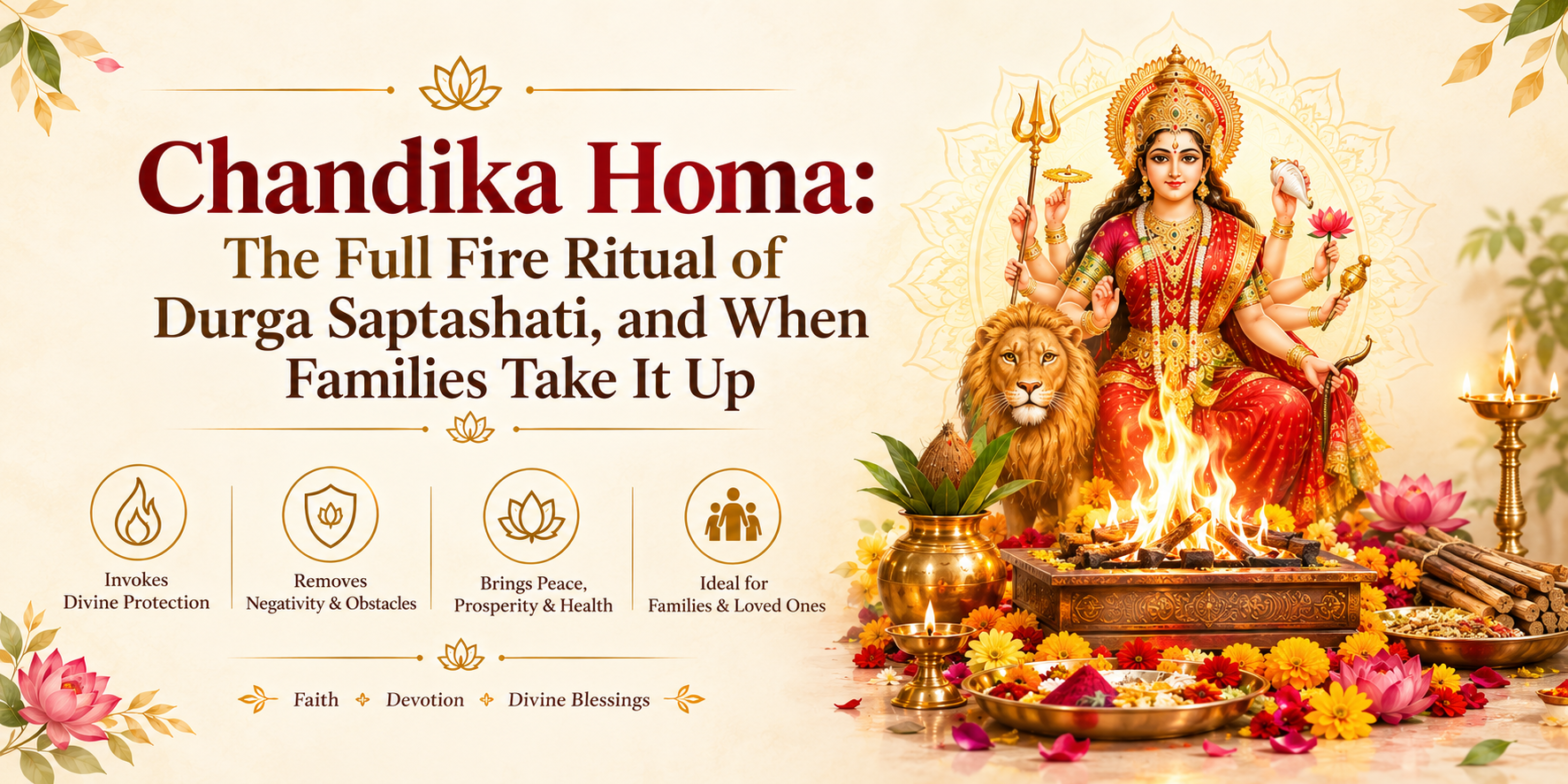
Chandika Homa is Durga Saptashati performed as a fire ritual.
In a parayana, the seven hundred verses are recited. In the homa, the recitation continues but each portion is accompanied by offerings made into the consecrated fire. Agni is invoked as the one who carries the offering, and the Devi is invoked into the fire in her form as Chandika, the fierce aspect of Durga who appears in the Saptashati to destroy what cannot be reasoned with.
This makes it a far larger undertaking than a recitation. There is the preparation of the kunda, the establishment of the fire, the ritual sequence that precedes the main offerings, the offerings themselves across the full text, and the purnahuti at the close. It needs a team of trained purohits and it takes a scale of samagri that a parayana does not.
That is why the cost sits where it does, and it is why we are cautious about recommending it to people whose situation a smaller ritual would address.
Why it is called Sarva Paapa Prayaschitta
You will see Chandika Homa described as Sarva Paapa Prayaschitta Homa. Prayaschitta means expiation, the act of making amends. Sarva Paapa means all wrongdoing.
The idea behind the name is not that a ritual erases what a person has done. It is the older understanding that some difficulties are not situational. They travel. They repeat across a life and sometimes across generations, and they do not respond to ordinary remedies because their root is not in the present circumstance. Prayaschitta rituals are what the tradition prescribes for that category of trouble.
Families who come to us for this homa often describe something along those lines without using the vocabulary. The same pattern keeps happening. It happened to a parent too. Nobody can point to a cause.
The Rahu connection
Chandika Homa is also recommended as a remedy where Rahu is causing difficulty.
Rahu in astrology is associated with confusion, with things that are not what they appear to be, with sudden reversals and with obsession. A Rahu period can feel like a fog that will not lift. People describe making decisions that make no sense to them afterwards, or a persistent sense of something working against them that they cannot identify.
The Devi in her Chandika form is invoked against exactly that quality of obstruction, which is why the two are linked. Whether Rahu is relevant to your chart is a question for a reading, not for a blog post. If someone has told you that you are in a difficult Rahu period, it is worth having that confirmed before choosing a remedy on the strength of it.
What the tradition says it addresses
The traditional sources associate Chandika Homa with protection from difficulties of many kinds. Trouble from enemies, which the texts call shathru badha. Trouble from authorities and from legal matters. Danger from fire, water and weapons. The influence of negative entities. Ill health. Disturbed sleep and troubling dreams. Adverse planetary influence. On the other side, the texts speak of prosperity, wellbeing across generations, good progeny and courage.
We list these as the tradition lists them. We do not promise them.
What the homa involves
The sankalpa is taken in your name, using your gotra and nakshatra, stating who the homa is for and with what intention. The date is chosen on a muhurat appropriate to the ritual.
The homa is performed by our purohits in Bangalore. You do not need to be present, and most of the families who book it are not. You receive video and photographs of the ritual along with prasad afterwards.
If you want to attend, tell us when you book and we will arrange it. Some families travel for it. Others send a family member. Both are fine, and neither is required.
Practical details
The Chandika Homa is Rs 1,30,000, reduced from Rs 1,50,000, inclusive of samagri, dakshina and courier of prasad. Payment is available in ten currencies for devotees booking from abroad.
Before you book a ritual at this scale, please write to us first. Send the birth details and a plain description of what has been happening. Dr. Mekhala’s team will look at the chart and tell you whether this is what your situation calls for or whether something smaller would serve you. We turn people away from this homa more often than we recommend it, and that is the way it should be.