
 13 August 2026
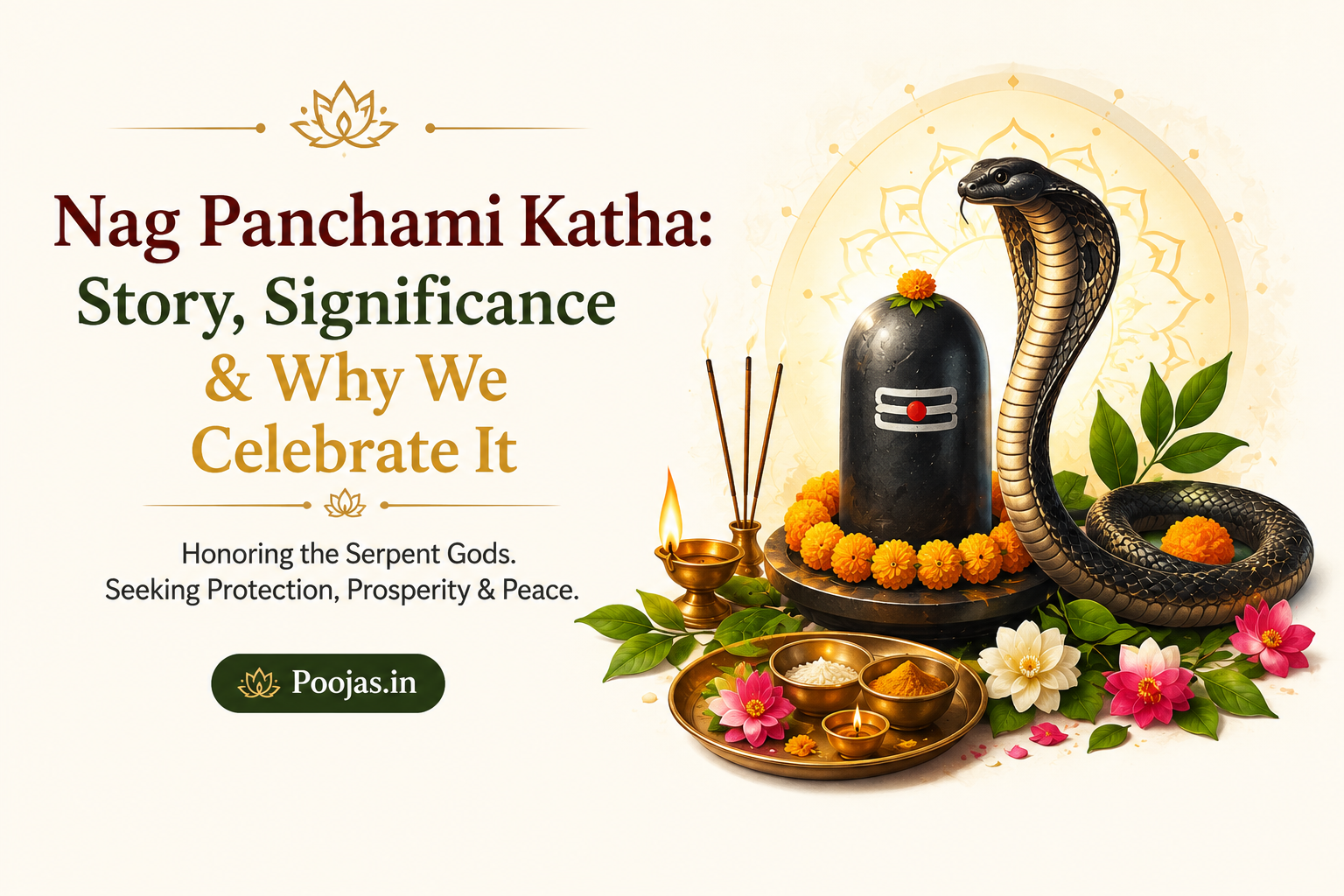
The Nag Panchami katha explains why an entire day of the sacred month of Shravan is set aside for the worship of serpents. The festival is celebrated because the Naga Devatas are among the most powerful and mystical beings in our tradition, presiding over Patala Loka, guarding the hidden treasures of the earth, and holding the power both to bless and to curse. Nag Panchami is the day devotees seek their blessings for progeny, marriage, wealth, and protection, and seek forgiveness for the disturbance caused to their abode. This article shares the deeper significance of Nag Panchami, its scriptural place, and the living traditions that surround it.
Nag Panchami Kya Hai?
Nag Panchami is the festival of serpent worship observed on the Shukla Paksha Panchami of Shravan maas, falling on 17 August in 2026. On this day, the Naga Devatas are honoured with milk, flowers, turmeric, and prayer, at temples, at anthills, and before images of the serpent deities in the home.
Why Nag Panchami Is Celebrated in the Monsoon
The timing is not arbitrary. Nag Panchami falls at the height of the monsoon, and this is the season when serpents come out. Rain floods their deep burrows and drives them into the open, bringing them closer to homes, fields, and pathways than at any other time of year.
Our ancestors saw this clearly. Two beings who ordinarily keep to separate worlds are, for a few weeks each year, brought into close contact. The festival exists to make that contact peaceful. Devotees pray to the Naga Devatas at the very beginning of the season, offering reverence and asking that no harm come from them, and that none be caused to them either. It is a practice of coexistence, expressed as devotion. In 2026 Naga panchami is worshiped on Monday, 17 August 2026
The Nagas as Guardians of the Earth
The Naga Devatas preside over Patala Loka, one of the subtler worlds described in our shastras alongside Bhu Loka and Swarga Loka. They are the guardians of the treasures hidden within the earth, and they are mystical beings in the fullest sense: they can appear and disappear at will.
This is why the tradition holds that sighting a serpent is rarely a matter of chance. If a Naga grants darshan, it is understood to carry a message. It may point to a dosha in the horoscope awaiting attention. It may be a blessing being conferred. Or, because the Nagas guard buried wealth, it may indicate the prospect of unexpected gain or a treasure coming to light.
Excavation, Disturbance, and the Need for Propitiation
There is a dimension of this festival that touches almost every modern household, and few people are aware of it. Whenever the earth is excavated, for construction, for a borewell, for farming, the dwelling place of the Nagas is disturbed, and tradition holds that such disturbance can invoke displeasure.
The difficulty is that most of us never did the digging ourselves. The builder who raised the apartment block we live in excavated that ground years before we moved in, and we have no way of knowing whether any propitiation was performed at the time. The karmic connection to the land, however, extends to those who dwell upon it. This is one of the most practical reasons the tradition insists that the blessings of the Naga Devatas be sought at least once every year, and Nag Panchami is that day.
The Nagas in Scripture and Beside the Gods
Few beings are as closely bound to the great deities as the serpents. Lord Shiva wears Vasuki around his neck as an ornament. Lord Vishnu reclines upon Adisesha, the cosmic serpent. Lord Ganesha wears a Naga as a belt at his waist. Lord Subrahmanya is worshipped in serpent form, most famously at Kukke Subramanya, where the association is central to the kshetra itself. The Ashta Nagas, the eight great serpent deities, are invoked in ritual across traditions.
The Sri Guru Gita speaks of the power of the serpent deities directly, in a verse describing the protection of the Guru:
Munibhih pannagair vaapi surair vaa shapito yadi, Kaalamrityu bhayaad vaapi gurur rakshati Parvati.
The verse tells Parvati that even one who has been cursed by sages or by the serpent deities, or who stands in fear of untimely death, is protected by the Guru. Consider what this implies. For the curse of the Nagas to be placed in the same breath as the curse of great sages is a measure of how powerful the serpent deities are held to be.
It is worth understanding this correctly, however. What follows a person is ultimately their own karma. It may indeed be connected to a particular serpent, or it may be the working out of a karmic debt that simply expresses itself in this form. The Nagas are not merely vengeful beings; they are participants in the law of karma.
The Nine Nagas and the Blessings Obtained From Them
The tradition names nine principal Naga Devatas, and each is associated with a specific blessing. This is knowledge that explains why devotees with particular prayers invoke particular Nagas, and it shows how precisely the tradition understood the domain of each:
- Ananta: bestows the blessing of a daughter (Putri Dayaka)
- Vasuki: bestows the blessing of a son (Putra Dayaka)
- Karkotaka: gives relief from skin diseases, traditionally including leprosy (Kushtha Roga Nivarana)
- Takshaka: bestows strength (Bala Pradayaka)
- Padma: bestows wealth and prosperity (Dhana Dayaka)
- Shankha: gives relief from ear-related ailments (Karna Roga Nivarana)
- Gulika: gives relief from eye-related ailments (Netra Roga Nivarana)
- Shesha: removes all sins (Sarva Papaharaka)
- Mahapadma: bestows moksha, spiritual liberation (Moksha Dayaka)
Read together, the nine cover the whole arc of human need: progeny, health of the body in its particular parts, strength, wealth, the clearing of sin, and finally liberation itself. On Nag Panchami all nine are worshipped together, and devotees carrying a specific prayer may hold the corresponding Naga in mind while offering their worship.
Living Traditions and Manifestations
The tradition preserves many accounts of the Nagas manifesting in response to devotion. In the Sarpa Bali ritual, payasam and other offerings are placed for the serpent deities, and it is held with confidence that the Nagas come to partake of them. There is a well-known Shiva temple near Kumbakonam where rishis are said to take the form of serpents and offer bilva leaves to the Lord.
Families across South India carry their own accounts as well. In many households it is remembered that a pregnant woman sighted a serpent, and that the child born afterwards bore a mark resembling a serpent. Such children were named in honour of the blessing, as Nagaraj or Nagaratna, the name itself carrying the memory of the darshan for a lifetime.
Why the Nagas Are Sought for Progeny, Marriage, and Wealth
The blessings of the Naga Devatas are traditionally connected to the most fundamental continuities of life. It is held that progeny and the continuation of a lineage proceed with their blessing, that marriage is enabled by their grace, and that wealth flows through their favour since they are the guardians of hidden treasure. When these areas of life are repeatedly obstructed, tradition looks to Sarpa Dosha as one possible cause, and to the propitiation of the Nagas as the response.
Frequently Asked Questions
What is the Nag Panchami katha?
The Nag Panchami katha centres on the worship of the Naga Devatas, who preside over Patala Loka and guard the earth’s hidden treasures. The festival is observed in the monsoon, when serpents emerge from flooded burrows, so that devotees may seek their blessings and their goodwill for the season and the year ahead.
Why is Nag Panchami celebrated?
Nag Panchami is celebrated to honour the serpent deities, to seek their blessings for progeny, marriage, wealth, and protection, and to seek forgiveness for disturbing their dwelling place through digging and construction. The monsoon timing reflects the season when serpents come closest to human habitation.
What is the significance of Nag Panchami?
Its significance lies in reverence for beings held to be powerful, mystical, and closely bound to the great deities themselves. Worshipping the Nagas at least once a year is considered important because almost every household lives on land that has been excavated at some point, disturbing their abode.
Is Nag Panchami a public holiday?
Nag Panchami is not a national public holiday across India, though it is widely observed and may be a regional or optional holiday in some states. Most devotees observe it with morning puja before their usual day.
Who are the nine Nagas and what do they bless?
The nine principal Naga Devatas are Ananta (a daughter), Vasuki (a son), Karkotaka (relief from skin diseases), Takshaka (strength), Padma (wealth and prosperity), Shankha (relief from ear ailments), Gulika (relief from eye ailments), Shesha (removal of all sins), and Mahapadma (moksha). All nine are worshipped together on Nag Panchami.
What does the Guru Gita say about serpent curses?
The Sri Guru Gita states that even one cursed by sages or by the serpent deities, or facing the fear of untimely death, is protected by the Guru. Placing the curse of the Nagas alongside that of great sages indicates how powerful the serpent deities are considered to be.