
 17 August 2026
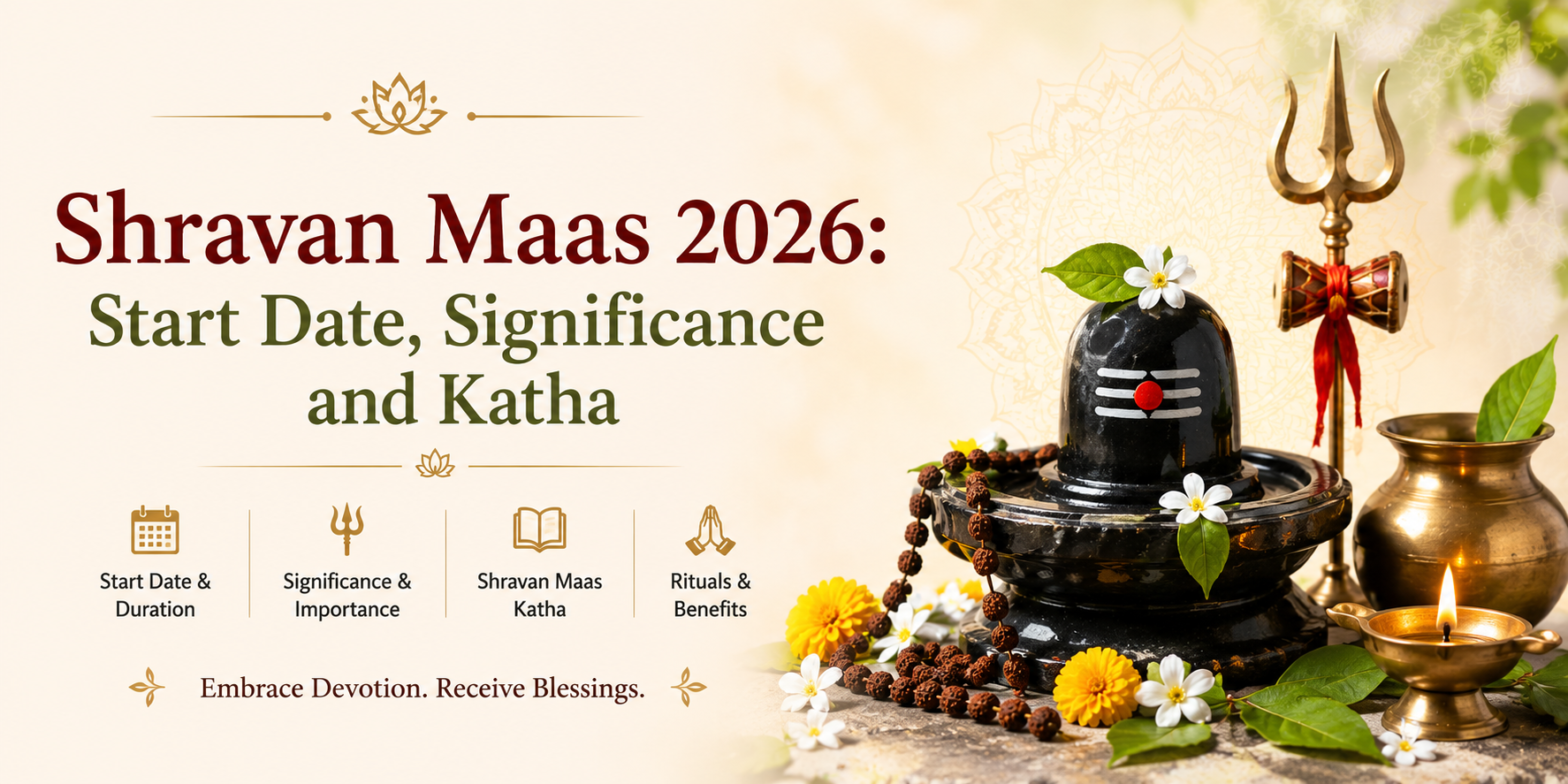
Shravan maas 2026 begins on 30 July in North India and on 13 August in South India, Maharashtra, and Gujarat, ending on 28 August and 11 September respectively. Shravan is the most festival-rich month of the Hindu calendar, opening with Nag Panchami and continuing through Varamahalakshmi Vrata, Mangala Gowri Vrata, Upakarma, Raksha Bandhan, and Krishna Janmashtami. This guide explains why the start date differs between regions, why Shravan follows a month in which almost nothing auspicious is performed, and what the month means in different parts of the country.
Shravan Maas Kab Se Shuru Hai in 2026?
The answer depends on the calendar your family follows, and both are equally correct.
- North and East India (Purnimanta reckoning): 30 July to 28 August 2026
- South India, Maharashtra, and Gujarat (Amanta reckoning): 13 August to 11 September 2026
The difference is a matter of where the month is considered to begin. In the North, every month ends on Purnima, the full moon, and the next month begins immediately after it. So Shravan, Bhadrapada, and the rest are all reckoned as Purnimanta. In the South, the Amanta system is followed: once Amavasya is complete, the next month begins. This is why Shravan maas prarambh falls on 13 August for us in the South while it began a fortnight earlier for North Indian families.
Importantly, the festivals themselves do not shift. Because they are fixed by tithi rather than by the start of the month, Nag Panchami, Raksha Bandhan, and Janmashtami fall on the same dates across the country. What differs between regions is the month’s start and end, and therefore which Mondays count as Shravan Somvar and which Tuesdays as Mangala Gowri.
Why Shravan Follows the Quiet Month of Ashada
To understand why Shravan bursts with festivals, you have to understand the month that precedes it. During Ashada, nothing auspicious is undertaken. No weddings, no housewarmings, no major functions.
The reasoning our ancestors followed was intensely practical. Ashada brings extreme weather, heavy winds and the onset of the monsoon, and in earlier times people simply could not travel. Transportation was poor, roads became impassable, and inviting families to a function meant asking them to make a journey they could not safely complete. It is also the season of pollination, when pollen and dust fill the air and allergies flare. The sensible response was to stay put.
The saints and sadhus formalised this in Chaturmas, the four-month period during which they remain in one place rather than wandering, devoting the time to sadhana instead of travel. The whole culture, in effect, paused.
Then Ashada ends, and Shravan arrives. Having observed the quiet month, the tradition says: now let us begin to celebrate, one festival after another. This is why Shravan feels less like a single festival and more like the opening of an entire season.
The Festivals of Shravan Maas
Shravan is the onset of many festivals, and the sequence begins in a specific way.
Nag Panchami
The month always begins with the worship of the Naga Devatas on 17 August in 2026 for Naga panchami. The timing is deliberate: the monsoon floods the deep burrows of serpents and drives them into the open, closer to human habitation than at any other time. Devotees seek the blessings of the Naga Devatas so that this contact brings no harm, and seek forgiveness for the disturbance caused to their dwelling place through digging and construction.
Varamahalakshmi Vrata
Varamahalakshmi Vrata Observed on the Friday before Shravana Purnima, falling on 21 August in 2026, this is the great vrata of the month for invoking the blessings of Lakshmi ji. It is among the most important observances for women across South India.
Mangala Gowri Vrata
Mangala Gowri Vrata is observed on the Tuesdays of Shravan, this vrata is kept especially by newly married women, who pray to remain eternally sumangali, a married woman whose husband lives long. It is a tradition particularly cherished in South India.
Upakarma and Raksha Bandhan
On Shravana Purnima, 28 August in 2026, Upakarma is observed, the day on which the sacred thread is ceremonially changed. The same Purnima is observed as Raksha Bandhan, celebrating the bond of protection between brother and sister, with regional customs of great variety across the country.
Krishna Janmashtami
The birth of Lord Krishna is celebrated towards the end of the Shravan period, completing a month unmatched in the calendar for the density of its observances.
Whom Do We Worship in Shravan? North and South Differ
Here is a distinction many people are unaware of. In North India and Maharashtra, Shravan is above all the month of Lord Shiva. Every Monday is observed as Shravan Somvar Rudrabhishek with fasting and temple visits. Part of the devotional reasoning connects back to the serpents themselves: Shiva wears the Naga as his ornament, so seeking his protection is also seeking safety from harm during the season when serpents move about.
In South India, Shravan carries a strong Vaishnava emphasis. Lord Venkateswara and the forms of Vishnu are worshipped through the month, and Fridays are given to Mahalakshmi. Lord Vishnu too reclines upon Adisesha, the cosmic serpent, so the connection is present in both traditions, expressed differently.
South Indian and North Indian traditions differ considerably, and within each region customs vary further from community to community and family to family. The wise approach is to follow the practice of your own family and local temple rather than seeking a single uniform rule.
Is Shravan 2026 an Adhik Maas?
No. Shravan 2026 is a regular month. Adhik maas, the extra lunar month inserted periodically to reconcile the lunar and solar calendars, does not fall on Shravan this year. When an Adhik Shravan maas does occur, the month is extended and the number of Shravan Somvars increases, which is why devotees watch for it. In 2026 the usual four Somvars apply in each calendar system.
Frequently Asked Questions
Shravan maas kab se shuru hai in 2026?
Shravan maas begins on 30 July 2026 in North India (Purnimanta calendar) and on 13 August 2026 in South India, Maharashtra, and Gujarat (Amanta calendar). It ends on 28 August and 11 September respectively.
Why does Shravan begin on different dates in North and South India?
North India follows the Purnimanta system, where each month ends on the full moon and the next begins after it. South India, Maharashtra, and Gujarat follow the Amanta system, where the month begins after Amavasya. This creates a difference of about a fortnight, though the festivals themselves remain on the same tithis.
Why is nothing auspicious done in Ashada?
Ashada brings extreme weather, heavy winds, the onset of monsoon, and the pollination season with its dust and allergies. In earlier times travel was difficult and guests could not reach functions safely, so no weddings or major ceremonies were held. Saints observed Chaturmas, remaining in one place for sadhana, and Shravan then opens the season of celebration.
Which festivals fall in Shravan maas?
Shravan opens with Nag Panchami, and includes Varamahalakshmi Vrata, the Mangala Gowri Vrata on Tuesdays, the Shravan Somvar observances, Upakarma and Raksha Bandhan on Shravana Purnima, and Krishna Janmashtami.
Is Shravan dedicated to Shiva or Vishnu?
Both, depending on the region. North India and Maharashtra observe Shravan primarily as the month of Lord Shiva, with Monday fasts and Rudrabhishek. In South India, Lord Venkateswara and the forms of Vishnu are worshipped through the month, with Fridays given to Mahalakshmi.