

 23 June 2026
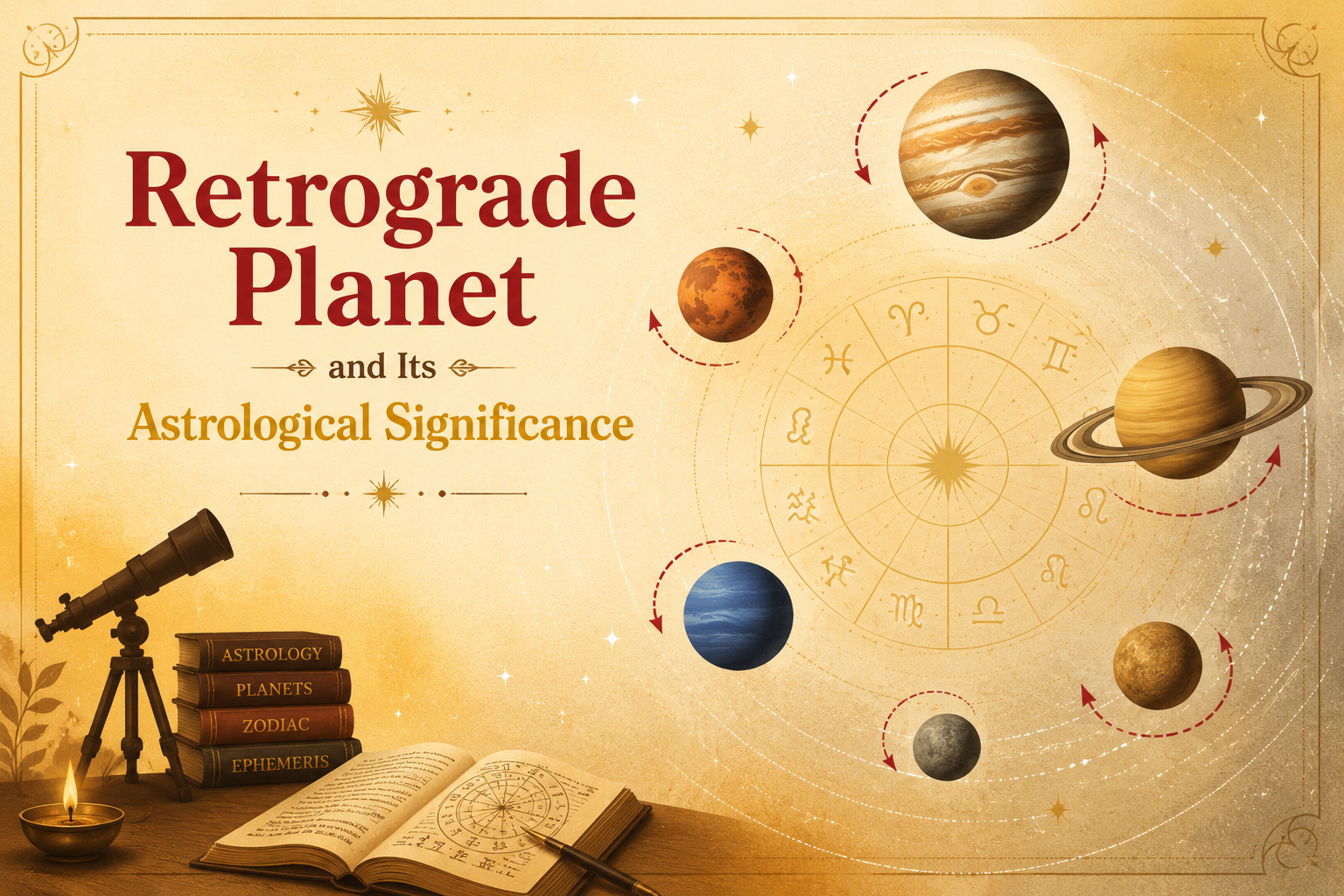
A retrograde planet is a planet that appears to move backward in the sky from the perspective of Earth. In astrology, a retrograde planet is believed to turn its energy inward, causing delays, reflection, and the revisiting of past matters connected to that planet. No planet actually moves backward in space. The backward effect is an optical illusion created when Earth and another planet move at different speeds around the Sun. Understanding what a retrograde planet means in astrology helps you read your birth chart with more depth and prepare for the periods when these planetary energies shift.
At Poojas.in, we explain retrograde planets through both the science of retrograde motion of planets and the timeless wisdom of Vedic astrology, so you get a complete and trustworthy answer.
What Is a Retrograde Planet in Astrology?
In astrology, a retrograde planet is a planet whose energy appears reversed, internalized, or slowed down during a specific period. When you ask what does a retrograde planet mean, the simplest answer is this: a retrograde planet asks you to pause, review, and revisit the themes it governs instead of pushing forward.
For example, when Mercury is one of the retrograde planets in astrology, communication, travel, and technology tend to need extra care. When Venus joins the planets in retrograde, relationships often call for reflection. Each retrograde planet carries the core meaning of that planet, but expressed in a more inward and reflective way.
The retrograde planet meaning in astrology is not about bad luck. It is about redirection. A retrograde planet invites you to slow down and complete unfinished business connected to that planet’s domain.
What Causes the Retrograde Motion of Planets?
The retrograde motion of planets is an illusion of perspective. As Earth orbits the Sun, it sometimes overtakes a slower outer planet or is overtaken by a faster inner planet. During this overtaking, the other planet seems to drift backward against the background of stars.
Think of two cars on a highway. When you pass a slower car, it briefly appears to move backward relative to you, even though both cars are moving forward. The retrograde motion of planets works the same way. This is why understanding what is a retrograde planet begins with understanding motion and viewpoint, not actual reversal in space.
In Vedic astrology, this apparent backward movement is called Vakra Chara or Vakri, and a retrograde planet is considered to be closer to Earth and therefore stronger in its influence, even though its expression turns inward.
It is worth noting how direct and retrograde motion differ in the sky. Normally a planet drifts slightly eastward from night to night against the backdrop of the rashis and nakshatras. This forward drift is called direct motion, or Ruju Chara. When a planet seems to reverse and move westward for a period before resuming its eastward course, that westward movement is its retrograde motion. While modern astronomy treats this purely as an illusion of perspective, Jyotisha gives retrograde motion separate weightage and interprets a retrograde planet through its own special principles rather than treating it the same as a direct planet.
Which Planets Can Be Retrograde?
Not every celestial body in your chart goes retrograde the same way. Here is a quick guide to the planets in retrograde you will encounter and their impact:
- Mercury retrograde: Affects communication, contracts, travel, and technology. This is one of the most commonly known retrograde planets in astrology.
- Venus retrograde: Influences love, relationships, beauty, and luxury matters.
- Mars retrograde: Slows action, drive, and energy, often turning anger or ambition inward.
- Jupiter retrograde: Reshapes growth, wisdom, beliefs, finances and inner expansion.
- Saturn retrograde: Brings deep review of discipline, karma, responsibility, and life lessons.
- Rahu and Ketu: In Vedic astrology, these shadow points are always considered retrograde.
The Sun and the Moon never go retrograde. They are the two luminaries and always appear in direct motion. So when people talk about a retrograde planet, they are referring to the Pancha Tara grahas, namely Mercury, Venus, Mars, Jupiter, and Saturn, along with Rahu and Ketu in the Vedic system. The five visible planets are the only true planets in retrograde, while Rahu and Ketu, the shadowy nodes or Chaya grahas, are considered to be always retrograde by nature.
Retrograde Duration of the Tara Grahas
Each retrograde planet stays retrograde for a different length of time before turning stable and then direct again. Classical Jyotisha records the approximate timings as follows:
| Planet | Retrograde duration | Stable time |
| Mercury | About 24 days | 1 day |
| Venus | About 42 days | 2 days |
| Mars | About 80 days | 3 days |
| Jupiter | About 120 days | 5 days |
| Saturn | About 140 days | 5 days |
These timings, along with the distance of the planet from the Sun when it turns retrograde and when it turns direct, help an astrologer judge the strength and effect of each retrograde planet.
The Eight Types of Planetary Motion
Jyotisha does not see planetary motion as simply direct or retrograde. The Siddhanta texts grade the motion of the five visible planets into eight types, because the motion is not uniform due to the gravitational pull of the Sun and other grahas. These eight types of planetary motion are:
- Vakra (Retrograde): the backward apparent motion that defines a retrograde planet.
- Ati Vakra (Severe Retrograde): an intense form of retrograde motion.
- Ruju (Direct): normal forward eastward motion.
- Sthambhana (Static): the planet appears to stand still.
- Astangata (Combust): the planet is hidden behind the Sun.
- Sheeghra (Fast): faster than average forward motion.
- Ati Sheeghra (Fastest): the quickest forward motion.
- Manda (Slow): slower than average motion.
Understanding these grades shows that a retrograde planet, especially in its Ati Vakra or severe retrograde state, carries a distinct and powerful signature in the chart.
What Does a Retrograde Planet Mean for Your Birth Chart?
A retrograde planet in your birth chart shapes your personality and karmic journey from the moment you are born. When you have one or more planets in retrograde at birth, the energy of those planets often feels more internal, reflective, and karmic.
People with a retrograde planet in their chart frequently feel that the themes of that planet are something they are meant to master over a lifetime. For example, a person born with Saturn as a retrograde planet may carry lessons about patience and responsibility that unfold slowly and deeply.
This is why so many people search for the retrograde planet meaning in astrology when reading their own chart. A retrograde planet is not a flaw. It is a signal of inner work, past-life themes, and areas where growth comes through reflection rather than rushing.
When the Lagna Lord or 5th Lord Is a Retrograde Planet
The house a retrograde planet rules matters greatly. When the Lagna Lord, the ruler of the ascendant, is Vakri or retrograde, the native often tends to make self-committed mistakes more frequently. Such a person may carry a dual mind, lacking a firm and settled outlook, which can make it harder to take the right decision at the right time.
A similar pattern is seen when the Panchamadhipati, the fifth Lord, is a retrograde planet. The fifth house governs intelligence, judgement, and the mind’s discriminative power, so when its ruler is Vakri, the native may struggle with indecision and a wavering mind. Recognizing such a retrograde planet in the chart is valuable, because it helps the person understand their tendency toward a dual mind and consciously work toward steadier, clearer decision-making.
How to Find Retrograde Planets in Birth Chart
If you want to know how to find retrograde planets in birth chart placements, the process is simple once you know what to look for. Here are the steps:
- Generate your birth chart. Use an accurate Vedic birth chart based on your exact date, time, and place of birth.
- Look for the retrograde symbol. A retrograde planet is usually marked with an “R” or “Rx” next to it in the chart.
- Note the sign and house. The sign and house of each retrograde planet tells you which life area is affected.
- Check Rahu and Ketu. In Vedic charts, these are always retrograde by nature.
- Consult an astrologer. For a precise reading of your planets in retrograde, an expert interpretation gives the clearest picture.
Knowing how to find retrograde planets in birth chart positions empowers you to understand your strengths, your karmic lessons, and the timing of important life themes. At Poojas.in, our expert astrologer Dr. Mekhala V Jois helps you identify every retrograde planet in your chart and explain its meaning and impact on your life clearly.
Astrological Significance of a Retrograde Planet
The astrological significance of a retrograde planet lies in its inward, karmic, and reflective nature. Here is what the retrograde planets in astrology generally signify:
- Reflection over action: A retrograde planet asks you to look inward and review rather than push forward.
- Karmic lessons: Planets in retrograde often point to unfinished karma that you are meant to resolve.
- Delays and revisions: Matters ruled by the retrograde planet may be slowed so they can be done correctly.
- Hidden strength: In Vedic astrology, a retrograde planet is closer to Earth and can express its results more intensely. Vakri grahas are considered powerful while judging the horoscope.
- Personal growth: A retrograde planet rewards patience, introspection, and a willingness to revisit the past.
The retrograde planet meaning in astrology reminds us that not all progress is forward motion. Sometimes the most meaningful growth happens when a retrograde planet turns our attention within.
How to Work With a Retrograde Planet
You cannot stop the retrograde motion of planets, but you can work with the energy of any retrograde planet wisely. During periods when there are planets in retrograde, focus on the “re” words: review, revise, reflect, reconnect, and restore.
Avoid signing major new agreements during a Mercury retrograde planet transit phase. Use a Venus retrograde planet period to reflect on relationships. Treat a Saturn retrograde planet phase as a time to strengthen discipline and resolve old karma. Performing the right pooja or remedy for a challenging retrograde planet in rashi kundali can also help balance its energy, and our experts at Poojas.in can recommend the appropriate remedies for your chart.
Frequently Asked Questions
What is a retrograde planet in simple words?
A retrograde planet is a planet that appears to move backward in the sky as seen from Earth. In astrology, this retrograde planet turns its energy inward, encouraging reflection, review, and the revisiting of past matters.
What does a retrograde planet mean in astrology?
The retrograde planet meaning in astrology is that the planet’s energy becomes internalized and reflective. A retrograde planet often brings delays, karmic lessons, unexpected outcomes or sudden change of outcome and a need to revisit themes connected to that planet rather than starting new things.
What causes the retrograde motion of planets?
The retrograde motion of planets is an optical illusion. It happens when Earth and another planet move at different speeds in their orbits, making the other planet appear to move backward against the stars. No planet truly moves backward in space.
How do I find retrograde planets in my birth chart?
To know how to find retrograde planets in birth chart placements, generate your accurate birth chart and look for an “R” or “Rx” symbol next to a planet. That mark identifies each retrograde planet. In Vedic charts, Rahu and Ketu are always retrograde.
Are retrograde planets in astrology bad?
No. Retrograde planets in astrology are not bad. A retrograde planet is considered powerful. It simply asks for reflection and inner work. Many people with planets in retrograde develop deep strength, wisdom, and mastery in the areas those planets govern. It makes the native work harder to achieve results.
Which planets can be retrograde?
Mercury, Venus, Mars, Jupiter, and Saturn can all become a retrograde planet, along with the outer planets. In Vedic astrology, Rahu and Ketu are always retrograde. The Sun and Moon never go retrograde.
Conclusion
A retrograde planet is one of the most fascinating concepts in astrology, blending the science of the retrograde motion of planets with deep spiritual meaning. Understanding what a retrograde planet is, how to find retrograde planets in birth chart positions, and the retrograde planet meaning in astrology gives you a powerful tool for self-awareness and timing. The retrograde planets in astrology invite you to pause, reflect, work harder and grow from within.
To get a personalized reading of every retrograde planet in your chart, along with the right poojas and remedies, connect with expert astrologer Dr. Mekhala V Jois at Poojas.in today.