

 30 October 2026
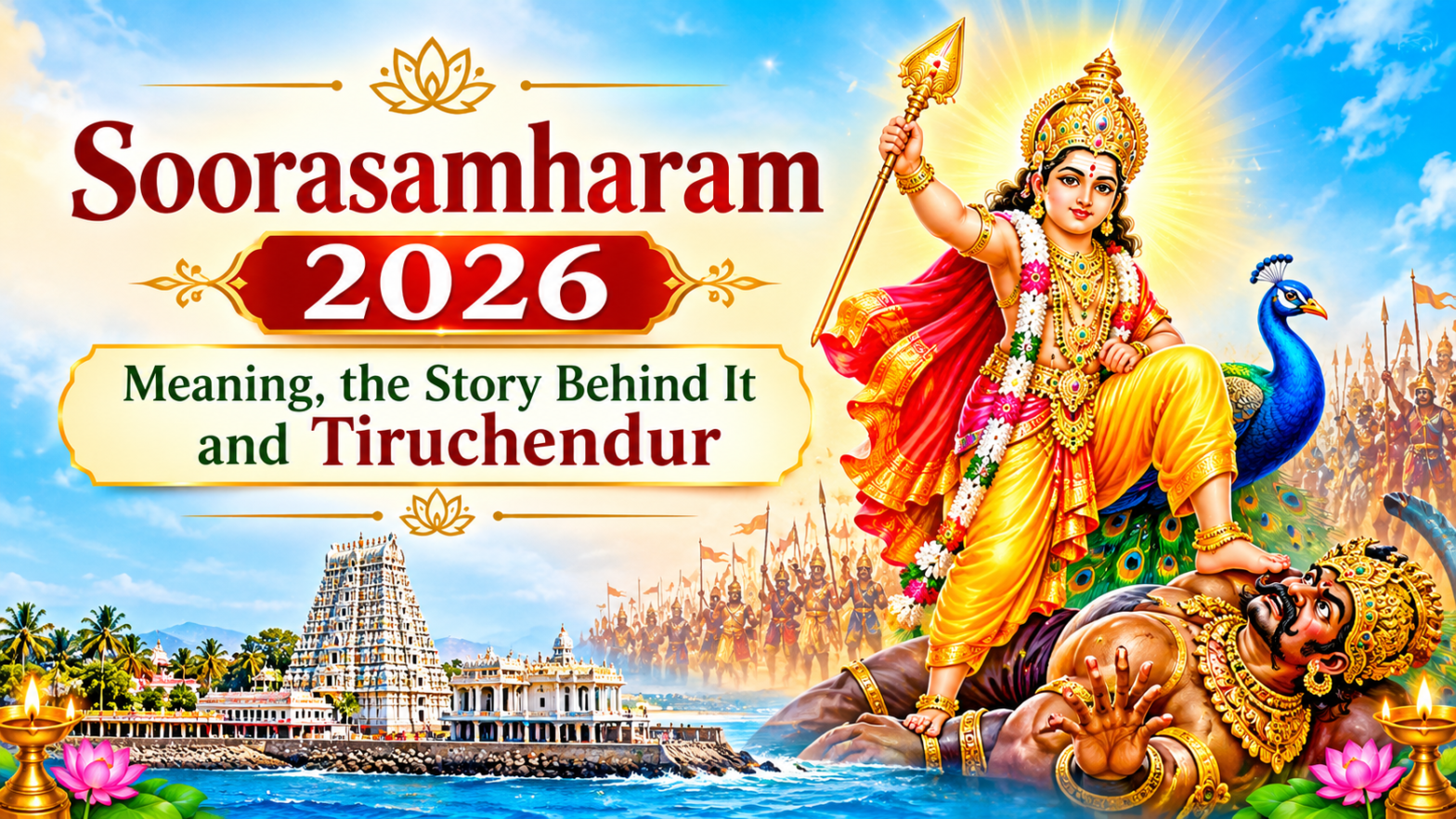
Soorasamharam 2026 falls on Sunday, 15 November, the sixth and final day of the Kanda Sashti festival. The word means the destruction of Soora, and it marks the moment Lord Murugan ended the six day war against the asura Surapadman with his Vel. At Tiruchendur the event is enacted on the temple grounds before lakhs of devotees, and it is among the most powerful public religious spectacles in Tamil Nadu. This guide explains what Soorasamharam means, the full story behind it, what happens at Tiruchendur, and the deeper reading devotees give the event.
What Does Soorasamharam Mean?
Soora refers to Surapadman, the asura, and samharam means destruction or annihilation. Soorasamharam is therefore the destruction of Surapadman. It is also called Suranporu in Tamil, meaning the war against Soora.
The event is not treated merely as a historical commemoration. In the Tamil Shaiva tradition it is understood as the decisive moment when divine force confronted unchecked ego and ended it, which is why the enactment carries such emotional weight for those who witness it.
The Story Behind Soorasamharam
The boon that made Surapadman nearly invincible
Surapadman was an asura of enormous power who, through severe penance, obtained a boon from Lord Shiva that made him effectively unconquerable. Secure in that protection, he and his brothers Simhamukha and Tarakasura subjugated the three worlds, imprisoned the devas and ruled without restraint. The devas, unable to act, appealed to Shiva.
The birth of Murugan
From the energy of Shiva, six sparks emerged and were carried to a lake, where they became six infants. Raised by the six Krittika mothers, they were united by Parvati into a single child with six faces, Shanmukha. He was born for one purpose: to lead the divine army against Surapadman. Parvati gave him the Vel, the divine spear, and he was appointed Devasenapati, commander of the celestial forces.
The six day war
Murugan advanced to the coast at Tiruchendur and sent Veerabahu as an emissary, offering Surapadman the chance to release the devas and avoid war. Surapadman refused. The war that followed lasted six days. Surapadman’s brothers and armies fell one by one, until on the sixth day Surapadman himself faced Murugan.
The final transformation
Here the story takes the turn that gives it its meaning. Surapadman, cornered, changed form repeatedly to escape, and finally took the shape of an enormous mango tree. Murugan hurled the Vel, which split the tree in two. Rather than destroy what remained, Murugan transformed the two halves: one became the peacock that is his mount, and the other became the rooster on his banner.
This ending is what devotees most often reflect on. The asura is not annihilated into nothing. He is taken into Murugan’s own service, carried beneath him and flown above him. The defeat is total and yet it ends in elevation rather than erasure.
Soorasamharam at Tiruchendur
The Tiruchendur Murugan Temple, one of the Arupadai Veedu and the only one situated on the seashore, is the principal site of the observance. It is held to be the very place from which Murugan launched the campaign.
On the afternoon of Soorasamharam, the temple deity is brought out in procession and the battle is enacted on the open ground before the temple, with effigies of Surapadman and his brothers. The sequence builds through the confrontation to the moment the Vel is cast. Lakhs of devotees gather on the sand and the surrounding streets to witness it, and the roar at the moment of the strike is something those who have been describe as difficult to convey second hand.
The following day, Thirukalyanam, the divine wedding of Murugan and Deivanai, is celebrated at the temple.
[ADD TIRUCHENDUR 2026 PROCESSION TIMINGS HERE once the temple publishes its schedule. Timings are usually announced a few days before and typically fall in the afternoon.]
The Inner Meaning
Devotees and commentators give Soorasamharam a reading that goes beyond the narrative. Surapadman is understood as ahamkara, the ego, which grows through genuine effort, as his penance was genuine, and then turns destructive when it recognises no limit. The Vel is understood as jnana, discriminating wisdom, which is why it is depicted as broad at the base, sharp at the tip and long in the shaft: wide understanding, keen insight, deep penetration.
On this reading, Soorasamharam is not an event that happened once. It is what happens whenever clear discernment cuts through inflated self regard. The transformation of the two halves into the peacock and the rooster carries the rest of the teaching: ego that has been pierced by wisdom is not wasted but converted into something that serves.
How Devotees Observe the Day
- Keeping the final day of the six day Kanda Sashti vratam, with the fast broken after the Soorasamharam observance in the evening
- Attending the enactment at Tiruchendur or at a local Murugan temple, many of which hold their own versions
- Reciting the Kanda Sashti Kavasam, often repeatedly through the day
- Offering abhishekam and archana to Murugan and to the Vel
- Watching a temple livestream where attendance is not possible, which many temples now offer
Frequently Asked Questions
When is Soorasamharam in 2026?
Soorasamharam 2026 falls on Sunday, 15 November, the sixth day of the Kanda Sashti festival. In the USA and Canada it falls a day earlier, on Saturday 14 November.
What is the meaning of Soorasamharam?
Soora refers to the asura Surapadman and samharam means destruction. The word means the destruction of Surapadman, commemorating Lord Murugan’s victory at the end of a six day war. It is also called Suranporu.
What happened to Surapadman at the end?
Cornered, he took the form of a giant mango tree. Murugan’s Vel split it in two, and he transformed the halves into his peacock mount and the rooster on his banner. The asura was defeated and then taken into Murugan’s own service rather than destroyed outright.
Why is Soorasamharam celebrated at Tiruchendur?
Tiruchendur, on the coast of Thoothukudi district, is held to be the site from which Murugan launched the campaign against Surapadman. It is the only one of the six Arupadai Veedu temples on the seashore, and its Soorasamharam enactment is the most famous in Tamil Nadu.
What is the spiritual meaning of Soorasamharam?
Surapadman is read as ahamkara, the ego, and the Vel as jnana, discriminating wisdom. The event represents wisdom cutting through unchecked self regard, with the transformation of the two halves showing that ego so pierced is converted into service rather than simply destroyed.