
 5 November 2026
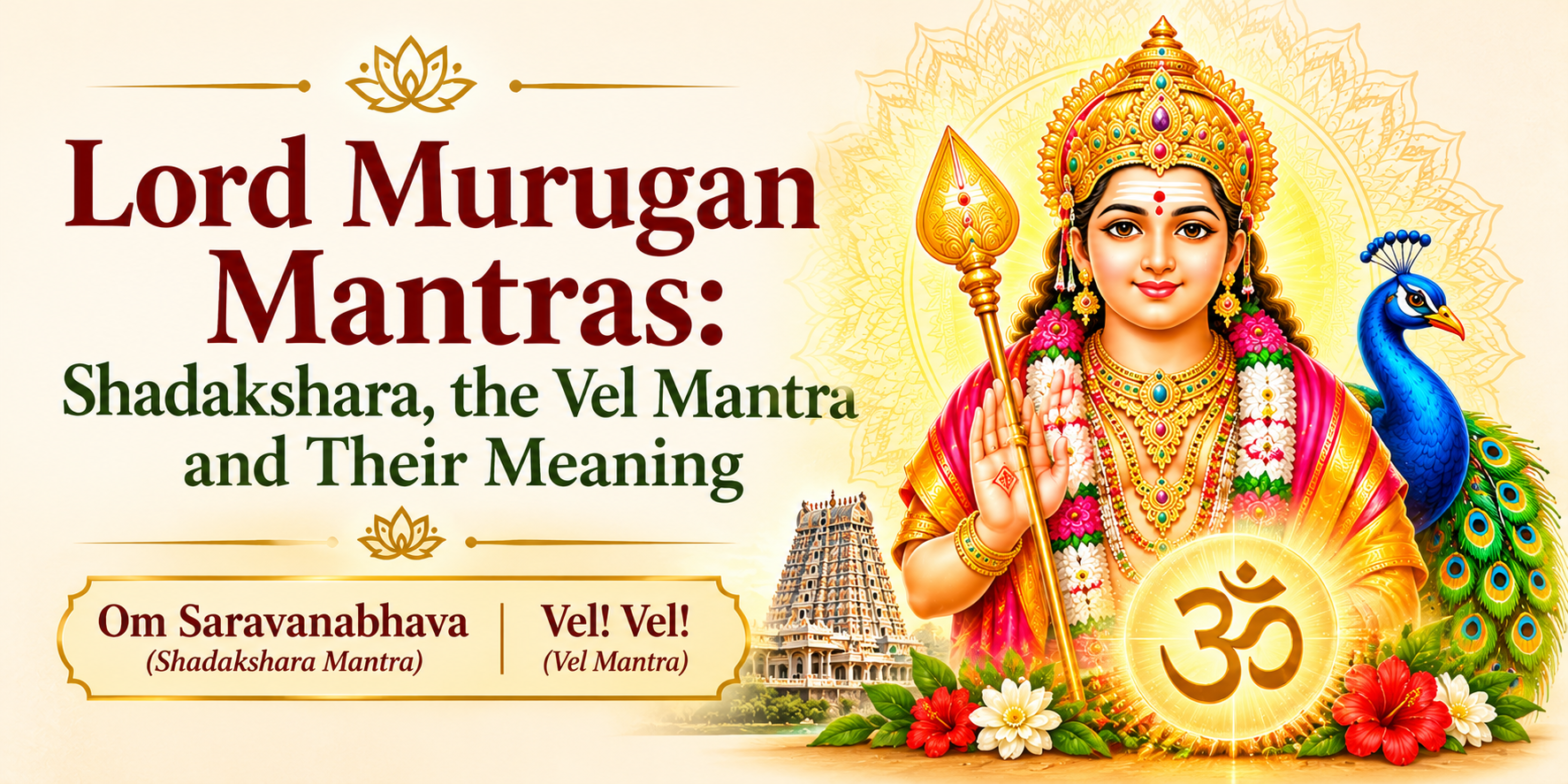
The principal Murugan mantra is the Shadakshara, Om Saravana Bhava, a six syllable mantra corresponding to the six faces of Lord Murugan and the six sparks from which he was born. Alongside it, devotees chant the Vel mantra, the Shanmukha Gayatri and the simple invocation Om Muruga. This guide explains each mantra, what the syllables mean, when to chant them, and how to begin a practice. During Kanda Sashti, from 10 to 15 November in 2026, chanting intensifies across all of these.
Om Saravana Bhava: The Shadakshara Mantra
Shadakshara means six syllables, and this is the core mantra of Murugan worship.
Om Saravana Bhava
Saravana refers to the Saravana Poigai, the lake of reeds where the six sparks from Shiva’s third eye became six infants. Bhava means being, becoming or origin. The mantra invokes Murugan by the circumstance of his appearance, which in the tradition is understood as invoking the very moment of his coming into form.
The six syllables, Sa Ra Va Na Bha Va, are mapped to the six faces of Shanmukha, and in some traditions to the six chakras, which is why the mantra is used both devotionally and as a meditative practice. It is chanted 108 times as a standard count, using a rudraksha mala.
The Vel Mantra
The Vel, Murugan’s divine spear given to him by Parvati, is worshipped as a form of the deity in its own right. Several invocations address it directly, the most familiar being the Tamil phrase devotees repeat constantly:
Vetri Vel, Muruganukku Arohara
This means victory to the Vel, and salutations to Murugan. It is the cry heard at Murugan temples, on pilgrimage routes and during Soorasamharam, and it functions as both a chant and a collective affirmation.
A second phrase, associated with Pamban Swamigal, is equally common:
Velum Mayilum Thunai
The spear and the peacock protect. Devotees use it as a brief invocation of protection, much as the Kanda Sashti Kavasam is used at greater length.
The Shanmukha Gayatri
The Gayatri form addressed to Murugan is chanted in more formal worship and at temple rituals.
Om Tatpurushaya Vidmahe Mahasenaya Dheemahi Tanno Shanmukha Prachodayat
Mahasena refers to Murugan as the commander of the great army, and Shanmukha to his six faced form. The verse follows the standard Gayatri structure: we know him, we meditate on him, may he impel us.
Other Common Invocations
- Om Sri Subrahmanyaya Namaha, used widely in Sanskrit worship, particularly in Karnataka and Andhra Pradesh
- Om Muruga, the simplest form, repeated continuously by many devotees through the day
- Om Kartikeyaya Namaha, used in North Indian and Sanskrit traditions where Murugan is known as Kartikeya
- Arohara, the devotional cry used on pilgrimage, particularly on the climb to Palani
What Devotees Chant These Mantras For
- Courage and the resolve to face difficulty, since Murugan is the commander of the divine forces
- Protection from harm and from negative influence
- Clarity of thought and discernment, the Vel being understood as discriminating wisdom
- Relief from fear and anxiety
- Success in examinations, competition and undertakings requiring nerve
- Removal of obstacles caused by adversaries
How to Begin a Murugan Mantra Practice
The practice is simple and requires no initiation for the common mantras above.
- Bathe, and sit facing east or north before an image of Murugan or before a Vel
- Light a lamp and sit still for a moment before beginning
- Chant Om Saravana Bhava 108 times using a rudraksha mala, aloud or in a murmur
- Keep the same time each day, early morning being the traditional preference
- Tuesdays, Sashti tithi and Krittika nakshatra are considered especially favourable
- Sit quietly for a minute after finishing rather than standing straight up
During the six days of Kanda Sashti many devotees raise the count, and combine the japa with daily recitation of the Kanda Sashti Kavasam.
Frequently Asked Questions
What is the main Murugan mantra?
Om Saravana Bhava, the Shadakshara or six syllable mantra. Saravana refers to the lake of reeds where Murugan appeared and bhava means origin or becoming. The six syllables correspond to his six faces.
What does Vetri Vel Muruganukku Arohara mean?
It means victory to the Vel and salutations to Murugan. It is the cry heard at Murugan temples, on pilgrimage and during Soorasamharam, functioning as both chant and collective affirmation.
How many times should Om Saravana Bhava be chanted?
108 times is the standard count, using a rudraksha mala, at the same time each day. Many devotees raise the count during the six days of Kanda Sashti.
Do Murugan mantras require initiation?
The common mantras, including Om Saravana Bhava, Om Muruga and Vetri Vel Muruganukku Arohara, are chanted freely by devotees without formal initiation. More elaborate tantric forms of worship follow their own requirements.
Which day is best for chanting Murugan mantras?
Tuesdays are associated with Murugan, along with the Sashti tithi of each fortnight and Krittika nakshatra. The six days of Kanda Sashti are the most intensive period of the year.
What does Velum Mayilum Thunai mean?
It means the spear and the peacock protect, referring to Murugan’s Vel and his peacock mount. The phrase is associated with Pamban Swamigal and is used as a short invocation of protection.