

 2 November 2026
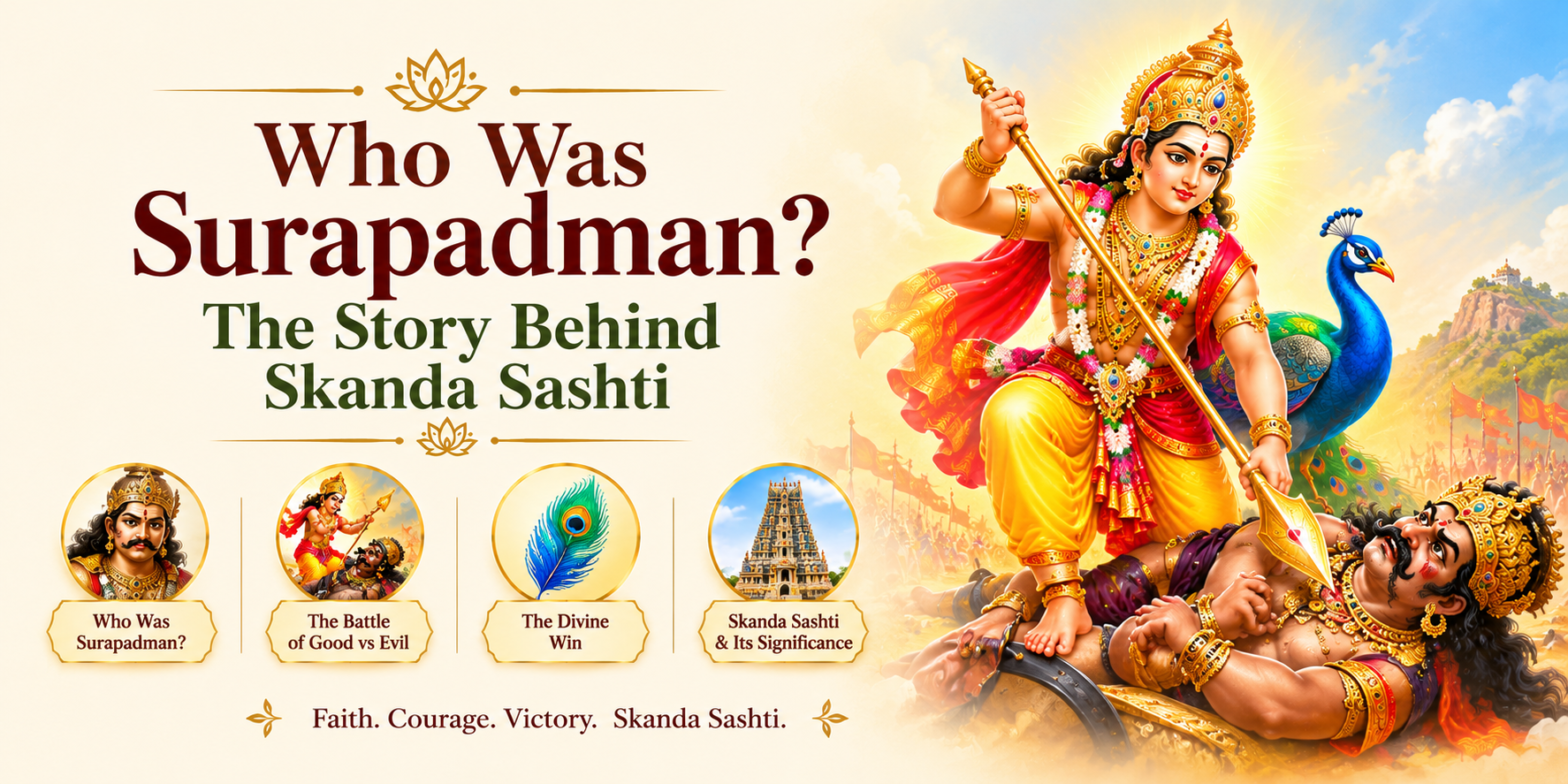
Surapadman was an asura who, through severe penance, won a boon from Lord Shiva that made him almost impossible to defeat, and who then used that power to subjugate the three worlds. The Skanda Sashti story is the account of how Lord Murugan was brought into being to end his rule, fought him over six days, and finally transformed him rather than destroying him outright. It is told in the Skanda Purana and in the Tamil Kanda Puranam, and in 2026 it is commemorated from 10 to 15 November.
Who Was Surapadman?
Surapadman was the eldest of three asura brothers, the others being Simhamukha and Tarakasura, born to the sage Kashyapa and Maya. He was not a crude villain in the telling. He was intelligent, disciplined and capable of extraordinary devotion, and it was precisely that capacity that made him dangerous.
He undertook penance to Lord Shiva of such severity and duration that Shiva appeared before him and granted him a boon. By its terms he gained rule over vast domains and a protection so complete that no existing being could destroy him. The specific condition is given differently in different recensions, but the effect is the same: nothing already created could end him.
How the Three Worlds Fell
With that protection secured, Surapadman and his brothers took the three worlds. The devas were defeated and imprisoned, Indra was driven from his throne, and the sages were prevented from performing their rites. The order of things was inverted, and there was no one in creation able to reverse it.
This is the deadlock the story is built on. The boon had been granted by Shiva himself and could not be revoked. The devas could not fight. What was needed was a being who did not yet exist when the boon was given.
The Birth of Murugan
Shiva opened his third eye, and from it emerged six sparks of fire, carried by Agni and Vayu to the Saravana Poigai, a lake of reeds. There they became six infants, nursed by the six Krittika mothers, the stars of the Pleiades. Parvati gathered the six into her arms and they became one child with six faces and twelve arms: Shanmukha, Murugan, Skanda.
He was born for a purpose and raised quickly into it. Parvati gave him the Vel, the divine spear, and the devas appointed him Devasenapati, commander of the celestial army. The six faces are variously explained as the six directions he watches, the six qualities he embodies, or the six Krittikas who raised him.
The Six Day War
Murugan advanced with the divine army to the coast at Tiruchendur. Before any fighting, he sent Veerabahu as an envoy to Surapadman with terms: release the devas, restore what was taken, and there need be no war. Surapadman rejected them.
The war ran six days. Tarakasura fell, then Simhamukha, then the asura generals and armies in turn, until on the sixth day Surapadman stood alone and faced Murugan directly. This is the day commemorated as Soorasamharam, which falls on Sunday 15 November in 2026.
The Ending That Makes the Story
Cornered, Surapadman used every power he had. He changed shape repeatedly, taking one form after another to escape or overwhelm, and at the last he became an immense mango tree that filled the sky and the sea.
Murugan hurled the Vel. It split the tree cleanly in two. And then, instead of destroying what remained, he transformed the halves. One became the peacock that carries him. The other became the rooster on his banner.
That ending is the whole point of the story and the reason it has been retold for so long. Surapadman is defeated completely, and in the same moment he is given a permanent place in Murugan’s own presence, one beneath him and one above him. The asura who wanted to rule everything ends by carrying the one who defeated him.
How the Story Is Read
The tradition reads the account on two levels at once, and devotees move easily between them.
Surapadman is understood as ahamkara, the ego. Note that his power came from genuine penance, not from fraud. The ego in this reading is not something foreign or contemptible; it is built from real effort and real capability, and it becomes destructive only when it acknowledges no limit beyond itself. That is why it cannot be destroyed by anything already within the system it dominates.
The Vel is understood as jnana, discriminating wisdom. Its shape is read deliberately: broad at the base for breadth of understanding, sharp at the tip for precision of insight, long in the shaft for depth of penetration. Wisdom of that kind is the one thing the ego’s defences were never built against.
And the transformation at the end carries the conclusion. Ego pierced by wisdom is not annihilated. It is converted into something that serves. The peacock and the rooster are not trophies; they are the former adversary, still present, now useful.
Frequently Asked Questions
Who was Surapadman?
Surapadman was an asura, eldest of three brothers, who won a boon from Lord Shiva through severe penance that made him nearly invincible, and then subjugated the three worlds. He was defeated by Lord Murugan on the sixth day of their war, the event commemorated as Soorasamharam.
Why could only Murugan defeat Surapadman?
The boon Surapadman received meant nothing already in existence could destroy him. Murugan was brought into being after the boon was granted, from the third eye of Shiva, specifically to end his rule, which is why he alone could do it.
What happened to Surapadman at the end?
He took the form of a giant mango tree. Murugan’s Vel split it in two, and he transformed the halves into his peacock mount and the rooster on his banner, giving the defeated asura a permanent place in his own presence.
Where is the Skanda Sashti story told?
It appears in the Skanda Purana and in the Tamil Kanda Puranam by Kachiappa Sivachariyar, which is the version most familiar to Tamil devotees.
What is the symbolic meaning of the story?
Surapadman is read as ahamkara, the ego, whose power comes from genuine effort but turns destructive when it recognises no limit. The Vel is read as jnana, discriminating wisdom. The transformation at the end shows that ego pierced by wisdom is converted into service rather than simply destroyed.
Why does Murugan have six faces?
He was formed from six sparks that became six infants nursed by the six Krittika mothers, united by Parvati into one child. The six faces are explained as the six directions he watches over, the six qualities he embodies, or the six mothers who raised him.