

 11 July 2026
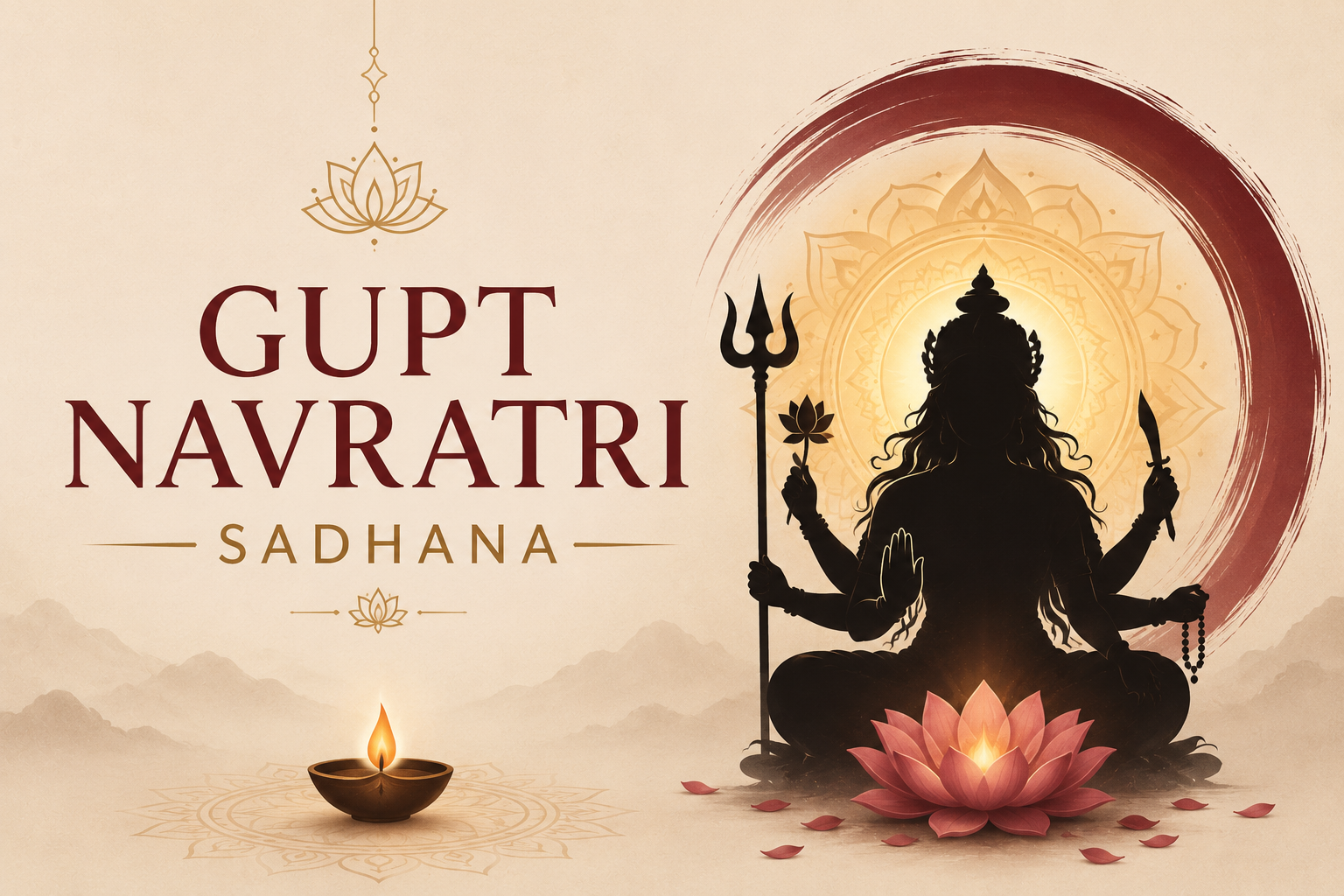
Gupt Navratri is the hidden Navratri, observed twice a year in the months of Magha and Ashadha, and dedicated not to public celebration but to quiet, focused sadhana. In 2026, Ashadha Gupt Navratri begins on July 15 (Wednesday) with Ghatasthapana and ends on July 23 (Thursday). Unlike Chaitra and Sharad Navratri, where the Devi is worshipped outwardly with garba, pandals, and festivity, Gupt Navratri is meant for internalising Devi Shakti through mantra japa, stotra paath, and disciplined daily practice. This guide from Poojas.in explains what Gupt Navratri is, the complete 2026 day-wise list, and five sadhana paths you can follow over these nine nights, so that you do not let this rare window pass in slumber.
What Is Gupt Navratri?
Gupt means hidden or secret. According to the Devi Bhagavata, Navratri occurs four times a year. Two of these, Chaitra Navratri in spring and Sharad Navratri in autumn, are the Prakat or visible Navratris, celebrated openly across the country. The other two, falling in Magha (January to February) and Ashadha (June to July), are the Gupt Navratris, observed quietly by sadhaks, tantrics, and serious devotees of the Divine Mother.
The secrecy is not a formality. It is the method. During the public Navratris, devotional energy flows outward into celebration. During Gupt Navratri, that same energy is deliberately turned inward. The sadhak worships without announcement, without social display, and in many traditions without even discussing the practice with others. Tradition holds that this containment is precisely what concentrates the power of the sadhana, which is why these nine nights have been prized by seekers wanting to accelerate their spiritual progress.
Tradition even links this period to the sages Vishwamitra and Vashishtha, who are said to have attained through Gupt Navratri sadhana the siddhis that open effort had not given them. The message is clear. This period exists for the seeker, not the spectator.
Gupt Navratri 2026 Kab Se Kab Tak Hai?
Ashadha Gupt Navratri 2026 kab se shuru hai? It begins on Wednesday, July 15, 2026, on Ashadha Shukla Pratipada. Ghatasthapana, the ritual establishment of the kalash that formally opens the nine nights, is performed on the morning of July 15, with the muhurat falling roughly between 5:30 AM and 10:10 AM depending on your city.
And Gupt Navratri kab tak hai? It runs until Thursday, July 23, 2026, when Navami concludes and parana is observed. That gives you nine complete nights of sadhana, from July 15 to July 23.
One practical note. Tithi timings shift slightly by location, so confirm Ashtami and Navami timings with your local panchang if you observe tithi-based vrats. The Magha Gupt Navratri of 2026 has already passed in January, so if you miss this July window, the next one arrives only in 2027.
Gupt Navratri Ka Mahatva: Why These Nine Nights Are Built for Sadhana
Gupt Navratri ka mahatva lies in a single shift of direction. Where the public Navratris invoke the Devi’s power outwardly, Gupt Navratri is about becoming receptive to her wisdom inwardly. The Ashadha period itself supports this. The monsoon arrives, nature turns inward, and the season naturally invites withdrawal from outer distraction into contemplation.
Here is the honest question this blog wants to put before you. Every Navratri, lakhs of devotees fast, eat phalahar, and consider the observance complete. Fasting has its place and purifies the body. But fasting alone is the body participating while the mind stays asleep. Gupt Navratri asks for more. It asks the sadhak to come out of that slumber and actually sit with the Devi: to chant, to meditate, to take a sankalpa and hold it for nine nights without breaking.
This is why sadhaks who want to increase their spiritual power wait for Gupt Navratri specifically. The tantric and shakta traditions treat these nine nights as the year’s most concentrated period for Shakti sadhana. If you have been postponing a deeper practice, this is the window tradition itself has marked out for beginning.
Gupt Navratri 2026 List: Day-Wise Dates and Devi Forms
Here is the complete Gupt Navratri 2026 list for the Ashadha cycle, mapping each day to the Navadurga form traditionally worshipped:
| Day | Date | Tithi | Devi Form |
| Day 1 | July 15, Wednesday | Pratipada | Maa Shailputri (Ghatasthapana) |
| Day 2 | July 16, Thursday | Dwitiya | Maa Brahmacharini |
| Day 3 | July 17, Friday | Tritiya | Maa Chandraghanta |
| Day 4 | July 18, Saturday | Chaturthi | Maa Kushmanda |
| Day 5 | July 19, Sunday | Panchami | Maa Skandamata |
| Day 6 | July 20, Monday | Shashthi | Maa Katyayani |
| Day 7 | July 21, Tuesday | Saptami | Maa Kalaratri |
| Day 8 | July 22, Wednesday | Ashtami | Maa Mahagauri |
| Day 9 | July 23, Thursday | Navami | Maa Siddhidatri, followed by parana |
Advanced tantric sadhaks also worship the Das Mahavidyas during this period, one wisdom goddess per night. For most householder devotees, however, the paths below are both authentic and completely accessible.
Gupt Navratri Sadhna: Five Ways to Internalise Devi Shakti Over Nine Nights
Choose one path. Depth matters more than variety in Gupt Navratri sadhna, and a single practice held sincerely for nine nights will do more for you than five practices attempted casually. Here are five traditional approaches, from the simplest to the more structured.
1. Worship the Nine Forms of the Goddess
The most familiar path. Each day, worship that day’s Navadurga form from the list above, Shailputri through Siddhidatri. Light a lamp morning and evening, offer flowers and a simple naivedyam, chant the form’s name or dhyana mantra, then sit in silence for at least ten minutes contemplating what that form embodies: Shailputri’s steadfastness, Brahmacharini’s tapasya, Kalaratri’s destruction of fear, Siddhidatri’s completion. The contemplation is the internalisation. Without it, the ritual remains outer.
2. Worship the Sapta Matrikas
A path especially suited to Gupt Navratri’s tantric character. The Sapta Matrikas are the seven mother goddesses described in the Devi Mahatmya: Brahmani, Maheshwari, Kaumari, Vaishnavi, Varahi, Indrani, and Chamunda. Each Matrika is the Shakti of a cosmic principle, and together they represent the complete spectrum of divine feminine power. Worship one Matrika per day for seven days, then dedicate the final two days to the Devi as a whole. Varahi in particular is deeply associated with Ashadha Gupt Navratri, and her worship is sought for protection and the removal of hidden obstacles.
3. Siddha Kunjika Stotra Paath
If you can adopt only one practice this Gupt Navratri, let it be this. The Siddha Kunjika Stotra, revealed by Lord Shiva to Parvati in the tantric tradition, is described as the key that unlocks the entire Durga Saptashati. The text itself states that reciting the Kunjika grants the fruit of the complete Saptashati paath, even without the kavach, argala, and keelaka that normally precede it. Recite it daily, morning or night, at the same time and the same place, for all nine days. It takes under ten minutes, and its consistency over nine nights is exactly the kind of contained, disciplined practice this period was designed for.
4. Navarna Mantra Japa
The Navarna mantra, Om Aim Hreem Kleem Chamundayai Vichche, is the nine-syllable heart of Devi worship, containing the combined Shakti of Mahasaraswati (Aim), Mahalakshmi (Hreem), and Mahakali (Kleem). Take a sankalpa on Ghatasthapana day for a fixed daily count, traditionally one, three, or more malas of 108, and complete that count every single day without exception until Navami. Japa done with a fixed count, fixed time, and fixed seat builds a momentum over nine nights that irregular chanting never reaches.
5. Tridevi Sadhana: Mahakali, Mahalakshmi, Mahasaraswati Over Three Days Each
For sadhaks who want a structured arc across the nine nights, the tradition of the Durga Saptashati itself offers one. Its three charitras are presided over by three great forms of the Devi, and the nine days divide naturally among them:
- Days 1 to 3: Mahakali. The destroyer of tamas. These first three days are for burning away inertia, fear, laziness, and old negative patterns, the very slumber this blog is asking you to leave.
- Days 4 to 6: Mahalakshmi. The harmonising power of rajas. The middle three days are for invoking abundance, stability, and right action in your material and family life.
- Days 7 to 9: Mahasaraswati. The illuminating power of sattva. The final three days are for wisdom, clarity, and the knowledge that liberates.
Worship each form for her three days with her mantra, a lamp, and contemplation of her quality. By Navami you will have traversed, in miniature, the entire journey of the Saptashati: from destruction of darkness, through harmonious living, to illumination.
How to Hold Your Sadhana for Nine Nights
Whichever path you choose, a few principles protect it. Take a clear sankalpa on July 15, stating your practice and daily commitment before the Devi. Keep the same time and seat every day, because regularity is what turns ritual into sadhana. Keep it gupt: no announcements, no altar photos on social media, energy contained as the very name of this Navratri instructs. Eat sattvic and treat the nine days as a quiet retreat inside your ordinary life. And if you break a day, do not abandon the sadhana. Offer a prayer of apology and continue. The Mother values persistence over perfection.
Gupt Navratri Benefits
The traditional Gupt Navratri benefits follow directly from this concentrated practice: accelerated spiritual growth and inner strength, removal of hidden obstacles and negative energies, protection from enemies and ill intent, success in stalled efforts, and the steady deepening of one’s connection with Devi Shakti. Sadhaks across the tantric and shakta traditions hold that practice done in these nine nights bears fruit faster than at almost any other time of year. But the deepest benefit is quieter than any list. Nine nights of held discipline changes the person who held it.
Frequently Asked Questions About Gupt Navratri
What is Gupt Navratri?
Gupt Navratri is the hidden Navratri observed twice a year, in Magha and Ashadha, dedicated to quiet personal sadhana rather than public celebration. It is considered especially powerful for mantra japa, stotra paath, and Shakti sadhana, and is traditionally observed by seekers wanting to deepen their spiritual practice.
Gupt Navratri kab se shuru hai?
Ashadha Gupt Navratri 2026 shuru hoti hai July 15, 2026 (Wednesday) se, Ashadha Shukla Pratipada par. Ghatasthapana is performed the same morning, with the muhurat falling before midday in most cities.
Gupt Navratri kab tak hai?
Gupt Navratri July 23, 2026 (Thursday) tak hai. Navami concludes and parana is observed on July 23, completing the nine nights that began on July 15.
Can beginners do Gupt Navratri sadhana?
Yes. Choose a single simple practice, such as daily Siddha Kunjika Stotra paath or one mala of the Navarna mantra, take a sankalpa on day one, and hold it for all nine days. Consistency matters far more than complexity. For guidance on choosing a practice suited to your situation, you can consult Dr. Mekhala V Jois at Poojas.in.
How is Gupt Navratri different from Chaitra and Sharad Navratri?
Chaitra and Sharad Navratri are Prakat Navratris, celebrated publicly with festivity. Gupt Navratri is observed privately, with the emphasis on internal sadhana, discipline, and secrecy, and many sadhaks worship the Sapta Matrikas or Das Mahavidyas alongside the Navadurgas.
Should I keep my Gupt Navratri sadhana secret?
Yes, as far as practical. Tradition instructs that the practice not be publicised, photographed, or discussed casually, because containment concentrates its power.
Do Not Let This Window Pass
Gupt Navratri 2026 opens on July 15, closes on July 23, and will not return until 2027. The invitation of these nine nights is simple: go beyond fasting, come out of the slumber, and give the Devi nine days of genuine, held practice. For help choosing the right sadhana for your horoscope, or to have a sankalpa-based pooja performed in your name during this period, reach out to Poojas.in or consult Dr. Mekhala V Jois before Ghatasthapana on July 15.