

 16 September 2026
why do we celebrate navratri for 9 days, Nine is not a round number. It is not a week, not a fortnight, not a lunar month. So why does Navratri run for exactly nine days — no more, no less?
The answer turns out to have several layers, and they stack neatly on top of one another.
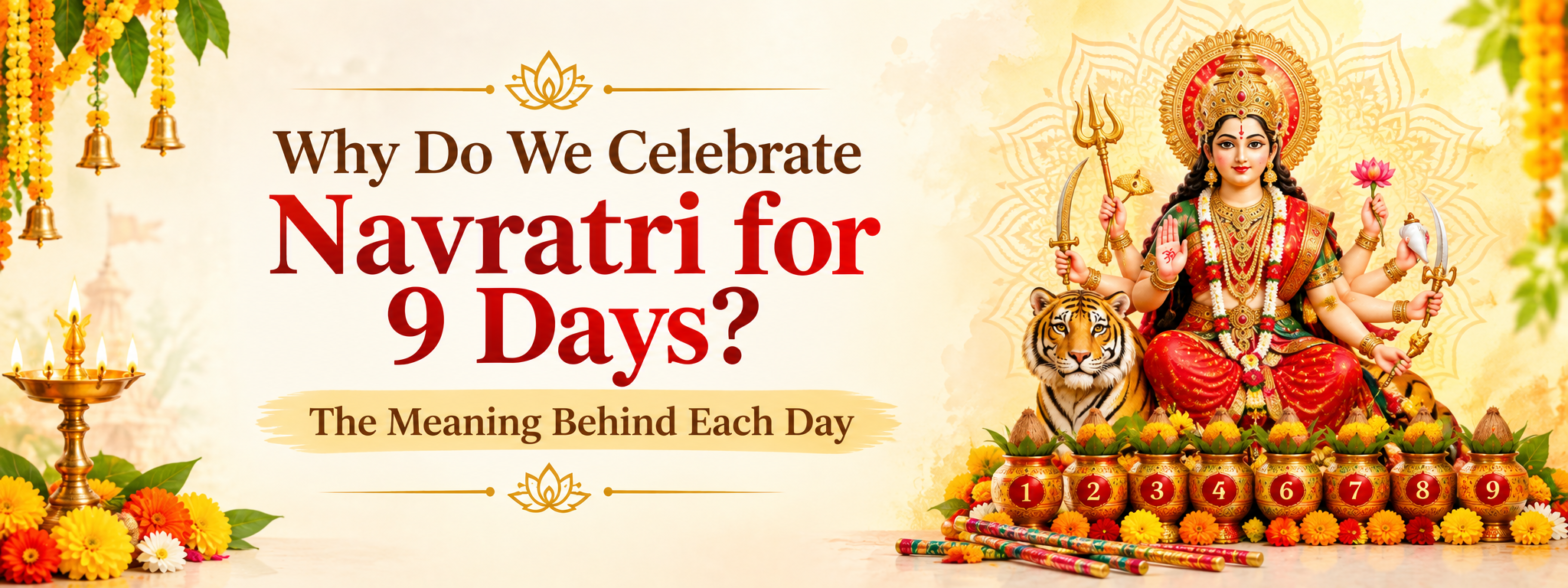
Why Do We Celebrate Navratri for 9 Days ?
1. The battle itself lasted nine nights
The simplest answer comes straight from the Devi Mahatmya. Mahishasura could not be killed by any man or god, and he could change shape at will. Durga fought him through nine successive nights, meeting each new form he took, and killed him on the tenth day. The festival is a direct re-enactment of that timeline. Nine nights of struggle, one day of victory.
2. The goddess has nine forms
Durga is worshipped as the Navadurga — nine distinct manifestations, each with her own name, iconography, weapon and blessing. One day is given to each. The nine days are not nine repetitions of the same puja; they are nine different encounters with nine different aspects of the same divine power, moving in a deliberate sequence from the gentlest form to the most complete.
3. Nine is the number of completion
In Indian thought, nine is the last of the single digits — every number beyond it is a repetition of what has already been counted. It is the number at which a cycle finishes. The human body is described as having nine gates. A pregnancy runs nine months. The planets in classical Indian astrology number nine. Navratri borrows this logic: nine days is a complete cycle, after which something genuinely new can begin on the tenth.
4. Nine days is long enough to actually change something
A one-day fast is an event. Nine days of disciplined eating, early rising and daily prayer is a practice. Ayurveda has always recommended a period of light, simple food at the seasonal junctions when the body’s immunity dips, and both major Navratris fall precisely at those junctions. The nine-day length is long enough to reset the body and settle the mind — and short enough that an ordinary householder can sustain it.
The Three Sets of Three
The clearest way to understand why the nine days are ordered the way they are is to read them as three groups of three, each belonging to a different goddess and a different task.
Days 1 to 3 — Durga. These days are for destruction. Not of enemies outside, but of everything within that stands in the way: ego, anger, laziness, fear, the habits you keep meaning to break. This is the clearing of ground.
Days 4 to 6 — Lakshmi. Once the ground is cleared, something must be planted. These days are for cultivating abundance — material, yes, but more importantly the inner abundance of generosity, contentment and steadiness.
Days 7 to 9 — Saraswati. Wisdom is the last thing to arrive, and it only grows in soil that has been cleared and enriched. The final three days are for knowledge, insight and the quiet understanding that the previous six days have made possible.
On the tenth day — Vijayadashami — the work is complete. This is why Vijayadashami is considered one of the most auspicious days of the year to begin anything: a new business, a child’s first lesson, the first note of a new raga. The ground has been prepared.
Navratri Days and Goddess: What Each Day Signifies
| Day | Goddess | What She Signifies |
| Day 1 | Maa Shailputri | Daughter of the mountains. Rooted strength, patience and the stillness you need before any beginning. |
| Day 2 | Maa Brahmacharini | The great ascetic. Devotion, discipline and the willingness to keep going without immediate reward. |
| Day 3 | Maa Chandraghanta | Bearer of the crescent-bell. Courage that is calm rather than loud, and the removal of fear. |
| Day 4 | Maa Kushmanda | Creator of the cosmic egg. Vitality, health and the radiant energy that brings things into existence. |
| Day 5 | Maa Skandamata | Mother of Kartikeya. Unconditional maternal love, protection and nurturing strength. |
| Day 6 | Maa Katyayani | The warrior born to destroy Mahishasura. Righteous anger, decisive action and the removal of obstacles. |
| Day 7 | Maa Kalaratri | The darkest and fiercest form. Destruction of ignorance, negativity and everything that must finally be faced. |
| Day 8 | Maa Mahagauri | The luminously pure. Forgiveness, purification and peace after the storm of the seventh night. |
| Day 9 | Maa Siddhidatri | Giver of perfection. Fulfilment, spiritual attainment and the completion of the nine-day journey. |
All Navratri Days: The Sequence Explained
Notice how the nine days move. They do not build steadily upward — they build, peak in darkness, and then resolve.
The first three days are gentle and grounding. Shailputri is stillness, Brahmacharini is patience, Chandraghanta is quiet courage. The middle days grow in energy: Kushmanda’s creative fire, Skandamata’s protective warmth, Katyayani’s decisive force. Then comes Kalaratri on the seventh night — the darkest, fiercest, most frightening form of the goddess, the one who destroys without hesitation.
And immediately after her comes Mahagauri, luminously white, utterly serene. The eighth day is the calm that follows the seventh. Only then, on the ninth day, does Siddhidatri appear to grant fulfilment.
The sequence is not arbitrary. It is a map of how transformation actually works: you do not arrive at peace by avoiding the difficult night. You arrive at it by going through it. Kalaratri has to come before Mahagauri. That is the whole teaching of the nine days, compressed into an order of worship.
How the Nine Days Are Observed at Home
• Day 1 — Ghatasthapana. The kalash is installed, barley seeds are sown in earth, and the akhand jyot is lit.
• Days 1 to 9 — Daily aarti morning and evening, a specific bhog offered to each day’s goddess, and the recitation of Durga Saptashati or Durga Chalisa.
• Day 8 or Day 9 — Kanya Pujan, where nine young girls are honoured as the nine goddesses, their feet washed, and a festive meal of halwa, puri and chana served.
• Day 9 — The havan, the final bhog, and the breaking of the nine-day fast.
• Day 10 — Vijayadashami. Visarjan of the idol where observed, and the beginning of new ventures.
In Tamil Nadu, arranging dolls during Navratri is a traditional practice known as Golu.
Karnataka has grand Dussehra celebrations in Mysore, and every household has Pattada Bombe — wooden dolls.
In 2026, these nine days fall from Sunday 11 October to Monday 19 October, with Vijayadashami on Tuesday 20 October. If you are planning a full nine-day observance at home, poojas.in can arrange verified pandits for Ghatasthapana, daily puja, Kanya Pujan and the Navami havan, with all samagri delivered in advance.