

 6 August 2026
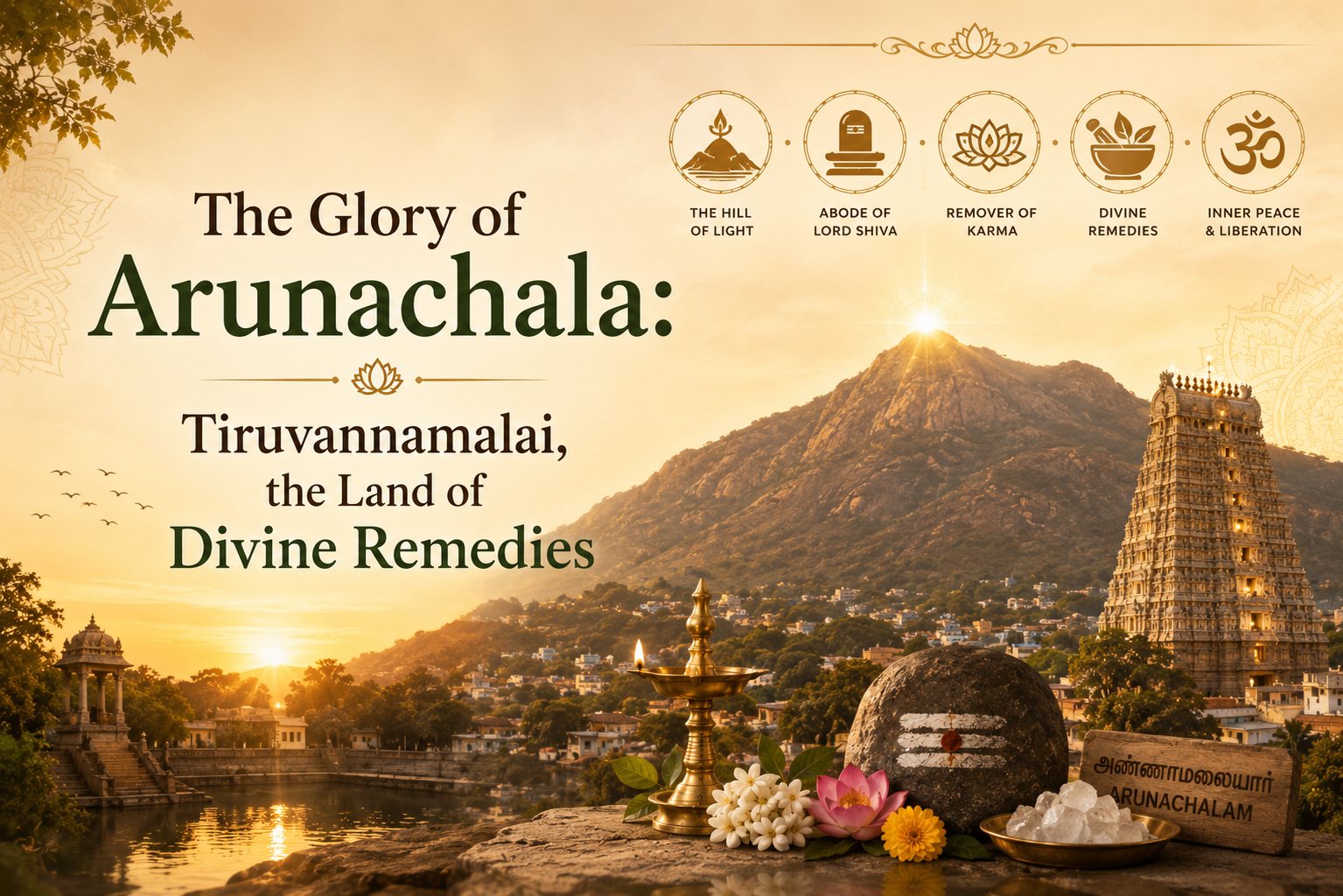
Tiruvannamalai is revered as one of India’s most powerful Parihara Sthalams, a place where the very act of pilgrimage is believed to dissolve sins and karma. At its heart stands the sacred hill Arunachala, worshipped as Lord Arunachaleswara, Shiva in the form of the fire element (Agni), and the grand Arunachaleswarar Temple at its foot. What makes this sthala unique among remedial centres is that its greatest remedy asks for no elaborate ritual and no great expense. It asks only that you walk. This guide explores the glory of Arunachala as a centre of divine remedy: the practice of Giri Pradakshina, the day-wise benefits described in the sacred texts, the significance of Pournami Girivalam and Karthigai Deepam, and why seekers from across the world have been drawn to this hill for centuries.
Arunachala: The Hill That Is Shiva Himself
In most temples, the deity is enshrined within. At Tiruvannamalai, the hill itself is the deity. Arunachala is not merely the home of Lord Shiva; it is worshipped as Shiva’s very form, the Agni Lingam among the Pancha Bhoota Sthalams, the five temples representing the five elements. Here Shiva is the element of fire, and the hill is revered as a Column of Effulgence, a pillar of light that has no beginning and no end. The sacred texts describe it directly: what is known as Arunadri is really a Column of Effulgence, and meditating upon this great Lingam, one should circumambulate it slowly.
This understanding is the foundation of every remedy associated with the place. When devotees walk around Arunachala, they are not walking around a mountain. In the tradition’s own understanding, they are circumambulating Lord Shiva in his most primordial form.
Giri Pradakshina: The Remedy of Walking
Giri Pradakshina, known in Tamil as Girivalam, is the practice of circumambulating the Arunachala hill on foot. The path around the hill stretches roughly fourteen kilometres, and pilgrims walk it barefoot, slowly, with reverence, meditation, and the names of Shiva on their lips. It is among the most beloved spiritual practices in all of South India, and it is the central remedy that this sacred place offers.
What sets this remedy apart is its accessibility. It requires no priest, no costly materials, and no elaborate arrangements, only sincerity, devotion, and the willingness to walk. For a devotee who is passing through a desperate period and cannot afford expensive remedies, the tradition holds that this simple act of walking around Arunachala carries immense spiritual merit. The Glory of Arunachala states that the merit acquired by bathing in all the sacred tirthas, by performing all the sacrifices, by studying all the scriptures, and by following all the dharmas can be gained simply by circumambulating Sonachala, another name for the hill.
The texts describe the inner meaning of pradakshina itself. The very sound of the word is said to carry its promise: pra for the granting of desires, da for freedom from sin, kshi for the destruction of the seeds of karma, and na for bestowing liberation. To walk with awareness is, in this understanding, to move through each of these blessings in turn.
The Day-Wise Benefits of Girivalam
Most pilgrims associate Girivalam with the full-moon night, and Pournami Girivalam is indeed the most crowded and celebrated occasion. Yet the sacred texts reveal something many devotees do not know: circumambulating Arunachala on each different day of the week is believed to grant a distinct blessing. This is knowledge drawn directly from The Glory of Arunachala, and it opens the remedy to any day the seeker is able to walk.
According to the text, the devotee who circumambulates the hill:
- On Sunday gains the region of the Sun and attains Liberation.
- On Monday lives free from the afflictions of old age and death.
- On Tuesday is released from all debts and becomes an emperor.
- On Wednesday becomes wise.
- On Thursday becomes omniscient.
- On Friday is worshipped by all the devas.
Read together, these blessings span the full range of human need, from health and freedom from debt to wisdom, and finally to liberation itself. A seeker weighed down by debt might walk on a Tuesday; one seeking relief from the fear of ageing and illness might choose a Monday; one on the path of wisdom and spiritual realisation might favour Wednesday, Thursday, or Sunday. The remedy meets each person where they are.
Three Steps, Three Worlds
The tradition attaches meaning even to the first steps a pilgrim takes. The Glory of Arunachala describes how one attains this world, the earth, at the first step, the middle world at the second step, and the world of the devas at the third. In the same movement, sins committed mentally are said to be destroyed at the first step, sins committed by speech at the second, and sins committed by the body at the third.
The text adds a striking image: the very moment one takes a step with the intention of circumambulating Sonagiri, the earth itself becomes pure by contact with the dust of that pilgrim’s feet. This is why devotees are counselled to walk slowly and mindfully, pausing at every point of the compass to meditate and bring the palms together in praise. The remedy is not in reaching a destination, for there is none. It is in the walking itself.
Pournami Girivalam and the Power of the Full Moon
On the night of the full moon, Tiruvannamalai transforms. Hundreds of thousands of pilgrims arrive to walk the fourteen-kilometre path together through the night, and Pournami Girivalam becomes a river of devotion flowing around the glowing hill. The full moon is held to be an especially potent time, when the mind is naturally drawn inward and the spiritual atmosphere of the hill is at its most powerful. For many devotees, walking Girivalam on Pournami is a monthly vow, a recurring return to the source.
While the crowds gather on Pournami, the day-wise benefits above remind us that the remedy is available on any day. A quieter weekday walk, undertaken with the same devotion, carries its own distinct blessing, and offers a more contemplative experience for those seeking solitude with the hill.
Karthigai Deepam: The Great Festival of Light
The most magnificent celebration at Arunachala is Karthigai Deepam, the festival of light observed in the Tamil month of Karthigai (November to December). On the day of the star Krittika, when the moon is in conjunction with the Pleiades, a colossal beacon of fire is lit atop the Arunachala hill, the Deepam Mahotsavam. This great flame, visible for miles across the surrounding plains, embodies Shiva’s manifestation as the infinite Column of Effulgence, the endless pillar of light that neither Brahma nor Vishnu could find the beginning or end of, according to the legend of Arunachala.
The preceding day, Bharani Nakshatra, is observed with its own special Girivalam, and many pilgrims time their pilgrimage to walk during Karthigai Bharani and to witness the lighting of the Deepam. To stand before Arunachala as the great flame is kindled is regarded as one of the most sacred sights in the whole of the Shaiva tradition.
A Hill That Draws the World
Few spiritual destinations attract seekers from as many corners of the earth as Tiruvannamalai. Pilgrims and spiritual seekers arrive from across the globe, and many stay not for days but for months. Some have settled permanently in the shadow of the hill, renting homes, cooking simply, cycling the path around Arunachala, and organising their lives around its rhythm. Ashrams have grown up around the hill to receive them.
This is also the place where Bhagavan Sri Ramana Maharshi, one of the most revered sages of modern times, was drawn as a young man. He experienced his awakening in connection with Arunachala, settled at its foot, and never left. Sri Ramanasramam, established in his memory, remains one of the most important spiritual centres in Tiruvannamalai and a magnet for seekers of self-enquiry from every continent. Ramana taught that Arunachala is the spiritual heart itself, and that merely thinking of the hill draws the seeker inward toward realisation.
Why Tiruvannamalai Is a Parihara Sthalam for Everyone
A Parihara Sthalam is a place of remedy, where pilgrimage and prayer are believed to remove afflictions and karmic burdens. Tiruvannamalai holds a special place among such centres for one reason above all: its greatest remedy is open to everyone, regardless of means. The temple offers its formal worship and rituals, but the hill offers its remedy freely to any devotee willing to walk with faith.
For the person in a desperate situation who cannot afford elaborate ceremonies, this is a message of hope. The tradition holds that sincerity of devotion, expressed through the simple act of Girivalam, is itself a complete remedy. And for the spiritual sadhaka, the seeker devoted to inner growth, Arunachala offers something rarer still: an atmosphere in which the mind naturally turns inward, and the path to realisation feels close at hand. Whether one comes carrying a burden to be released or a longing to be fulfilled, Arunachala is said to receive all who approach it with reverence.
Planning Your Pilgrimage: A Few Notes
For those wishing to undertake Girivalam, a few practical points help. The path is traditionally walked barefoot, so pilgrims often begin building up to it gently. Many choose to walk in the cooler hours of early morning or through the night, especially on the full moon. The full fourteen-kilometre circuit passes several smaller shrines and lingams along the way, each traditionally honoured with a pause and a prayer. Walking slowly, keeping Shiva in the heart, and maintaining a spirit of reverence rather than haste is, according to the texts, the way to receive the full merit of the pradakshina.
Above all, the tradition asks that the walk be undertaken with devotion. It is the inner attitude, the love and reverence carried in the heart, that transforms a fourteen-kilometre walk into one of the most powerful remedial practices in the Shaiva world.
Frequently Asked Questions
What is Giri Pradakshina or Girivalam?
Giri Pradakshina, called Girivalam in Tamil, is the practice of walking around the sacred Arunachala hill in Tiruvannamalai on foot, a circuit of roughly fourteen kilometres. It is undertaken with devotion, meditation, and reverence, and is regarded as one of the most powerful and accessible spiritual remedies in the Shaiva tradition.
Why is Tiruvannamalai considered a Parihara Sthalam?
Tiruvannamalai is revered as a place of remedy because the sacred texts hold that circumambulating Arunachala dissolves sins and the seeds of karma and bestows a range of blessings. Its remedy is prized especially because it requires no expensive ritual, only the sincere act of walking around the hill with devotion.
What are the day-wise benefits of walking around Arunachala?
According to The Glory of Arunachala, circumambulating the hill on different weekdays grants different blessings: Sunday for the region of the Sun and Liberation, Monday for freedom from the afflictions of old age and death, Tuesday for release from debts, Wednesday for wisdom, Thursday for omniscience, and Friday to be honoured by the devas. This makes the remedy meaningful on any day of the week, not only the full moon.
What is Pournami Girivalam?
Pournami Girivalam is the circumambulation of Arunachala performed on the full-moon night, when hundreds of thousands of pilgrims walk the path together. The full moon is considered an especially potent time for the practice, and for many devotees walking on Pournami is a monthly spiritual vow.
What is Karthigai Deepam?
Karthigai Deepam is the great festival of light at Tiruvannamalai, celebrated in the Tamil month of Karthigai. A massive flame is lit atop the Arunachala hill on the day of the star Krittika, symbolising Shiva as the infinite Column of Effulgence. The preceding Bharani Nakshatra day is marked with a special Girivalam that many pilgrims undertake.
Do I need to spend a lot of money to receive Arunachala’s remedy?
No. This is part of what makes Tiruvannamalai so revered. While the temple offers formal worship, the central remedy of Girivalam asks only for devotion and the willingness to walk. The tradition holds that this simple, cost-free act carries immense spiritual merit, which is a source of hope for those unable to afford elaborate remedies.
Who was Ramana Maharshi, and what is his connection to Arunachala?
Sri Ramana Maharshi was one of the most revered sages of modern times, drawn to Arunachala as a young man, where he experienced his spiritual awakening and settled for the rest of his life. Sri Ramanasramam at the foot of the hill remains a major spiritual centre, attracting seekers of self-enquiry from around the world.
A Closing Word
The glory of Arunachala lies in its generosity. It is a hill that turns no one away, that asks for no wealth, and that offers its blessing to king and pauper, scholar and simple devotee alike. To walk its path with a quiet, reverent heart is to take part in a remedy as old as the tradition itself. Whether you are planning a pilgrimage or simply wish to deepen your connection with this sacred place, may the light of Arunachala guide you toward wisdom, freedom, and inner transformation.