

 5 September 2026
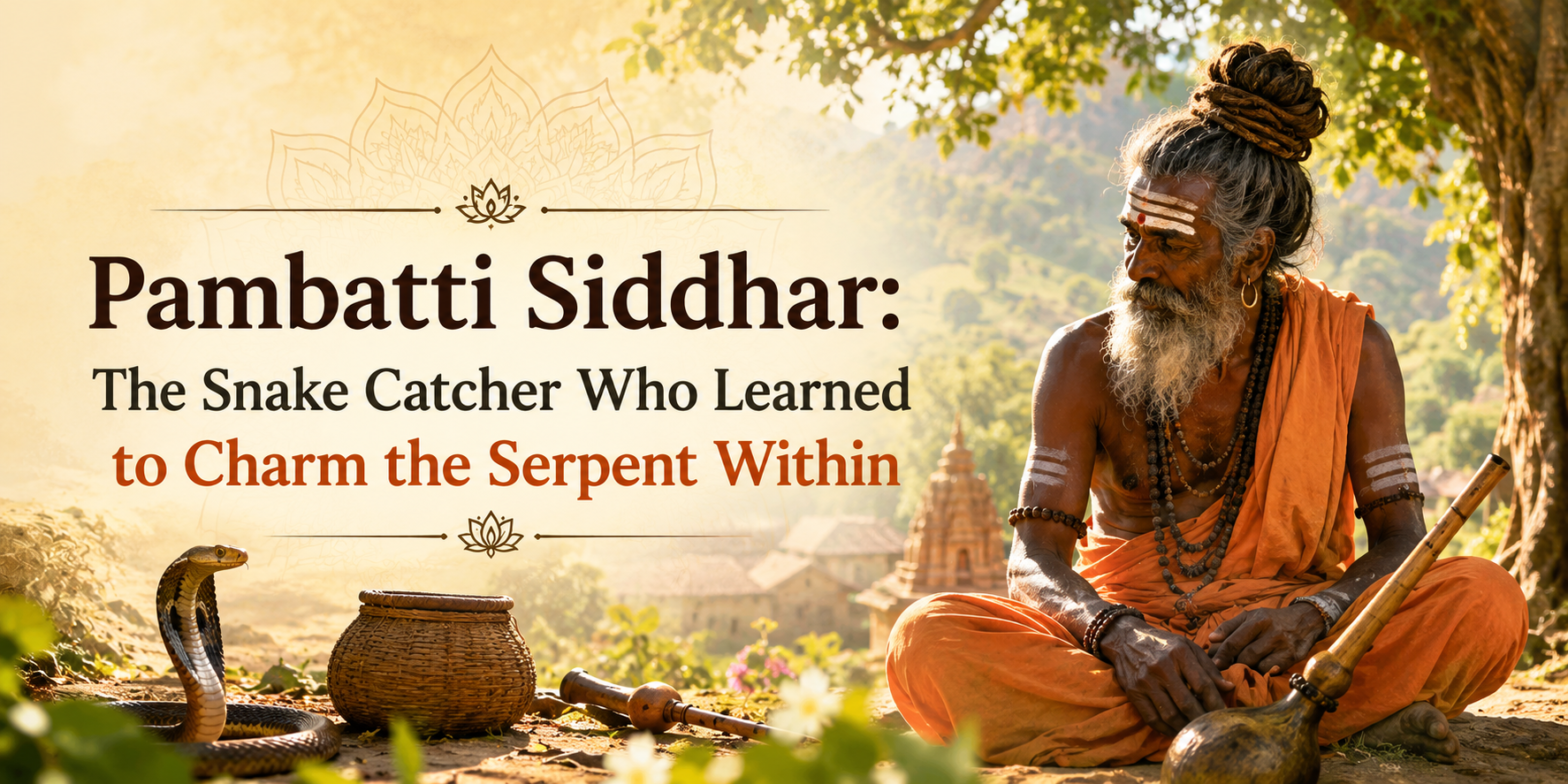
Picture a wandering hunter deep in the forest, tracking a legendary snake said to carry a jewel on its head. He is not searching for God. He is searching for a fortune. Then he stumbles onto a man sitting in trance, and the encounter rewrites the rest of his life. That hunter became Pambatti Siddhar, the snake charmer saint, one of the celebrated eighteen Siddhars of Tamil Nadu.
The Man Who Hunted the Wrong Snake
In the old Pandya kingdom, a fearless young man of the Jogi community made his living catching snakes, extracting venom, preparing cures, and treating those who had been bitten. He was obsessed with finding the Navaratna snake, a mythical serpent believed to carry a priceless gem upon its head, and he searched for it for years.
One day, in the middle of that search, he came upon a man in meditation. It was Sattaimuni Siddhar, one of the revered eighteen Siddhars. When the hunter explained what he was chasing, the siddha is said to have laughed and told him something that ended his old life on the spot.
The most glorious snake of all, he said, lives within you. You are foolishly hunting for one outside. The true snake in every human body is the Kundalini, and whoever catches and controls that snake is the only real Pambatti, the true snake charmer.
The hunter surrendered there and then, and received his new name from his guru. He would be Pambatti, because his life had always revolved around the snake, first the one outside his body and now the one within it.
What He Mastered
Under Sattaimuni’s guidance, Pambatti Siddhar mastered Kundalini yoga and Vaasi Yogam, the profound Siddha science of internal breath control and reversal, used to awaken higher consciousness and transcend the ordinary workings of the mind. He is said to have attained the Ashtama Siddhis, the eight classical supernatural powers, after deep penance in a cave on Marudamalai near Coimbatore, a cave that can still be visited today.
The Verses and the Refrain
His surviving verses run to fewer than six hundred lines, written in blunt everyday Tamil rather than in scholarly language, and each one ends with his signature refrain: Aadu Pambe, dance, O snake, coaxing the Kundalini upward the way a snake charmer coaxes a cobra from its basket.
His sharpest teaching concerned where people look for liberation. In one of his best known verses he asks what use it is to wear out your legs running to forests, mountains, and holy rivers, even to Kashi itself, chasing moksha somewhere out there. The path home, he says, is inward, through the Self and not through geography. No amount of pilgrimage or ritual bathing, he insisted, can substitute for love in the heart, and without genuine devotion liberation is simply not possible however far one travels to find it.
It is a strikingly modern idea from a man who spent his early life chasing something external and found the real treasure only when he stopped looking outward.
The Temple Where Death Was Defeated
The tradition this series follows holds that Pambatti Siddhar attained his Jeeva Samadhi at Thirukadaiyur, and the choice of place carries its own meaning. His Samadhi is located next to brahmapureeshwarar temple a temple very unique Shiva temple which also has Murguan here carry bow and arrow and wear paduka given of Sri Rama.
The Amirthakadeswarar Temple at Thirukadaiyur is one of the Ashta Veerattanam, the eight sacred sites where Shiva is believed to have manifested his fiercest form. The reason lies in the story of Markandeya, a boy destined to die at sixteen. Clinging to the Shiva lingam in prayer, he watched Yama, the god of death, throw a noose that fell upon both the boy and the lingam. Shiva’s fury was immediate. The lingam split open and he emerged with a trident to strike Yama down, which is why the deity here is worshipped as Kala Samhara Murthy, the destroyer of time itself.
Markandeya was granted eternal youth. But with Yama disabled, nothing on earth could die while births continued unchecked, until the earth goddess begged Shiva to release Yama once more. Because of this legend, Thirukadaiyur became the temple in Tamil Nadu associated with longevity rituals, and couples still travel here for milestone birthday poojas at sixty, seventy, eighty, and even a hundred.
This is the ground in Tamil Shaivism where the idea took root that death itself can be confronted and mastered, which is precisely why a saint famous for controlling the snake within would be drawn to it.
Where Does the Story End?
Honesty matters more here than a clean ending. The location of Pambatti Siddhar’s final samadhi is genuinely disputed. Some accounts place it at Sankarankovil in Tirunelveli district, others, including the tradition followed here, at Thirukadaiyur, and a smaller number at Virudhachalam. Even sources within the Siddha tradition acknowledge that the places overlap, since he is believed to have lived and taught in more than one location across a very long life, with some accounts claiming he lived to a hundred and twenty three.
What every version agrees on is the meaning rather than the geography. A man who once chased a mythical snake for money ended his life having tamed the real serpent power within himself, in a landscape where tradition says even Death had once been forced to kneel.
Thirukadaiyur is where Shiva proved that death is not absolute. Pambatti Siddhar spent his life performing the interior version of the same feat, not fighting death with a trident but disciplining the coiled energy within his own body until it stopped being something to fear and became something to dance with. Aadu Pambe. Dance, snake. Not away from the danger, but through it.