

 4 September 2026
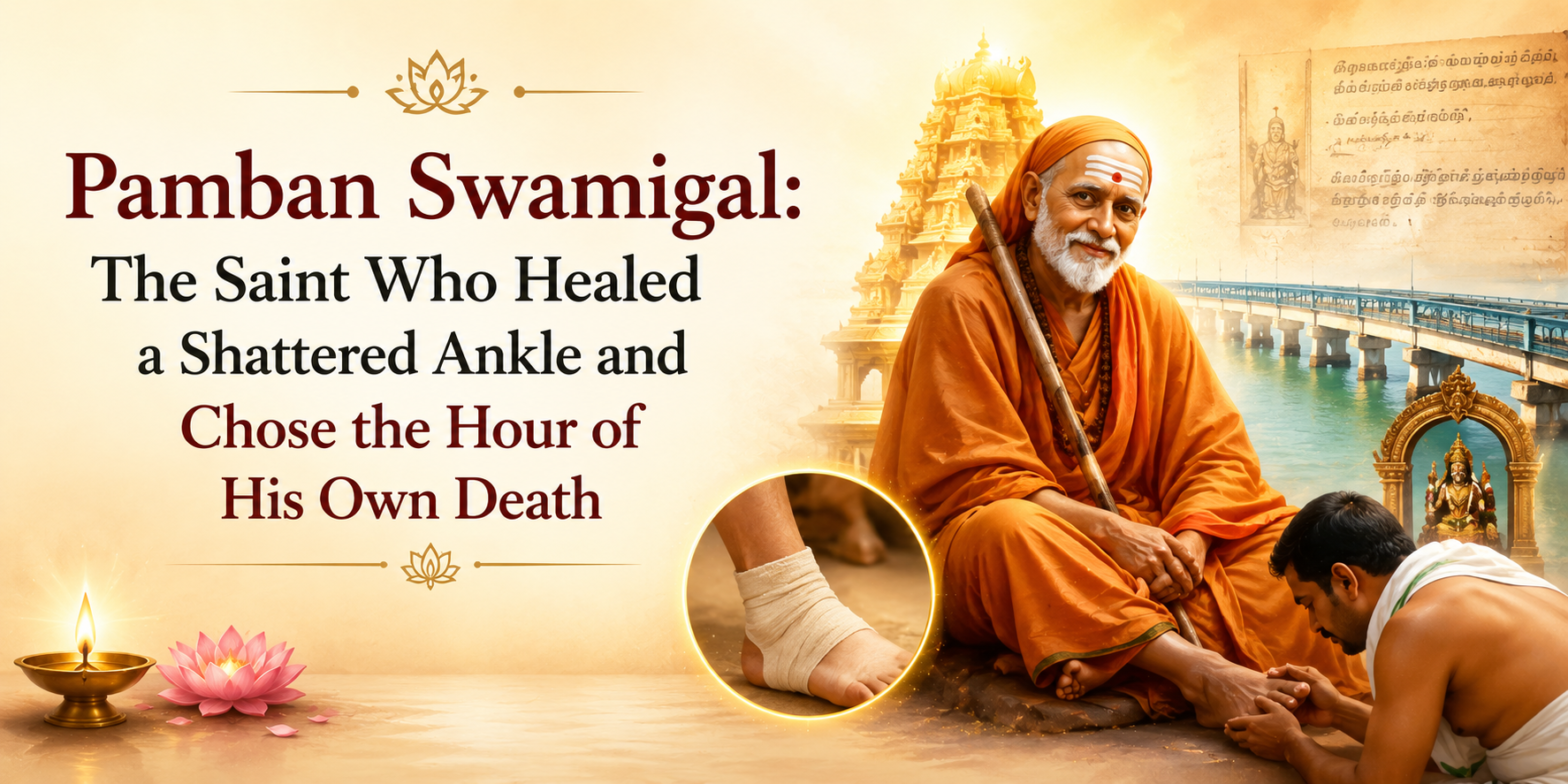
On the morning of 30 May 1929, at exactly 7:15 in the morning, an elderly man sat down before his followers in a quiet Chennai neighbourhood, told them to keep their faith in Lord Murugan, took a deep breath, held it in, and simply stopped living. There was no illness, no struggle, and no final rites rushed in panic. That man was Pamban Swamigal, and six years before that morning, British doctors had told him he was about to lose a leg. What happened instead is the part of his story that far fewer people know.
The Boy Who Wrote a Hundred Poems in a Hundred Days
He was born around 1848 near Rameswaram and named Appavu. He showed early brilliance in both Tamil and English, but the turn that shaped his life came at the age of thirteen. A vision at sunrise compelled him to write poetry to Lord Murugan, one poem every day, completed before lunch, for a hundred straight days. He did not miss a single one.
He came to be known as Pamban Swamigal after the years he spent living on Pamban Island. In time he wrote the Subrahmanya Veyasam, arguing that Shiva and Murugan were never two separate deities but one divine whole, a unifying and, for his time, almost radical position.
The Accident and the Verdict
In December 1923, when he was around seventy five years old, Pamban Swamigal was walking along Thambu Chetty Street in Madras when a speeding horse drawn jatka ran him over. His left ankle was crushed.
He was taken to the Government General Hospital opposite Central Station. The British doctors examined the leg and gave their verdict without ambiguity. At his age, with the bone damaged that badly, amputation was the only way to stop gangrene from setting in. The operation was scheduled.
His response was to keep chanting the name of Murugan. Let them do what they want to do, he said.
The Kavacham at the Bedside
Word of the accident reached a devoted follower named Chinnaswami Jothidar, who came to the bedside and began reciting the Shanmuga Kavacham, a composition of Pamban Swamigal’s own, without pause. He continued without food, without water, through day and night.
That night Chinnaswami had a vision of the Vel, the sacred spear of Murugan, entering the broken ankle. On the eleventh day, Pamban Swamigal himself saw two peacocks dancing before him, and beside him on the hospital bed the image of an infant. Looking closer, he recognised the infant as Lord Murugan.
By morning the fracture had healed. There was no surgery and no infection. The British doctors who had scheduled an amputation were left examining a leg that had mended itself overnight, and they openly attributed it to divine grace.
Pamban Swamigal did not let the moment pass quietly. He instructed his followers always to keep faith in Murugan, and to perform the Mayuravahana Sevai, the festival of Murugan’s peacock vehicle, without fail every year. It is the origin of a phrase Tamil devotees still repeat: Velum Mayilum Thunai, the spear and the peacock protect.
The Ground He Chose
The place he chose for his final years was not random. It was Thiruvanmiyur, home to the ancient Marundeeswarar Temple, one of the 276 Paadal Petra Sthalams, the Shiva temples glorified in verse by the Nayanar saints as early as the seventh century.
Marundu means medicine in Tamil. Legend holds that Sage Agastya came here seeking a vision of Shiva and Parvati and instead received the secrets of medicinal herbs and healing, taught to him by Shiva himself. For more than a thousand years devotees have believed this ground itself holds curative power. Even the name of the town carries a legend of release, deriving from Sage Valmiki, the author of the Ramayana, who is said to have heard Shiva’s voice here and attained liberation on a full moon night.
A saint whose own leg had been healed against every medical expectation built his final home on land already carrying a thousand years of stories about healing and release. That was not coincidence. It was a pattern.
Choosing the Moment
In his final years, sensing that his time was near, Pamban Swamigal asked Chinnaswami Jothidar to find him a plot of land in Thiruvanmiyur, and he marked out its corners himself with his own foot.
On 30 May 1929 at 7:15 in the morning he gathered his devotees, told them to hold on to their faith in Murugan, took a deep breath, held it, and entered Jeeva Samadhi, the conscious and self willed departure from the body. It was not death by illness or by accident. It was a death he appears simply to have chosen.
Where the Story Lives Today
His samadhi shrine, the Sri Pamban Swamigal Temple, still stands in Thiruvanmiyur near the Marundeeswarar Temple. Inside, a bronze Murugan statue that he once worshipped is still honoured, alongside the Jeeva Samadhi of his closest disciple, Subramaniya Dasar. Four daily poojas continue there, along with Thirupugazh bhajan sessions, the same devotional tradition that shaped a thirteen year old boy into a saint who would one day heal a shattered ankle through faith and choose the very hour of his own departure.