

 7 September 2026
A young sadhu with no ticket is thrown off a train in the Farrukhabad district of Uttar Pradesh. The guards put him down on the platform, the whistle blows, and the driver releases the brakes. Nothing happens. The engine will not move. Mechanics are called and they find no fault. Someone finally suggests what nobody wants to say aloud, that the man they removed might be the reason. The officials go back, request him to board, and the train starts. He asked only that a station be built for the village. That village was Neeb Karori, and the sadhu became known to the world by its name.
The Man Behind the Name
He was born around 1900 in the village of Akbarpur in Uttar Pradesh, into a wealthy Brahmin family, and named Lakshman Narayan Sharma, a name that also appears in many accounts as Lakshmi Narayan Sharma. His parents married him at the age of eleven, as was common in that time and place. Soon afterwards he left home altogether and disappeared into the life of a wandering sadhu.
For years he moved across northern India under a series of names given to him by the people of whatever place he happened to be in. He was Baba Lakshman Das to some, Handi Wala Baba to others, Tikonia Wala Baba and Tallaiya Baba elsewhere. He did not correct anyone or insist on a name of his own. This indifference to identity would remain with him for the rest of his life.
His father eventually found him and asked him to return to his responsibilities, and he did. He lived as a householder, and he and his wife Ram Beti had two sons and a daughter. Then, in time, he left again. What is unusual is that he never framed this as an abandonment of duty. He simply moved between the two worlds without treating either as a contradiction.
The Devotee of Hanuman
Everything about Neem Karoli Baba’s spiritual life ran through Hanuman. He built Hanuman temples wherever he went, at Vrindavan, Rishikesh, Shimla, Lucknow, Delhi, and later even in Taos in New Mexico. He spoke of Hanuman constantly, and many of his devotees came to believe that he was himself an aspect of Hanuman, though he never made any such claim.
The reasoning of his devotees was simple enough. Hanuman is the great servant, the one whose strength exists entirely to serve Rama, and Neem Karoli Baba’s teaching consisted almost wholly of service. Love everyone, feed everyone, serve everyone, remember God. He said little that was philosophically complicated. He fed people relentlessly, often more than they wished to eat, and he treated the act of feeding as worship rather than hospitality.
Kainchi Dham
In 1964 he established the ashram at Kainchi, in the hills near Nainital in Uttarakhand, on a bend in the road beside a mountain stream. The name comes from the Hindi word for scissors, describing the sharp double bend in the road at that spot. Kainchi Dham has become the most visited of all the places associated with him, and the annual bhandara held there every 15 June draws enormous numbers of devotees who are fed exactly as he would have wished.
Through the winters of many of these years he stayed in Allahabad with Dada Mukerjee, a professor of economics at Allahabad University, and his wife Kamala, at the house on Church Lane that devotees still call the Red House. Dada Mukerjee later wrote two of the most valuable accounts of his life, By His Grace and The Near and the Dear, written from the perspective of someone who lived alongside him rather than someone who visited him.
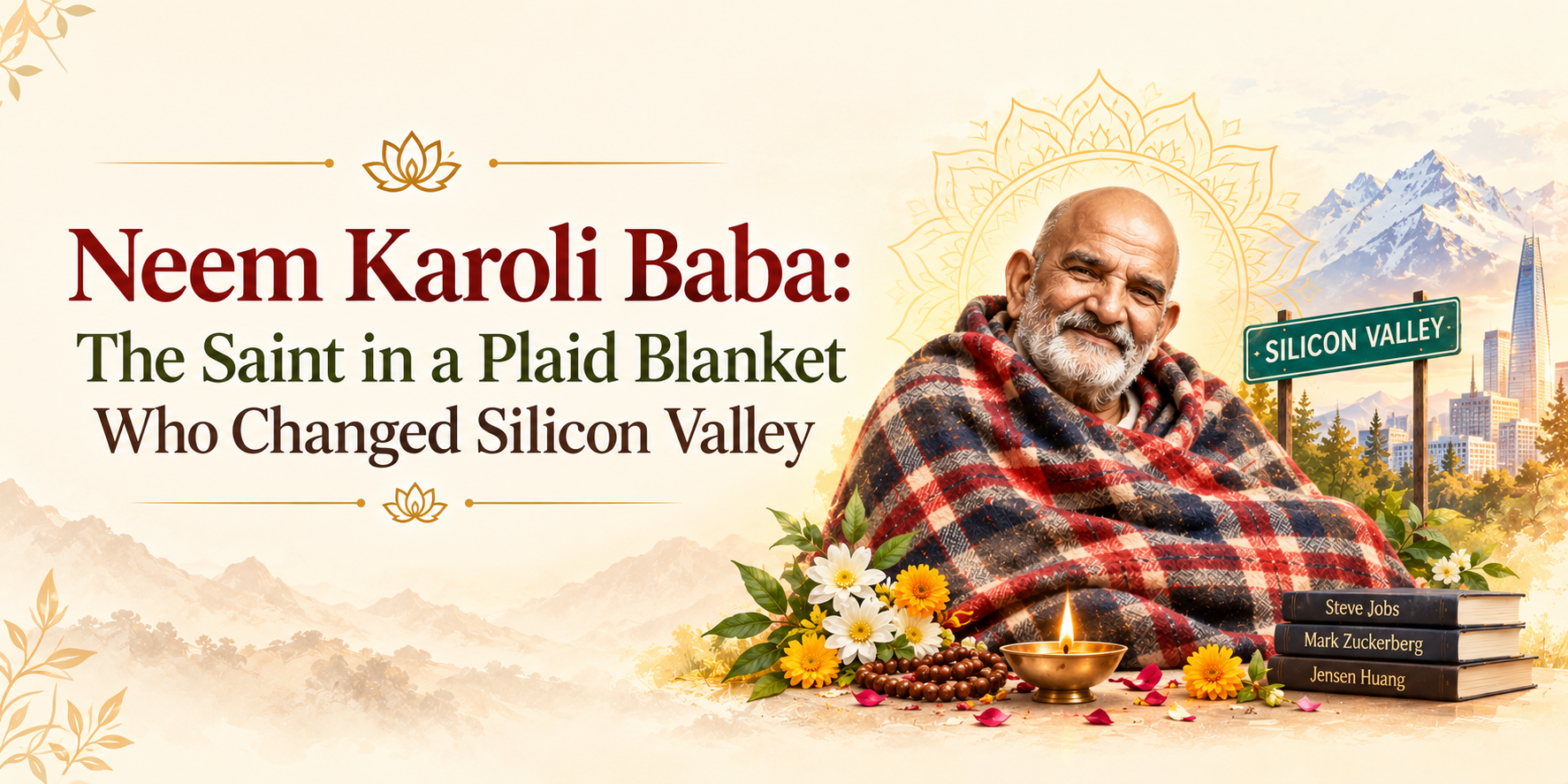
Through all of it, the image that stayed with everyone was the plaid blanket. He wore it constantly, sat wrapped in it, gave darshan in it, and it appears in almost every photograph of him. There was no robe, no ornament, and no throne.
How the West Found Him
In 1967 an American named Richard Alpert arrived in India. He had been a professor of psychology at Harvard, had been dismissed from the university over his research into psychedelics, and had come east looking for something he had not found in the laboratory. Guided by a young Western sadhu called Bhagavan Das, he was brought to Neem Karoli Baba in the hills.
What happened at that first meeting is the story most often told about Neem Karoli Baba. Baba, who had never met him, spoke to Alpert about his mother, who had died shortly before, and named the illness that had killed her. Alpert had told no one in India any of this. The account he gives is not of being impressed but of something breaking open in him. He stayed, and Neem Karoli Baba gave him the name Ram Dass, servant of Rama.
There is a second story from that period that has been repeated countless times. Baba asked Ram Dass about the medicine that had made him famous in America, and Ram Dass gave him a very large dose of LSD, enough to affect anyone severely. Baba took it and nothing whatever happened. He remained exactly as he had been. Ram Dass told this story for the rest of his life, not as a miracle to be marvelled at but as the moment he understood that what he had been chasing chemically was already permanently present in the man sitting in front of him.
In 1971 Ram Dass published Be Here Now, and it became one of the most influential spiritual books of the century in the West. He later wrote Miracle of Love, a collection of the stories devotees told about Maharaj-ji. Through those books, an Indian saint who never travelled abroad, gave no formal lectures, and wrote no books of his own became known across the world.
The devotees who gathered around him in those years went on to shape a great deal. Krishna Das and Jai Uttal carried Indian devotional chanting into Western practice. Larry Brilliant, sent by Baba into the work, became part of the World Health Organization team that eradicated smallpox, one of the great achievements of modern public health.
The Silicon Valley Connection
In 1974 a young Steve Jobs travelled to India with his friend Daniel Kottke, hoping to meet Neem Karoli Baba. He reached Kainchi Dham and found that Baba had left his body the previous year. Jobs never met him. He stayed in India for some months, returned changed, and the influence of that period on his thinking and his aesthetics has been widely discussed ever since. Ram Dass’s Be Here Now was among the books he cited as formative.
Decades later, in 2015, Mark Zuckerberg described visiting Kainchi Dham himself, saying that Jobs had told him to go there at a difficult moment for his company. The actress Julia Roberts has spoken about encountering a photograph of Neem Karoli Baba and the effect it had on her turn towards Hinduism.
There is a genuine irony here worth noticing. A man who owned almost nothing, who wore one blanket, who never sought publicity and repeatedly slipped away when crowds became too large, ended up shaping the interior lives of people who built some of the largest companies on earth. He would very likely have found the whole thing amusing and gone back to arranging for someone to be fed.
The Teaching
Neem Karoli Baba gave no systematic philosophy and had no interest in doctrine. What he said instead was direct enough to be remembered word for word by people who met him only once.
Love everyone. Feed everyone. Serve everyone. Remember God. When people asked him how to raise their consciousness, he told them to feed people. When they asked how to reach God, he told them to serve. He spoke of serving everyone as God, saying that when you are serving food, it is God who is being fed. He is often quoted saying that love is the strongest medicine, more powerful than electricity.
He also refused the distinctions that people brought to him. Sub ek, he would say. All is one. He received Hindus, Muslims, Westerners, sceptics, and the desperately troubled without appearing to distinguish between them, and gave them, for the most part, food and attention rather than instruction.
Mahasamadhi
He left his body on 11 September 1973 in Vrindavan, the town most associated with Krishna and with devotion itself. His samadhi shrine is there, and the ashrams he established continue at Kainchi, Vrindavan, and elsewhere.
What is striking about his legacy is that it was never institutional. He founded no order, appointed no successor, and left no written teaching. What he left instead were people, thousands of them, who had been fed by him and looked at by him, and who then went out and did things in the world. That, and a road bend in the Kumaon hills where the food is still served every year on the fifteenth of June, exactly as he liked it.
Visiting Kainchi Dham
Kainchi Dham lies about seventeen kilometres from Nainital in Uttarakhand, on the road towards Almora, set beside the Kosi river in the Kumaon hills. The ashram is open to visitors through much of the year, and the annual bhandara on 15 June, marking the anniversary of the temple’s establishment, is the day of greatest gathering, when devotees are fed in enormous numbers.
Those who go describe the atmosphere rather than any spectacle. There is little to see in the conventional sense. There is a temple, a stream, the hills, and a great deal of quiet. For a place that has drawn some of the most recognisable people in the world, it remains remarkably plain, which is probably the most fitting thing about it.