
 15 September 2026
Ask ten people why we celebrate the Navratri festival and you will get ten answers, all of them partly right. One will say it is for Goddess Durga. Another will say it is about Rama and Ravana. Someone from Gujarat will talk about garba, someone from Bengal about Durga Puja, and someone from Tamil Nadu about arranging dolls on a wooden staircase.
None of them is wrong. Navratri is one of those rare festivals that means something slightly different in every part of India while remaining, at its core, exactly the same thing everywhere. Here is what that core actually is.
What Is the Navratri Festival?
Navratri comes from two Sanskrit words — nava, meaning nine, and ratri, meaning night. Nine nights. Across those nine nights and ten days, devotees worship the Divine Feminine in nine distinct forms, known collectively as the Navadurga.
In practice, Navratri is a period of fasting, prayer, music and community. Households install a kalash on the first day and keep a lamp burning through the nine days. Many people give up grains, onion and garlic. Temples fill up. Evenings turn into garba and dandiya in western India, into pandal-hopping in the east, and into quiet lamp-lit aartis in countless homes everywhere else.
It is, by almost any measure, the longest festival in the Hindu calendar — and one of very few major world festivals centred entirely on a goddess.
What Is the Story Behind Navratri?
There are two great stories behind Navratri, and both are true at once depending on where in India you are standing.
The Story of Durga and Mahishasura
This is the story most closely tied to the nine nights themselves.
Mahishasura was an asura who performed severe penance and won a boon from Lord Brahma: no man and no god would ever be able to kill him. Believing himself effectively immortal, he conquered the earth, drove the gods out of the heavens, and ruled with a cruelty that nobody could answer. The gods had, quite literally, written the loophole into his boon themselves — he had never thought to ask for protection from a woman.
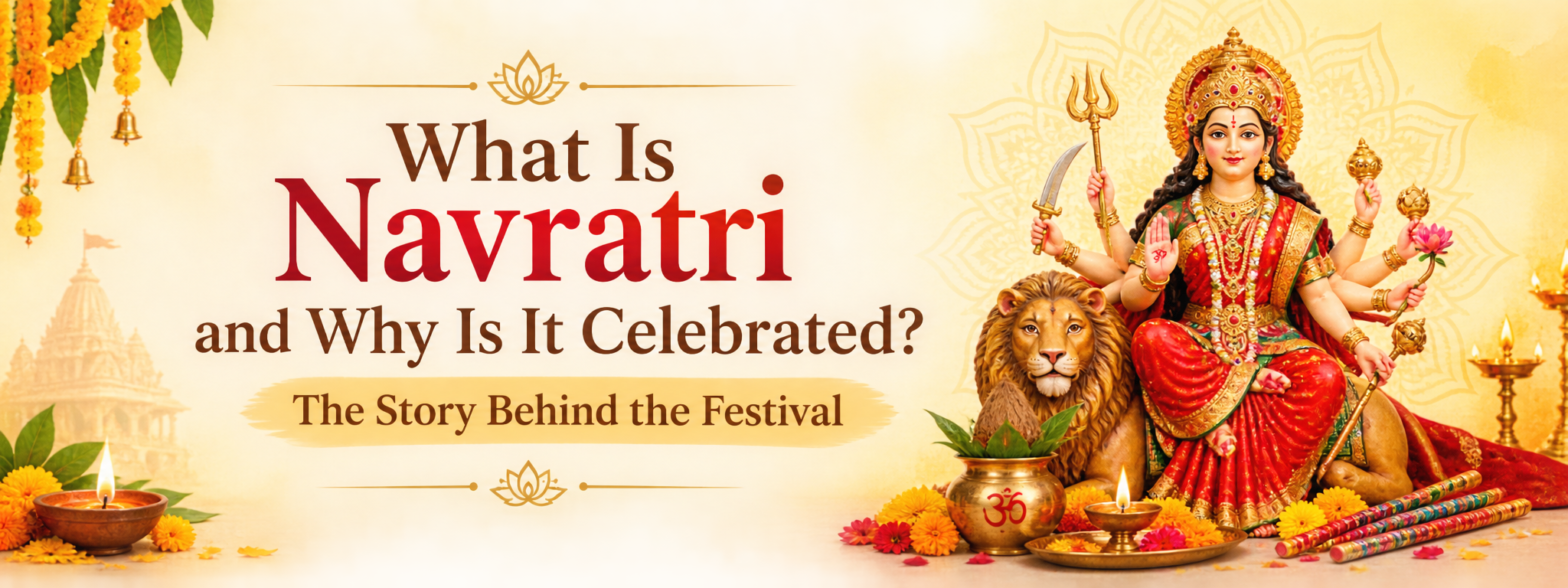
So the gods pooled their energies. From the combined light of Brahma, Vishnu, Shiva and all the devas emerged a warrior goddess of overwhelming power — Durga. Each god gave her a weapon: Shiva his trident, Vishnu his discus, Indra his thunderbolt, Varuna his conch. Himavan gave her a lion to ride.
The battle that followed lasted nine nights. Mahishasura, a shapeshifter, changed form again and again — buffalo, lion, elephant, man — and Durga met him in every form. On the tenth day, as he emerged one final time in his buffalo form, she pierced him with her trident and ended him.
That tenth day is Vijayadashami — literally, the tenth day of victory. The nine nights of battle are the nine nights of Navratri.
The Story of Rama and Ravana
In much of north India, the same ten days carry a second story. Before marching on Lanka to rescue Sita, Rama is said to have worshipped Goddess Durga for nine nights, seeking her blessing. The worship was untimely — performed in autumn rather than spring — and so came to be known as Akaal Bodhan, the untimely awakening of the goddess. On the tenth day, with her blessing, Rama killed Ravana.
This is why north Indian cities stage Ramlila performances through the nine nights and burn effigies of Ravana, Meghnad and Kumbhakarna on Dussehra. Two victories, one festival, the same tenth day.
Why Do We Celebrate the Navratri Festival?
Strip away the regional variations and there are four reasons that hold everywhere.
First, to honour the victory of good over evil. Both founding stories end the same way — an apparently unbeatable force is defeated, and order returns. Navratri is the annual retelling of that promise.
Second, to worship Shakti, the feminine principle of creative power. Hinduism holds that the universe runs on this energy, and Navratri is the year’s most sustained act of devotion to it. This is a festival where a goddess is not a consort or a supporting figure but the central, supreme power.
Third, to mark the turning of the seasons. Both major Navratris fall at seasonal junctions — Chaitra at the start of spring, Shardiya (Sharad Navratri) at the end of the monsoon.. These are exactly the periods when the body is most vulnerable to illness, which is why fasting and light, simple food have always been built into the observance. The festival is as much a physical reset as a spiritual one.
Fourth, to gather. In a year full of one-day festivals, Navratri gives families and neighbourhoods nine consecutive evenings together. For a great many people, that is the reason they would name first.
What Is Navratri Celebrated For in Different Parts of India?
• Gujarat and Rajasthan — Garba and dandiya raas every night, danced in circles around a lamp-lit earthen pot representing the womb of the goddess. Entire cities stay up until dawn.
• West Bengal, Odisha, Assam — The last five days become Durga Puja, with enormous themed pandals, all-night crowds, dhunuchi dancing, and visarjan on the tenth day.
• Tamil Nadu, Karnataka, Andhra Pradesh — Golu or Bommai Kolu, where families arrange tiered displays of dolls and figurines, known as Golu, and invite neighbours home for sundal and music. Karnataka has grand Dussehra celebrations in Mysore, and every household has Pattada Bombe (traditional wooden dolls). Mysuru’s royal Dasara procession is the region’s grandest expression.
• North India — Ramlila performances through the nine nights, Kanya Pujan on Ashtami or Navami, and the burning of Ravana’s effigy on Dussehra.
• Maharashtra — Ghatasthapana, bhondla and hadga games for young girls, and the start of the auspicious season for new purchases.
What Does Navratri Symbolize?
At its deepest, Navratri symbolizes the journey of the self.
The nine nights are traditionally read as three sets of three. The first three days are given to Durga in her fierce aspect, and they represent the destruction of what holds us back — ego, anger, old habits, accumulated impurity. The middle three days belong to Lakshmi, and they represent the cultivation of what is worth having: abundance, generosity, inner steadiness. The final three days belong to Saraswati, and they represent wisdom — the understanding that only becomes possible once the ground has been cleared and made fertile.
Read that way, Navratri is not really about Mahishasura at all. The demon is the part of yourself you have not yet defeated, and the nine nights are the time set aside each year to go to war with it. The lamp that burns unbroken for nine days is your own attention, kept steady. The tenth day is not a reward handed down from outside — it is what you have earned.
That is the reason the festival has survived, across regions that share almost no other customs, for thousands of years. Everyone, everywhere, has something they are still fighting.