
 14 August 2026
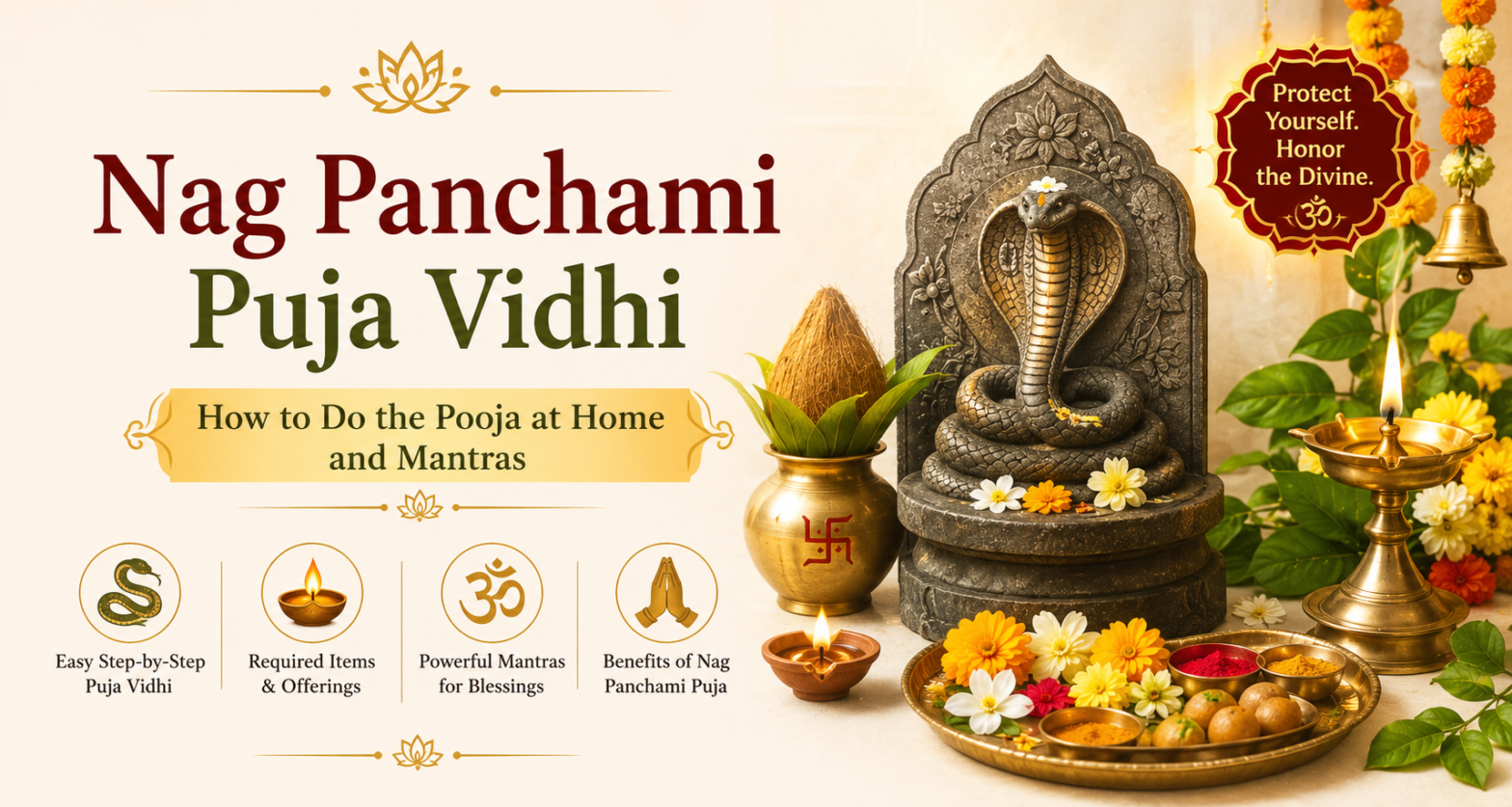
The Nag Panchami puja vidhi is simple enough to perform at home in the morning hours of the festival. In 2026, Nag Panchami falls on Monday, 17 August, devotees bathe early, prepare an image or representation of the Naga Devatas, and offer milk, turmeric, flowers, and naivedyam accompanied by mantras. This guide sets out the step by step Nag Panchami pooja vidhi, the mantras to chant, the items required, and the traditional practice of offering milk at anthills.
Nag Panchami Ki Puja Kaise Kare: Step by Step
Step 1: Bathe and prepare in the morning
The puja is performed in the morning after bathing, wearing clean clothes. Many devotees observe a fast through the day, taking a single meal after the puja is complete. Clean the puja space and place your seat facing east or north.
Step 2: Prepare the Naga representation
Traditionally, an image of the Naga Devata is drawn on the wall or floor near the puja space using turmeric, sandalwood paste, or rangoli. Families may also use a silver or clay Naga idol, a Naga stone if the household maintains one, or a picture of the serpent deities. Any of these is acceptable, and the sincerity of the worship matters more than the material.
Step 3: Perform the abhisheka
Bathe the Naga idol or stone with milk, and then with water. Milk is the offering most closely associated with this festival, and the abhisheka is the heart of the ritual.
Step 4: Offer the upachara
After the abhisheka, perform a Panchopachara puja, the worship of five offerings, or the more elaborate Shodashopachara puja of sixteen offerings if you are able. These include sandalwood paste, turmeric and kumkum, flowers, incense, lamp, and naivedyam. Everything the tradition prescribes is contained within these two frameworks, and families follow whichever suits their capacity and custom.
Step 5: Offer naivedyam
Milk, and preparations made with milk, are the most traditional offerings. Many households prepare payasam, and offerings of fruits, coconut, and jaggery preparations are also common. The naivedyam is offered before the concluding aarti.
Step 6: Chant the mantras and complete with aarti
Chant the Nag Panchami mantras given below, offer the aarti, and conclude by praying for the protection of your family and for forgiveness for any disturbance caused knowingly or unknowingly to the dwelling of the Naga Devatas.
Nag Panchami Mantra
The following mantras are traditionally chanted on this day. Recite them with a settled mind after completing the abhisheka.
The most widely chanted verse invokes the nine principal Nagas:
Anantam Vaasukim Shesham Padmanaabham cha Kambalam, Shankhapaalam Dhritaraashtram Takshakam Kaaliyam tathaa.
This verse names Ananta, Vasuki, Shesha, Padmanabha, Kambala, Shankhapala, Dhritarashtra, Takshaka, and Kaliya, and tradition holds that reciting these names on Nag Panchami remove the effects of Sarpa Dosha and the fear of serpents
It is worth noting that the names of the nine Nagas vary somewhat between traditions. Another widely followed enumeration lists Ananta, Vasuki, Karkotaka, Takshaka, Padma, Shankha, Gulika, Shesha, and Mahapadma, each associated with a specific blessing such as progeny, strength, wealth, relief from particular ailments, freedom from sin, and liberation. Both enumerations are authentic, and families follow the one their lineage prescribes.
A simple beeja invocation may also be chanted:
Om Naagakulaaya Vidmahe Vishadantaaya Dheemahi Tanno Sarpah Prachodayaat.
For those seeking a shorter mantra for daily japa, Om Naagadevataayai Namaha may be chanted 108 times.
Nag Panchami Puja Samagri
- Milk for the abhisheka, and water
- Turmeric, kumkum, and sandalwood paste
- Flowers, preferably white or fragrant varieties
- Durva grass and bilva leaves where available
- Incense sticks and a ghee lamp
- Naivedyam: payasam or milk preparations, fruits, coconut, jaggery
- A silver or clay Naga idol, Naga stone, or an image drawn with turmeric
The Tradition of Offering Milk at Anthills
Beyond the household puja, one of the most cherished customs of Nag Panchami is the visit to an anthill or a serpent dwelling to offer milk. In regions with hills and forested areas, families walk to the places where serpents are known to dwell, pour milk at the entrance, offer their prayers, and return with the blessings of the Naga Devatas. Anthills near temples are also visited for this purpose, and many temples with Naga shrines or Naga stones receive large numbers of devotees on this day.
Where such a visit is not possible, the offering is made at the home puja or at the local temple, and the tradition holds this to be complete in itself.
Nag Panchami Quotes for the Day
- The serpent adorns the neck of Shiva and the bed of Vishnu. What the divine honours, let us also revere.
- Milk, flowers, and folded hands. That is all the Nagas ask of us.
- To respect what we fear is the beginning of wisdom.
- The blessings of the Naga Devatas reach the whole lineage, not the individual alone.
Frequently Asked Questions
Nag panchami ki puja kaise kare at home?
Bathe early, prepare a Naga image using turmeric or place a silver or clay idol, perform abhisheka with milk and water, offer Panchopachara or Shodashopachara puja, offer payasam or milk naivedyam, chant the Naga mantras, and conclude with aarti and prayers for family protection.
What is the main Nag Panchami mantra?
The most widely chanted verse invokes the nine principal Nagas: Anantam Vaasukim Shesham Padmanaabham cha Kambalam, Shankhapaalam Dhritaraashtram Takshakam Kaaliyam tathaa. Reciting these names is traditionally held to remove fear of serpents and the effects of Sarpa Dosha.
What should be offered to the Naga Devatas?
Milk is the central offering, along with turmeric, kumkum, sandalwood, flowers, incense, a lamp, and naivedyam such as payasam or other milk preparations, fruits, coconut, and jaggery.
Can Nag Panchami puja be done without an idol?
Yes. An image of the Naga Devata drawn with turmeric or sandalwood paste on the wall or floor is entirely traditional and is used in many households. A picture of the serpent deities is also acceptable.
Should the puja be done in the morning or evening?
The Nag Panchami puja is traditionally performed in the morning after bathing. Many devotees fast through the day and take their meal after completing the worship.