
 9 September 2026
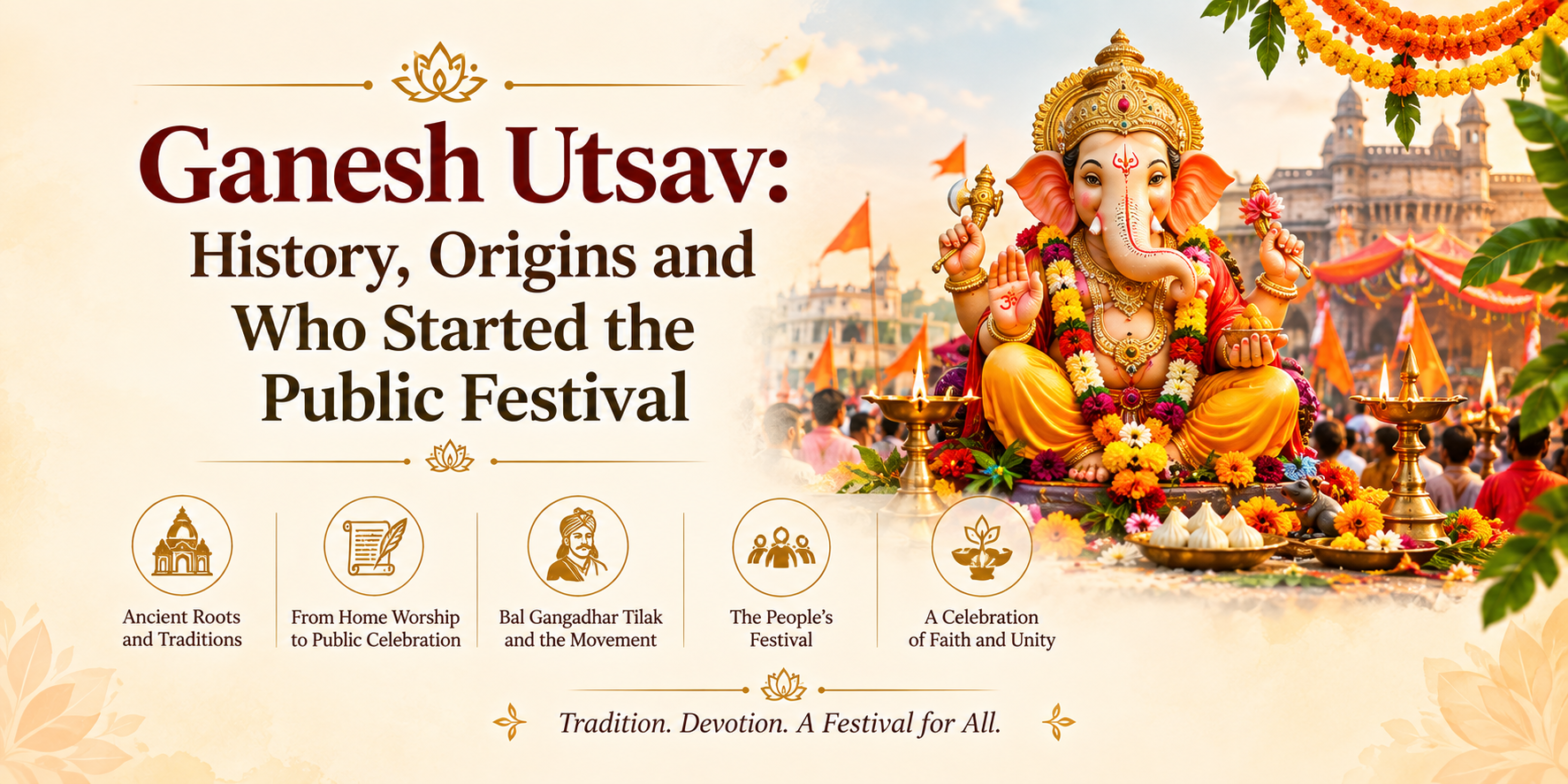
Ganesh Utsav is the multi-day festival of Lord Ganesha, and in its modern public form it was started by Lokmanya Bal Gangadhar Tilak in Pune in 1893, who transformed what had been a private household observance into a grand community celebration. In 2026, Ganesh Utsav begins on Monday, 14 September and concludes with Anant Chaturdashi and the main visarjan on Friday, 25 September. This guide covers the history of Ganesh Utsav, its origins before Tilak, why he made it public, and how it grew into the festival seen across India today.
Ganesh Utsav Date 2026
- Ganesh Chaturthi and Sthapana: Monday, 14 September 2026
- Chaturthi tithi: begins 7:06 AM on 14 September, ends 7:44 AM on 15 September
- Anant Chaturdashi and main visarjan: Friday, 25 September 2026
Families observing shorter durations perform visarjan on 15 September for one and a half days, 16 September for three days, 18 September for five days, and 20 September for seven days. All of these are equally traditional, and the choice generally follows family custom rather than any rule.
Ganesh Utsav Before Tilak
The worship of Ganesha is ancient, and the festival did not begin in 1893. What began then was its public form.
Long before that, Ganesh Chaturthi was observed in homes as a family occasion. In Maharashtra, historical accounts describe the festival being celebrated with royal patronage under the Maratha rulers. Chhatrapati Shivaji Maharaj is traditionally associated with encouraging the public celebration of Ganesha, and the Peshwas, who held Ganesha as their family deity, observed the festival with considerable grandeur in Pune. After the decline of Peshwa rule, that public dimension faded, and the festival contracted once more into the household.
Who Started Ganesh Utsav in Its Modern Form?
The person who revived and reshaped it was Lokmanya Bal Gangadhar Tilak, the nationalist leader, in Pune in 1893.
His reasoning was political as well as devotional, and it is worth understanding properly. Under colonial rule, restrictions on public assembly made it difficult for Indians to gather in large numbers for political purposes. Religious gatherings, however, could not easily be prohibited. Tilak saw that a public festival could lawfully bring together enormous numbers of people, and he set about converting the household worship of Ganesha into a large public celebration.
He introduced the elements that define the festival to this day: large idols installed in public pandals, community organisation and funding, daily programmes of music, lectures, and cultural performances during the ten days, and a grand procession culminating in immersion on Anant Chaturdashi.
There was a second purpose that mattered to him a great deal. The festival was deliberately open to all, across communities and castes, and became a place where people who would not ordinarily gather together did so. Tilak used the platform for speeches and for the circulation of ideas, and the Ganesh pandal became one of the significant spaces of public life in western India during that period.
Why Ganesha?
The choice of deity was well judged. Ganesha is worshipped across regions, communities, and sectarian traditions, and is invoked at the beginning of every undertaking regardless of which deity a family holds foremost. He is Vighnaharta, the remover of obstacles, and Buddhi Pradayaka, the giver of intelligence. No other deity offered quite the same breadth of acceptance, which made Ganesha the natural centre for a festival intended to bring people together.
How Ganesh Utsav Grew
From Pune the public festival spread rapidly through Maharashtra and then well beyond it. Mumbai became the great centre of the modern celebration, with pandals that draw enormous numbers of visitors and immersion processions that fill the streets for hours. The festival is now observed widely in Goa, Karnataka, Andhra Pradesh, Telangana, Tamil Nadu, Gujarat, Madhya Pradesh, and across the Indian diaspora.
The form varies considerably. In some regions the emphasis remains on the household installation and quiet family worship. In others the public pandal, the cultural programme, and the procession dominate. Both descend from the same festival, and neither is a departure from it.
The Festival Today
Contemporary Ganesh Utsav carries an added dimension that the tradition has taken up seriously: the environmental question. Idols made of plaster of Paris and finished with chemical paints do not dissolve and damage the water bodies they are immersed in. Clay murtis, natural colours, and immersion in tanks or at home in a bucket have become widespread, and many pandals and households have made the change. Honouring the deity and honouring the rivers he is associated with are not in tension, and the shift reflects that.
Frequently Asked Questions
Who started Ganesh Utsav?
Lokmanya Bal Gangadhar Tilak started the modern public form of Ganesh Utsav in Pune in 1893, converting what had been a household observance into a large community festival with public pandals, cultural programmes, and immersion processions.
Why did Tilak start the public Ganesh Utsav?
Colonial restrictions limited public political assembly, but religious gatherings could not easily be prohibited. Tilak used the festival to bring people together lawfully in large numbers, across communities and castes, and to create a public platform for speeches and the circulation of ideas.
Was Ganesh Chaturthi celebrated before 1893?
Yes. Ganesha worship is ancient and the festival was long observed in homes. Ganesh Chaturthi was celebrated with royal patronage under the Marathas, and the Peshwas, whose family deity was Ganesha, observed it grandly in Pune. What Tilak revived and reshaped was the public form.
What is the Ganesh Utsav date in 2026?
Ganesh Utsav 2026 begins on Monday, 14 September with Ganesh Sthapana and concludes with Anant Chaturdashi and the main visarjan on Friday, 25 September. Shorter observances immerse on 15, 16, 18, or 20 September.
How long does Ganesh Utsav last?
The full public festival runs ten days from Ganesh Chaturthi to Anant Chaturdashi. Households commonly observe one and a half, three, five, or seven days according to family custom, and all these durations are traditional.