
 22 October 2026
Bhai Dooj is the festival of the bond between brother and sister, observed on the second day after Diwali, and in 2026 it falls on Tuesday, 10 November. The sister applies a tilak to her brother’s forehead, prays for his long life and wellbeing, and he in turn pledges to protect her and offers a gift. The name comes from bhai, meaning brother, and dooj, the second tithi of the lunar fortnight. This guide explains the meaning of Bhai Dooj, why it is celebrated, what happens on the day, and how it is observed across different regions.
What Is Bhai Dooj?
Bhai Dooj is the fifth and final day of the Diwali festival, dedicated to the relationship between siblings. Sisters invite their brothers home, prepare a meal for them, perform a small ceremony involving a tilak and aarti, and receive a gift in return. Where Raksha Bandhan centres on the thread a sister ties, Bhai Dooj centres on the tilak she applies and the meal she serves.
The festival carries a particular warmth because it is traditionally the occasion when a married sister, living in her husband’s home, welcomes her brother to visit her. The journey he makes is part of the meaning.
Bhai Dooj Meaning
The name is literal. Bhai means brother. Dooj, from dwitiya, is the second day of the lunar fortnight, and the festival falls on the Shukla Paksha Dwitiya of Kartik, two days after Diwali.
The festival goes by several names across the country, and all refer to the same observance:
- Bhai Dooj or Bhaiya Dooj in North India
- Bhau Beej in Maharashtra, Goa and Gujarat
- Bhai Phonta in West Bengal
- Bhai Tika in Nepal
- Yama Dwitiya, the scriptural name, used widely in the south
On the question of spelling, Bhai Dooj is the most common English form, though Bhaiya Dooj, Bhai Duj and Bhai Dwitiya all appear and are equally acceptable.
Why Bhai Dooj Is Celebrated
Two accounts explain the day, and both are widely told.
Yama and Yamuna. The most important account, and the source of the name Yama Dwitiya, concerns Yama, the lord of death, and his sister Yamuna. The two had been long separated, and when Yama finally visited his sister on this day, she welcomed him with great joy, applied a tilak to his forehead, garlanded him and served him a meal she had prepared herself. Yama was so moved that he offered her a boon. She asked that he return to her on this day every year, and further, that any brother who received a tilak from his sister on this day should be freed from fear and granted long life. Yama granted it, and the day has been kept since.
Krishna and Subhadra. The second account tells of Lord Krishna returning to his sister Subhadra after defeating the demon Narakasura. She welcomed him with sweets, flowers and a tilak on his forehead, and the custom is traced to that welcome.
Both stories carry the same message. The sister’s prayer is for her brother’s protection and long life, and the brother’s presence is his acknowledgment of the bond.
What Happens on Bhai Dooj
- The sister prepares. The house is cleaned and a puja thali is arranged with roli or kumkum, rice, a diya, sweets, flowers and a coconut.
- The brother is seated. He sits on a low wooden seat or chowki, often on a rangoli drawn by his sister, facing east or north.
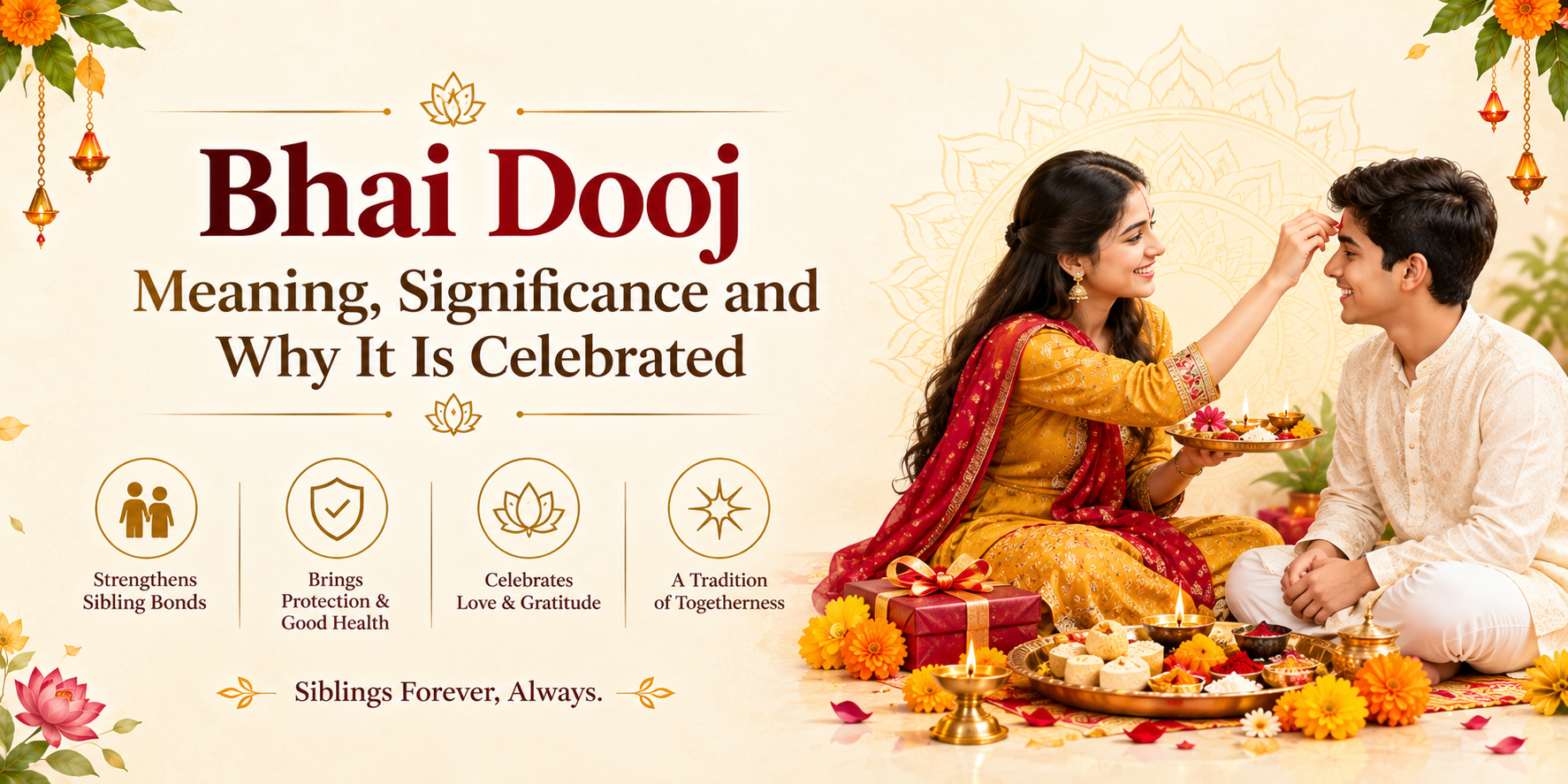
- The tilak and aarti. The sister applies a tilak of kumkum and rice to his forehead, performs aarti, and prays for his long life, health and prosperity.
- Sweets and the meal. She offers him sweets with her own hand, and a full meal is served, traditionally cooked by her and including his favourite dishes.
- The gift and the pledge. The brother gives her a gift and pledges to protect her through the years. In many families this is accompanied by a small sum of money placed in the thali.
- The Yama prayer. In several regions the family also offers prayers to Yama and Yamuna on this day, and some sisters keep a fast until the tilak ceremony is complete.
There is a custom worth mentioning for sisters who have no brother, or whose brother cannot travel. In such cases the tilak is offered to the moon, and in Maharashtra and parts of the north the sister draws a figure on the ground and performs the ceremony to it. The tradition makes room for absence.
Regional Variations
In Maharashtra and Goa, Bhau Beej involves the sister drawing a square on the floor on which the brother is seated, and the day is marked by the preparation of basundi puri or shrikhand puri. In West Bengal, Bhai Phonta involves a sandalwood paste mark applied with the ring finger of the left hand, accompanied by a verse the sister recites, and a feast follows. In Nepal, Bhai Tika uses a tilak of seven colours and is among the most important festivals of the year. In the south the day is observed as Yama Dwitiya, with the scriptural emphasis on the Yama and Yamuna account.
The Significance of Bhai Dooj
The significance lies in the formal, annual renewal of a relationship that otherwise has no ceremony of its own. A marriage has a wedding. A birth has a naming. The sibling bond, in most traditions, has nothing. Bhai Dooj gives it a day, a ritual and an obligation to show up.
The practical dimension matters too. In a culture where a married daughter moves to her husband’s home, the festival establishes a standing occasion on which her natal family must come to her, which preserves the connection across the distance that marriage creates.
Frequently Asked Questions
What is Bhai Dooj?
Bhai Dooj is the festival of the brother and sister bond, observed on the second day after Diwali. The sister applies a tilak to her brother’s forehead, performs aarti, prays for his long life and serves him a meal, and he offers her a gift and pledges his protection. In 2026 it falls on Tuesday, 10 November.
What is the meaning of Bhai Dooj?
Bhai means brother and dooj means the second tithi of the lunar fortnight. The festival falls on Shukla Paksha Dwitiya of Kartik, two days after Diwali. It is also known as Bhaiya Dooj, Bhau Beej, Bhai Phonta, Bhai Tika and Yama Dwitiya.
Why is Bhai Dooj celebrated?
It is traced to Yama visiting his sister Yamuna, who welcomed him with a tilak and a meal. Moved, he granted that any brother receiving a tilak from his sister on this day would be freed from fear and granted long life. A second account tells of Krishna being welcomed by his sister Subhadra after he defeated Narakasura.
How is Bhai Dooj celebrated?
The brother is seated on a chowki, the sister applies a tilak of kumkum and rice, performs aarti, prays for his wellbeing and offers sweets by hand. A meal cooked by her follows, and the brother gives a gift and pledges to protect her.
What is the correct spelling of Bhai Dooj?
Bhai Dooj is the most common English spelling. Bhaiya Dooj, Bhai Duj and Bhai Dwitiya are also used and are equally correct. Regional names include Bhau Beej, Bhai Phonta, Bhai Tika and Yama Dwitiya.
What should be done on Bhai Dooj?
The sister prepares a puja thali, seats her brother, applies the tilak, performs aarti and serves sweets and a meal. The brother gives a gift. In several regions prayers are also offered to Yama and Yamuna, and some sisters fast until the ceremony is complete.
What if a sister has no brother?
The tradition makes room for this. The tilak may be offered to the moon, and in Maharashtra and parts of North India the sister draws a figure on the ground and performs the ceremony to it.