

 1 September 2026
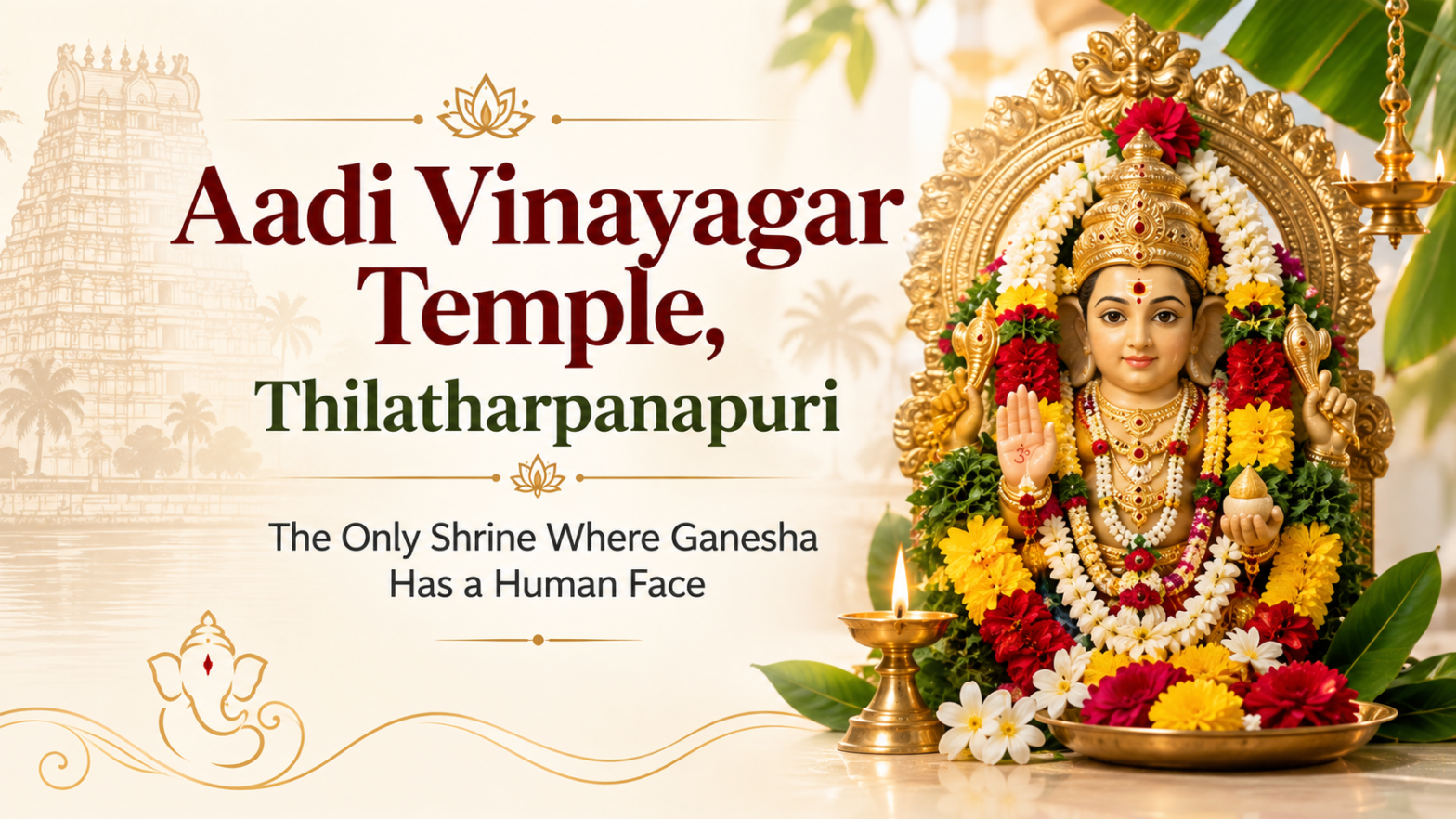
Long before Ganesha became the elephant headed deity worshipped across the world, tradition holds that he had a human face. At the Aadi Vinayagar Temple in Thilatharpanapuri, near Koothanur in Tamil Nadu, that original form is still worshipped. The five foot idol here has no trunk and no elephant head, only a serene human face, and the deity is revered as Nara Mukha Vinayagar, the human faced one. It is the only shrine of its kind, and it stands within the Muktheeswarar Temple complex in a village whose very name carries one of the most important associations in the tradition of ancestral rites.
The Form That Came Before
Every devotee knows the story of how Ganesha received his elephant head. Far fewer know that a temple exists where he is worshipped exactly as he was before that moment. The idol at Aadi Vinayagar is unlike any other Ganesha image in the country. There is no trunk, no tusk, no elephant countenance. What the devotee sees is a calm human face, and the sense of standing before something older than the familiar form is immediate.
The word Aadi means the first, or the original. This is Ganesha in his primordial form, and devotees come here precisely for that reason, to offer worship to the deity in his most unfiltered aspect.
Thilatharpanapuri: A Sacred Ground for Ancestral Rites
The name of the place tells its own story. Thila refers to the sesame seed offered in ancestral rites, and tharpanam is the offering of water to the departed. Thilatharpanapuri is, quite literally, the town of the sesame offering.
This is one of the seven sacred sthalams in the Hindu tradition for the performance of tharpanam, standing alongside Kashi and Rameswaram. Tradition holds that ancestral rites performed here on Amavasya carry merit equal to performing them at those great holy cities. For families who wish to observe tharpanam for their ancestors but cannot travel to Kashi or Rameswaram, this is a place of genuine significance rather than a substitute, and it is among the reasons the temple draws devotees from well beyond its region.
Tradition further associates the place with Lord Rama, who is believed to have performed the ancestral rites for his father Dasharatha here, and it is from this that the town is said to take its name.
The Sage Who Still Visits
A living belief attaches to this shrine. Sage Agastya, one of the greatest of the rishis, is believed to visit and worship at this temple on every Sankatahara Chaturthi, the fourth day after the full moon dedicated to Ganesha. Devotees who come on that day do so with the sense that they are not alone in their worship.
What Devotees Seek Here
Beyond the ancestral rites for which the sthalam is known, devotees come to Aadi Vinayagar seeking blessings in education, growth in their careers, and clarity of mind. Ganesha is the remover of obstacles in every tradition, and here that prayer is offered to him in his earliest form.
Visiting the Temple
The shrine lies within the Muktheeswarar Temple complex at Thilatharpanapuri, near Koothanur in the Thiruvarur district of Tamil Nadu, in the heart of the Cauvery delta country that holds so many of the oldest temples in the south. Amavasya days see the greatest number of devotees, particularly those arriving to perform tharpanam, and Sankatahara Chaturthi carries its own special significance here.
For anyone travelling through the temple towns of the delta, this is a shrine worth going out of the way for. There is only one place in the world where Ganesha is worshipped with a human face, and this is it.