
 18 September 2026
Somewhere around the second week of October, office WhatsApp groups across India start carrying the same forwarded image: nine coloured squares, nine dates, nine goddess names. By Day 3 half the floor is in red, and whoever forgot is quietly regretting it.
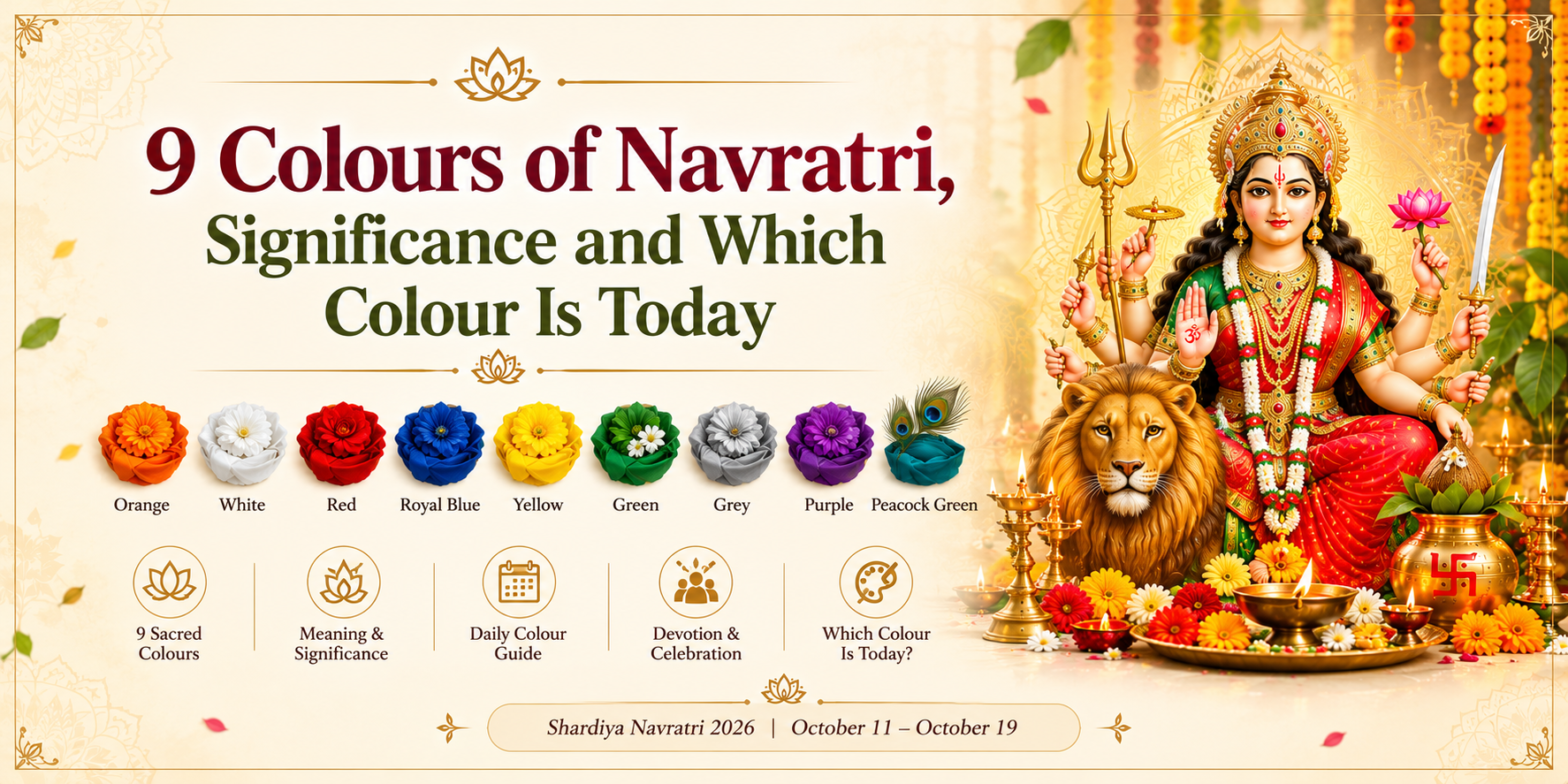
The 9 Navratri colours have become one of the most beloved parts of the festival — a way of participating that costs nothing, includes everyone, and turns an ordinary Tuesday into something visibly festive. Here is the full 2026 list, what each colour means, and how the sequence is actually decided.
Navratri Colours for Nine Days 2026
| Day | Date | Colour | Goddess |
| Day 1 | Sun, 11 Oct 2026 | Orange | Maa Shailputri |
| Day 2 | Mon, 12 Oct 2026 | White | Maa Brahmacharini |
| Day 3 | Tue, 13 Oct 2026 | Red | Maa Chandraghanta |
| Day 4 | Wed, 14 Oct 2026 | Royal Blue | Maa Kushmanda |
| Day 5 | Thu, 15 Oct 2026 | Yellow | Maa Skandamata |
| Day 6 | Fri, 16 Oct 2026 | Green | Maa Katyayani |
| Day 7 | Sat, 17 Oct 2026 | Grey | Maa Kalaratri |
| Day 8 | Sun, 18 Oct 2026 | Purple | Maa Mahagauri |
| Day 9 | Mon, 19 Oct 2026 | Peacock Green | Maa Siddhidatri |
Which Navratri Colour Is Today?
Today is 18 September 2026, and Navratri 2026 has not yet begun — Day 1 falls on 11 October. When the festival starts, the colour of the day is simply the colour matched to that date in the table above. Bookmark this page and you will have the answer every morning of the festival without hunting through forwards.
How the Navratri Colour Sequence Is Decided
This is the part most people never learn, and it explains why last year’s list will not work this year.
The colour sequence is tied to the weekdays of the festival, not to the goddesses. Each day of the week has a traditional colour association in Indian astrology, drawn from its ruling planet — Sunday belongs to the Sun and takes warm orange and red tones, Monday belongs to the Moon and takes white, Tuesday belongs to Mars and takes red, and so on down the week.
Because Navratri begins on a different weekday each year, the entire nine-colour sequence rotates. In 2026 Navratri opens on a Sunday, which is why the sequence begins with orange. A year when it opens on a Wednesday will produce a completely different list.
This is also why you will occasionally see two slightly different colour lists circulating for the same year. The practice was popularised in the 2000s largely through Maharashtra’s newspapers and women’s groups, and different publications have made marginally different calls ever since. All of them are legitimate. Pick one list and stay consistent within your family or office, and you will be fine.
Worth saying plainly: wearing the colour of the day is a joyful modern custom, not a scriptural requirement. No puja is diminished because you wore the wrong shade. The colours are an invitation to participate, not a rule to be anxious about.
Navratri Colours and Significance: What Each One Means
Day 1 — Orange
Orange is the colour of the rising sun and of sannyasa, of energy that is warm rather than harsh. It opens the festival with enthusiasm and optimism. Paired with Maa Shailputri, the daughter of the mountains, it sets a tone of grounded, patient strength — the kind of energy you can sustain for nine days rather than burn through in one.
Day 2 — White
White is purity, peace and simplicity — the absence of everything unnecessary. It belongs to Maa Brahmacharini, the goddess of penance and disciplined devotion, who performed austerities for thousands of years wearing nothing but plain cloth. White is the colour of stripping away, and it is no accident that it falls on the day dedicated to the ascetic form of the goddess.
Day 3 — Red
Red is the most auspicious colour in Hindu practice — the colour of the chunri offered at the shrine, of sindoor, of the bridal saree. It signifies passion, vitality, courage and raw life force. It belongs to Maa Chandraghanta, who wears the crescent moon shaped like a bell on her forehead and rides into battle on a tiger. On this day, red is worn for fearlessness.
Day 4 — Royal Blue
Royal blue carries depth, calm and a certain quiet richness. It is the colour of both the deep ocean and the open sky — the two things in nature most suggestive of infinity. It belongs to Maa Kushmanda, who is said to have created the universe with a single smile, and whose energy is the source of the sun’s own light. Blue is the vastness she brought into being.
Day 5 — Yellow
Yellow is brightness, warmth and uncomplicated happiness — the colour of turmeric, of marigolds, of a good day. It belongs to Maa Skandamata, the mother of Kartikeya, who is depicted holding her infant son on her lap. Yellow is the colour of maternal warmth: protective, cheerful and steady.
Day 6 — Green
Green is growth, fertility and new beginnings — the colour of the earth after rain, and of the barley shoots that have by now sprouted in the kalash bowl. It belongs to Maa Katyayani, the warrior form born specifically to destroy Mahishasura. Green here is not passive: it is the growth that comes after the ground has been cleared by force.
Day 7 — Grey
Grey is the most unusual colour on the list, and the most fitting. It is the colour of ash, of storm clouds, of the moment before something breaks. It belongs to Maa Kalaratri — the darkest, fiercest form of the goddess, who destroys ignorance and negativity without hesitation. Grey signifies the transformation of darkness itself: not avoiding the difficult night, but passing through it.
Day 8 — Purple
Purple signifies dignity, grandeur and spiritual ambition. It belongs to Maa Mahagauri, the luminously white and utterly serene form who appears immediately after the storm of Kalaratri. Day 8 is Durga Ashtami, one of the most significant days of the festival, and purple carries the weight the day deserves.
Day 9 — Peacock Green
Peacock green — that shifting blue-green with a sheen to it — signifies individuality, compassion and freshness. It belongs to Maa Siddhidatri, the giver of perfection and the final form of the Navadurga. It closes the nine days on a note of completion and quiet beauty, which is exactly the right place to end.
Making the Colours Work for You
You do not need nine new outfits. A dupatta, a kurta already in the cupboard, a bangle, a bindi, a pocket square, even the colour of the flowers you place at the shrine — any of these count. Offices and housing societies often coordinate a single garment so the whole group photographs well. Families sometimes match the day’s bhog and the rangoli to the colour instead of the clothes.
The point was never the fabric. It is that for nine days, an ordinary weekday morning carries a small reminder of which goddess you are with today.
At poojas.in, you can book verified pandits and complete puja samagri for all nine days of Navratri 2026 — so the rituals are taken care of, and you can give your attention to the celebration.