

 5 September 2026
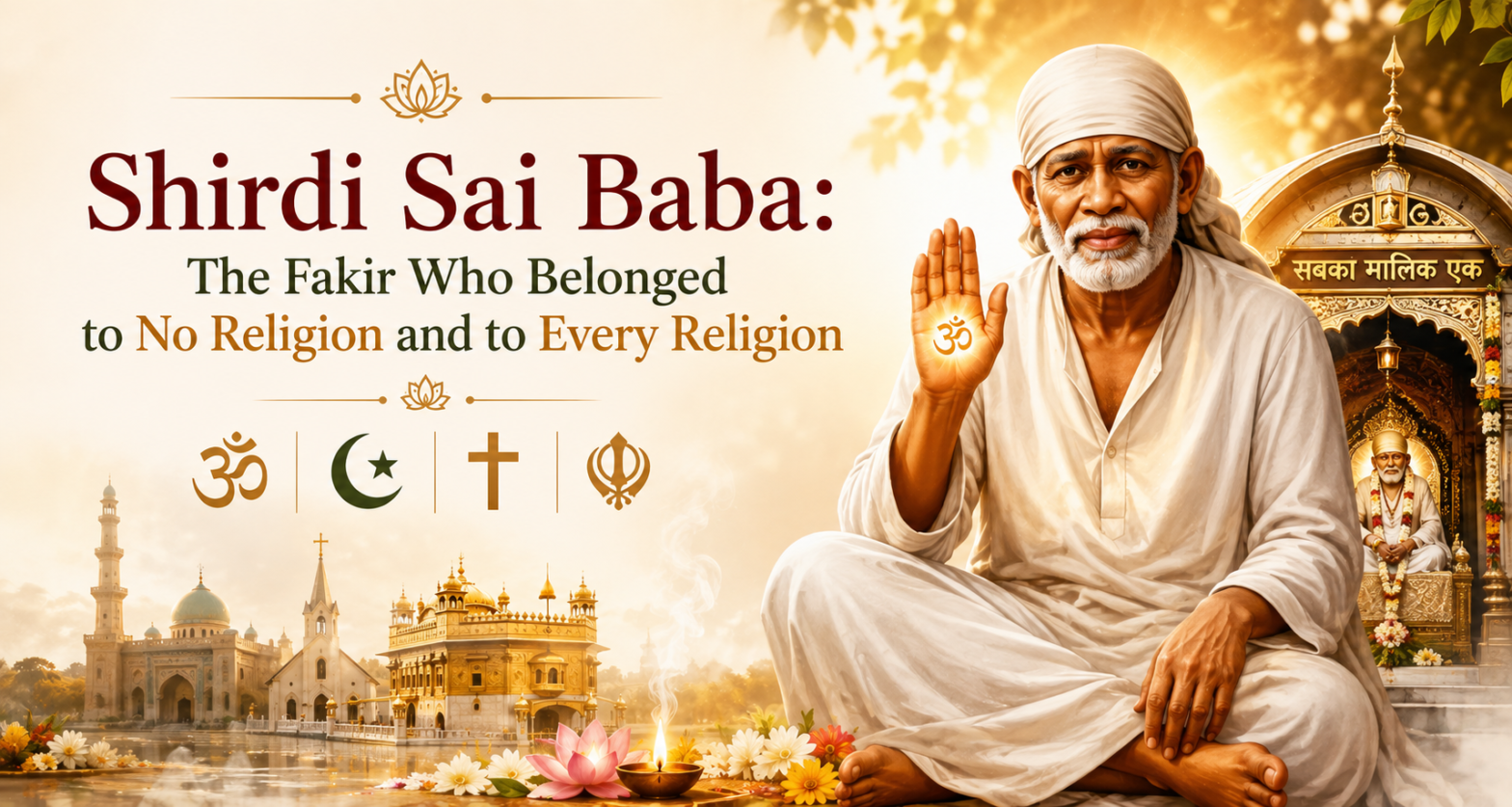
A teenage boy walks into a small, sleepy village in Maharashtra, sits down under a neem tree, and says nothing about who he is, where he was born, or which god he worships. No name, no caste, no hometown. When people pressed him for answers he redirected them every time. Lineage is temporary, he would say. The soul is not. That boy became Shirdi Sai Baba, a man whom both Hindus and Muslims would come to call their own, and whose message has outlived him by more than a century: Sabka Malik Ek, one God governs all.
The Arrival Nobody Could Explain
Sai Baba’s early life remains genuinely mysterious even to historians. Most accounts place his birth around 1838, but no verified record of his birthplace or parentage exists. He is believed to have first appeared in Shirdi in his mid teens, sometime around 1854, spent a few years there, and then vanished, only to return permanently around 1858 as part of a village headman’s wedding procession.
The story goes that a man named Chand Patil was searching for his lost mare when he came upon a young fakir under a tree, who calmly told him where to find it. Grateful, Chand Patil brought the young ascetic along to a family wedding in Shirdi. When the procession reached a banyan tree near the old Khandoba temple, the temple’s caretaker, Mhalsapati, looked at the young stranger stepping down and instinctively called out, Aao, Sai. Welcome, Sai. The name stayed. From that day he was Sai Baba, and he would not leave Shirdi again for the next sixty years.
Dwarkamai, the Abode That Bridged Two Faiths
Sai Baba took up residence in a crumbling, abandoned mosque and renamed it Dwarkamai, fusing Dwarka, the holy city of Lord Krishna, onto a Sufi dwelling in a single word. It became his home for the rest of his life, a place where he kept a sacred dhuni, a fire, burning continuously day and night, and where Hindus and Muslims sat side by side without division. The ash from that fire, called Udi, is still distributed to devotees today and is believed to carry healing and protective power.
The Night the Lamps Burned on Water
One of his earliest and most famous miracles happened in Dwarkamai itself. Sai Baba lit earthen lamps each night, relying on oil donated by the local grocers. One evening the grocers, tired of the daily requests, refused him and claimed they had no oil left. Sai Baba returned to Dwarkamai anyway with an empty tin. He poured a small quantity of water into it, drank a sip as though it were a sacred offering, then poured the rest into the lamps and lit them one by one.
The lamps burned all night on water. The grocers who had refused him, and the villagers who had come expecting him to fail, stayed to watch and were humbled. It was one of the first moments when Shirdi stopped seeing him as a mad fakir and began to see him as something else entirely.
The Healer of the Untreatable
His compassion appeared as often as his miracles. During a cholera outbreak in Shirdi villagers came to him in desperation. He washed his hands, ground a small quantity of wheat by hand, and instructed the villagers to scatter the flour along the boundary of the village, and the outbreak is reported to have subsided soon afterwards. In another widely told account, a man left bedridden by severe paralysis after years of failed treatment came to him. Sai Baba applied Udi to his body and told him simply to have faith, and within days the man stood and walked again.
Through all of it his teaching stayed remarkably simple: Shraddha and Saburi, faith and patience. He asked his devotees for nothing more than these two things, and told them repeatedly, why fear when I am here, place all your burdens on me and I shall bear them.
The Day He Chose to Leave
In 1916, two years before his death, Sai Baba gave the village its first hint. During the Vijayadashami celebrations he tore off his headdress and kafni, stood before the dhuni, and demanded that the crowd decide once and for all whether he was Hindu or Muslim. It was a moment of raw and deliberate provocation that devotees later understood as his refusal, right to the end, to be confined within a single identity.
On 15 October 1918, once again Vijayadashami, the festival marking the victory of good over evil, Sai Baba, weakened by fever, asked to be moved to the nearby Buti Wada. He leaned into the lap of his devotee Bayyaji Patil and quietly left his body at around half past two in the afternoon. Devotees who were present said that his body remained warm and flexible for hours afterwards, which many read as a final sign of his yogic mastery even in death.
That Buti Wada, originally built by a wealthy devotee named Bapusaheb Buty as a Krishna temple, became his resting place. Sai Baba had once told Buty, almost in passing, that he would sleep in his wada. It turned out to be a prophecy. Today that building is the Samadhi Mandir of Shirdi, drawing millions of pilgrims every year regardless of which god, or which religion, they came praying to.
Why He Still Matters
No throne, no possessions, and no institution behind him. A man who lived his entire adult life inside a crumbling mosque, begging for food from five homes a day and sharing whatever he received, and who still built a spiritual movement that today spans temples across the world more than a century after his death. His enduring instruction was never complicated: love everyone, help everyone, and remember that the God everyone is praying to is, in the end, the same one.