
 24 July 2026
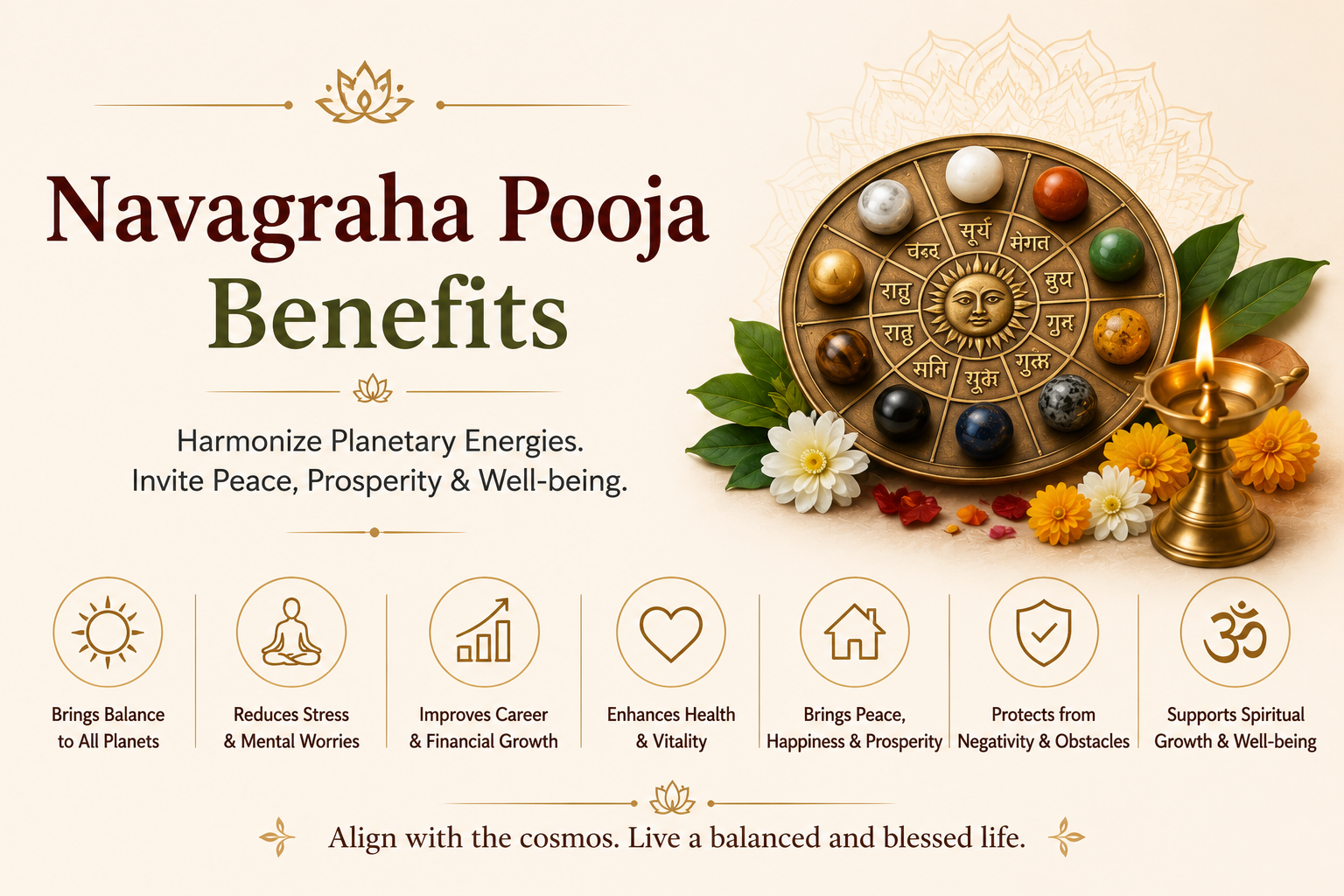
Navagraha pooja benefits include relief from planetary doshas in the horoscope, stability in career and finances, harmony in marriage and family life, better health and mental peace, success in education, and smoother dasha transitions, all achieved by pacifying the nine grahas that Vedic astrology holds responsible for the ups and downs of human life. Because it addresses all nine planets in a single ritual, the Navagraha pooja is often the first remedy astrologers prescribe when multiple areas of life are disturbed at once. This guide from Poojas.in covers the complete Navagraha pooja benefits, the items required, the correct navagraha positions in pooja, the best days to perform it, what is possible at home, and how the cost is determined.
What Is Navagraha Pooja?
The Navagraha pooja is the combined worship of the nine celestial influencers of Vedic astrology: Surya (Sun), Chandra (Moon), Mangala (Mars), Budha (Mercury), Guru (Jupiter), Shukra (Venus), Shani (Saturn), Rahu, and Ketu. Each graha governs specific areas of life, and each occupies a specific position in your birth chart. When a graha is weak, afflicted, or unfavourably placed, its significations suffer: an afflicted Guru disturbs education and wisdom, a weak Shukra troubles marriage and comforts, an unfavourable Shani brings delay and hardship.
Rather than pacifying one planet at a time, the Navagraha pooja invokes all nine together through their individual mantras, offerings, and rituals, strengthening the benefics and pacifying the malefics in one coordinated remedy. For a deeper introduction to the ritual itself, see our guide on Navagraha Shanti Pooja.
Navagraha Pooja Benefits: What Each Pacified Graha Gives You
The full span of Navagraha pooja benefits becomes clear when you see what each graha governs, because pacifying that graha directly supports its domain:
- Surya: health, vitality, authority, career recognition, and relationship with father and superiors
- Chandra: mental peace, emotional stability, intuition, and relationship with mother
- Mangala: courage, energy, property matters, and relief from Mangal Dosha affecting marriage
- Budha: intelligence, communication, business acumen, and success in trade and negotiation
- Guru: education, wisdom, wealth, progeny, and marriage prospects
- Shukra: married life, love, comforts, luxury, and artistic success
- Shani: discipline, longevity, career stability, and relief from Sade Sati and Shani Dasha hardships
- Rahu: worldly ambition steadied, confusion and sudden losses removed
- Ketu: spiritual growth, intuition, and freedom from unexplained fears and detachment
Taken together, the traditional Navagraha pooja benefits are:
- Relief from graha doshas: the pooja is the standard remedy for combined afflictions, from Mangal Dosha to Kaal Sarpa Dosha to a generally weak chart
- Career and financial stability: when several grahas are pacified together, stalled work, financial leakage, and repeated obstacles ease across the board
- Marriage and family harmony: Guru, Shukra, and Mangala together govern matrimony, and the pooja is regularly prescribed for delayed marriage and domestic discord
- Health and mental peace: Surya and Chandra pacification supports vitality and calms mental restlessness, one of the most immediately felt Navagraha pooja benefits
- Smoother dasha and transit periods: performed before or during a difficult Mahadasha, Sade Sati, or a major transit, the pooja softens what the period brings
- Auspicious beginnings: the pooja is traditionally performed before griha pravesh, marriage, business launches, and other major beginnings, so that no graha obstructs the new chapter
Navagraha Pooja Items: The Complete List
The Navagraha pooja items reflect a beautiful principle: each graha has its own grain, its own colour, and its own offerings. The core items are:
Navadhanya (the nine grains), one for each graha:
| Graha | Grain |
| Surya | Wheat |
| Chandra | Raw rice |
| Mangala | Toor dal (red gram) |
| Budha | Moong (green gram) |
| Guru | Chana dal (Bengal gram) |
| Shukra | White beans (mochai) |
| Shani | Black sesame (til) |
| Rahu | Urad (black gram) |
| Ketu | Horse gram (kollu) |
Nine cloths in the nine graha colours: red for Surya and Mangala, white for Chandra and Shukra, green for Budha, yellow for Guru, black for Shani, blue-black for Rahu, and smoke-grey or multicolour for Ketu.
Other items: kalash with water, turmeric, kumkum, sandalwood paste, betel leaves and nuts, camphor, incense, ghee lamp (with a sesame oil lamp for Shani), flowers of the appropriate colours, fruits, coconut, and naivedyam. For a Navagraha homam, samidha (sacred wood), ghee, and havan materials are added. When you book the pooja through a temple or through Poojas.in, all items are arranged by the priests, so this list matters mainly for devotees performing simple worship at home.
Navagraha Positions in Pooja: The Correct Arrangement
The navagraha positions in pooja follow a precise geometry that you will recognise from every Navagraha shrine in a South Indian temple. Surya is installed at the centre, and the other eight grahas surround him in the eight directions:
- Centre: Surya
- East: Shukra
- Southeast: Chandra
- South: Mangala
- Southwest: Rahu
- West: Shani
- Northwest: Ketu
- North: Guru
- Northeast: Budha
One rule governs the entire arrangement: no two grahas face each other. Each is oriented so that its gaze does not fall directly upon another, reflecting the astrological principle that the grahas’ mutual aspects must not clash within the sacred arrangement. In pooja performed with kalash or grain heaps rather than idols, the same directional positions are recreated with the navadhanya, each graha’s grain placed in its own direction around Surya’s wheat at the centre. Arrangement conventions can vary slightly between Vaidika and Agama traditions, which is one more reason the full ritual is best left to trained priests.
Which Day Is Good for Navagraha Pooja?
Sunday, the day of Surya who sits at the centre of the nine, is traditionally considered the best day for Navagraha pooja. Beyond Sundays, the right day depends on your purpose:
- Saturday is preferred when Shani is the main affliction, such as during Sade Sati
- The specific graha’s weekday is chosen when one planet dominates the problem: Tuesday for Mangala, Wednesday for Budha, Thursday for Guru, Friday for Shukra, Monday for Chandra
- Amavasya, eclipses, and dasha transitions are potent windows, especially when Rahu and Ketu are involved
- Before major beginnings, the pooja is simply scheduled a few days ahead of the event, on the nearest auspicious muhurta
If your horoscope shows a specific affliction, the priest or astrologer will fix the day and muhurta accordingly rather than defaulting to Sunday.
Navagraha Pooja at Home: What You Can Do
A meaningful Navagraha pooja at home is possible at the devotional level:
- Place a Navagraha yantra or picture in your pooja space, or arrange small heaps of the navadhanya in the directional positions described above
- Light a ghee lamp, and a sesame oil lamp on Saturdays
- Chant the Navagraha stotra of Vyasa (Japa kusuma sankasham…) or each graha’s beeja mantra, traditionally 108 times for the graha troubling you
- Offer the appropriate grain, flower, and naivedyam for that graha on its weekday
- Donate the graha’s grain and cloth colour to the needy on its day, a remedy tradition holds equal to worship
What home practice cannot replicate is the full Navagraha shanti with its prescribed japa counts, homam, and danam performed by qualified priests, which is what astrologers actually prescribe for significant doshas. Home worship maintains the connection; the priest-performed pooja delivers the remedy. If you are unsure which your situation calls for, consult Dr. Mekhala V Jois at Poojas.in before deciding.
Navagraha Pooja Cost: How the Price Is Determined
There is no single Navagraha pooja cost, and understanding why protects you from both overpaying and under-remedying. The price varies with exactly four factors: the scale of mantra japa (a simple archana for nine grahas versus thousands of repetitions per graha), whether homam and danam are included, the seniority and tradition of the priests engaged, and the temple where the ritual is performed. A basic Navagraha archana may cost a few hundred rupees at a local temple, while a complete Navagraha shanti with japa, homam, and danam by senior priests runs into several thousands or more.
This is why two Navagraha poojas with the same name can carry very different prices, and neither is wrong; they are different scales of the same remedy. The right scale depends on the severity of the dosha in your chart. Share your horoscope with the Poojas.in team, and we will tell you plainly what your situation needs and what it will cost before you commit.
Frequently Asked Questions About Navagraha Pooja Benefits
What are the main Navagraha pooja benefits?
The main Navagraha pooja benefits are relief from planetary doshas, career and financial stability, harmony in marriage and family life, improved health and mental peace, success in education, smoother dasha and Sade Sati periods, and unobstructed beginnings for new ventures, homes, and marriages.
Which day is good for Navagraha pooja?
Sunday is the traditional best day, since Surya presides at the centre of the nine grahas. When one specific graha is afflicted, its own weekday is chosen instead, and Amavasya, eclipse days, and dasha transitions are also considered potent windows.
What items are needed for Navagraha pooja?
The core Navagraha pooja items are the navadhanya (nine grains, one per graha), nine cloths in the graha colours, kalash, turmeric, kumkum, betel leaves, flowers, fruits, coconut, ghee and sesame oil lamps, and havan materials if a homam is included. Priests arrange all items when the pooja is booked through a temple or Poojas.in.
What are the correct navagraha positions in pooja?
Surya sits at the centre, surrounded by Shukra in the east, Chandra in the southeast, Mangala in the south, Rahu in the southwest, Shani in the west, Ketu in the northwest, Guru in the north, and Budha in the northeast, arranged so that no two grahas face each other.
Can I do Navagraha pooja at home?
Yes, at the devotional level: navadhanya arrangement, lamps, the Navagraha stotra, graha-day offerings, and danam. The complete Navagraha shanti with prescribed japa and homam requires qualified priests. Home practice supports the remedy rather than replacing it.
What is the Navagraha pooja cost?
The cost depends on the japa scale, whether homam and danam are included, the priests’ seniority and tradition, and the temple. Simple archanas cost a few hundred rupees, while complete shanti rituals run into several thousands. Poojas.in will recommend the right scale for your chart before you book.
Is Navagraha pooja enough for Rahu Ketu problems?
For general nodal weakness, the Navagraha pooja covers Rahu and Ketu within the nine. For a pronounced affliction such as Kaal Sarpa Dosha or a difficult Rahu Mahadasha, a dedicated Rahu Ketu shanti pooja is usually prescribed in addition. A horoscope review will confirm which applies to you.
Set All Nine in Your Favour
Few remedies cover as much ground in one ritual as this, which is exactly why the Navagraha pooja benefits reach into career, marriage, health, wealth, and peace of mind at once. If life feels obstructed from several directions at the same time, the nine grahas are the traditional place to look first. Share your birth details with Poojas.in or consult Dr. Mekhala V Jois, and have the Navagraha pooja performed at the right scale, on the right day, in your name.