

 17 November 2026
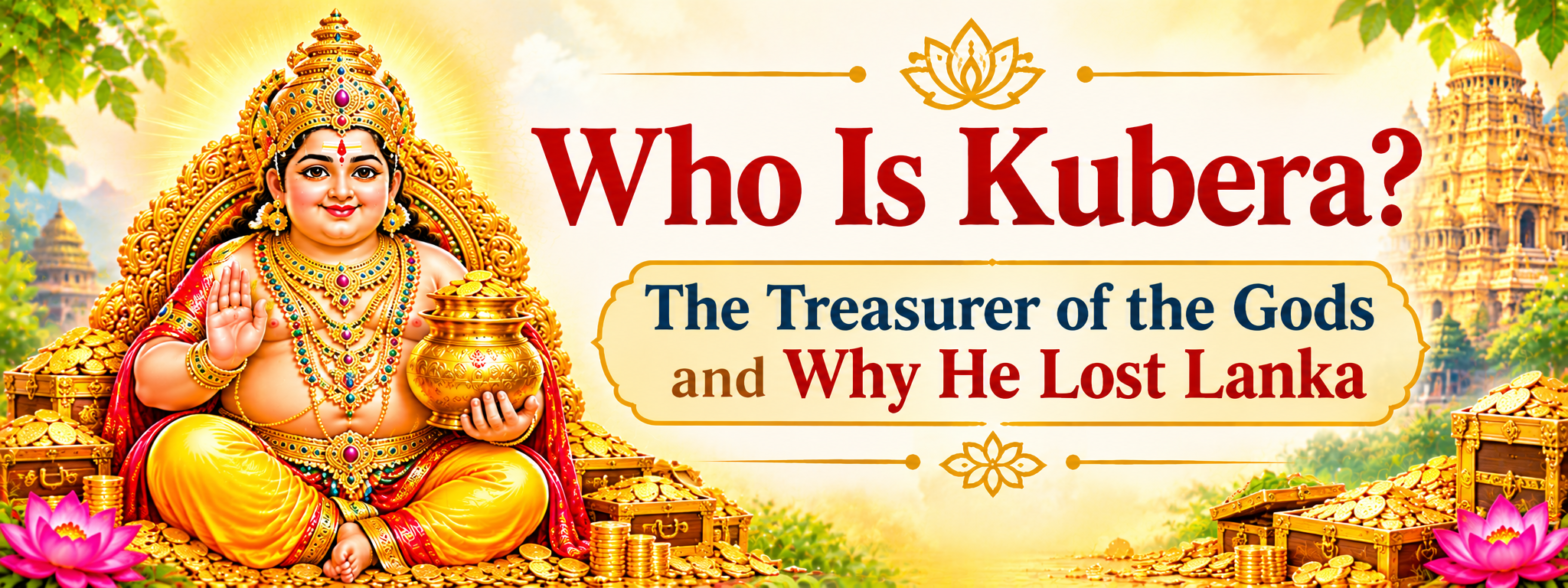
Kubera is the treasurer of the gods in the Vedic tradition, lord of the yakshas, and guardian of the northern direction. He is the son of sage Vishrava, which gives him the name Vaishravana, and he is the elder half-brother of Ravana, who drove him out of Lanka and seized his flying chariot. Kubera then established his city at Alakapuri in the Himalayas, near Mount Kailash, where he remains as custodian of the wealth of the three worlds.
Last reviewed: November 2026
Who Is Kubera in Hinduism?
Kubera holds a specific office rather than a general status. He is Dhanapati, the lord of wealth, but the emphasis in the tradition is on his role as custodian and treasurer. He guards and distributes the wealth of the worlds. He does not originate it.
He is also Yaksharaja, king of the yakshas, the nature spirits who guard hidden treasures within the earth, and one of the Ashta Dikpalas, the eight guardians of the directions, holding the north.
Kubera and Ravana: The Family Story
This is the part of Kubera’s story most people do not know, and it explains how he came to be where he is.
Kubera was born to the sage Vishrava and Ilavida, which gives him the patronymic Vaishravana, son of Vishrava. Vishrava later married Kaikesi, and their children were Ravana, Kumbhakarna, Vibhishana and Surpanakha. Kubera is therefore the elder half-brother of Ravana.
Through severe penance, Kubera obtained the lordship of wealth and the city of Lanka, where he ruled. Ravana, having performed his own formidable penance and grown in power, drove his half-brother out and took Lanka for himself, seizing also the Pushpaka Vimana, Kubera’s flying chariot. The Pushpaka appears again at the end of the Ramayana, when Rama uses it to return to Ayodhya after Ravana’s defeat.
Displaced, Kubera moved north and established Alakapuri, also called Alaka, in the Himalayas near Mount Kailash, in the company of Shiva. There is a quiet lesson the tradition draws from this: the custodian of all the wealth in the three worlds was himself dispossessed, and what he kept was his office, not his property.
Why Kubera Is Associated With Shiva
Kubera’s relationship with Shiva runs throughout his story. He is described as a devotee and friend of Shiva, and Alakapuri was established in Shiva’s vicinity on Mount Kailash. Several accounts attribute Kubera’s attainment of his position to Shiva’s grace following his penance.
This association explains a practice many people find puzzling: why Kubera, a deity of wealth, is worshipped at Shaiva temples and invoked alongside Shiva rather than only alongside Lakshmi.
The Loan That Is Still Being Repaid at Tirumala
Of all the accounts attached to Kubera, this is the one with the largest living consequence, and most devotees who participate in it every day do not know they are doing so.
When Lord Vishnu descended as Srinivasa and wished to marry Padmavati, the daughter of Akasha Raja, the wedding required resources beyond what he had. He borrowed from Kubera, the treasurer of the gods, undertaking to repay the debt with interest, and tradition holds that the repayment would continue until the end of Kali Yuga. Having given that undertaking, he remained at Tirumala as Venkateswara, and he remains there still.
This is the belief behind the hundi at Tirumala. Devotees who place an offering there are not making a donation in the ordinary sense. They are contributing toward the repayment of the Lord’s debt to Kubera, on his behalf. It is understood as participation rather than charity, which is why the giving at Tirumala has the character it does.
The scale is worth pausing on. The Tirumala hundi collection was reported at an average of around 4.6 crore rupees a day in 2022, with monthly figures crossing 140 crore, and the temple’s annual hundi budget estimated at roughly 1,000 crore rupees. That is what is being offered toward a debt, every single day, century after century.
Now consider what the story implies about the lender. If the repayment alone runs at that scale and has not yet concluded, the wealth Kubera was able to advance is beyond any ordinary reckoning. Devotees across India pray to Balaji for relief from financial difficulty, and the tradition quietly places Kubera behind him as the one who made that wedding possible in the first place. It is the clearest statement the tradition makes about Kubera’s standing as custodian of the wealth of the three worlds.
How Kubera Is Depicted, and Why
Kubera’s iconography is unusual and every element of it carries meaning.
- Dwarfish and pot-bellied, representing abundance and plenty rather than physical ideal
- Seated, often on a lotus or a chariot, in the posture of one who holds rather than one who travels
- Holding a mace and a money pot, the guardian’s weapon and the treasurer’s vessel
- Accompanied by a mongoose, which is the detail worth knowing
The mongoose, or nakula, is depicted vomiting jewels. The tradition gives two readings. The mongoose is the natural enemy of the serpent, and serpents are the guardians of hidden wealth within the earth, so the mongoose represents the release of wealth that lies locked away. The jewels it disgorges represent wealth that flows out rather than being hoarded, which is the point the image is making: the treasurer’s function is to distribute, not to accumulate.
The Names of Kubera
| Name | Meaning |
| Vaishravana | Son of Vishrava |
| Dhanapati | Lord of wealth |
| Dhanada | Giver of wealth |
| Yaksharaja | King of the yakshas |
| Vittesha | Lord of treasure |
| Rajaraja | King of kings |
| Nara-raja | Lord of men |
| Guhyakadhipa | Lord of the guhyakas, keepers of hidden wealth |
Kubera and Lakshmi: The Distinction That Matters
Both are deities of wealth, and they are not interchangeable.
Lakshmi is wealth itself, prosperity in its living form, the goddess whose presence constitutes abundance. Kubera is the treasurer who holds, guards and distributes what exists. One is the wealth. The other is the custodian of it.
This is why Diwali Lakshmi Puja invokes both, and why wealth practice in the tradition generally addresses the two together. A common practitioner’s reading: Lakshmi worship concerns the arrival of wealth, Kubera worship concerns its retention. Someone earning adequately who cannot hold on to anything is pointed toward Kubera.
Kubera in Vastu: Why North Is the Wealth Direction
As guardian of the north among the Ashta Dikpalas, Kubera gives the direction its association with wealth. This is the origin of several familiar Vastu prescriptions: the safe or cash box placed in the north, the north-east kept clear and uncluttered, and japa to Kubera performed facing north.
The Kubera yantra, where kept, is traditionally placed in the north of the home or in the puja space, facing south so the devotee faces north while worshipping.
When Kubera Is Worshipped
- Dhanteras, the most significant day of the year for Kubera worship, when the puja and japa count are both raised
- Diwali Lakshmi Puja, where Kubera is invoked alongside Lakshmi and Ganesha
- Thursdays and Fridays, the weekdays associated with wealth and with Lakshmi
- Akshaya Tritiya, traditionally favourable for beginning any wealth practice
- Before a significant financial undertaking, such as a business launch or property purchase
Frequently Asked Questions
Who is Kubera?
Kubera is the treasurer of the gods in the Vedic tradition, lord of the yakshas and guardian of the northern direction. He is the son of sage Vishrava, hence Vaishravana, and the elder half-brother of Ravana. He rules from Alakapuri in the Himalayas near Mount Kailash.
Is Kubera the brother of Ravana?
Yes, his elder half-brother. Both are sons of the sage Vishrava, Kubera by Ilavida and Ravana by Kaikesi. Ravana drove Kubera out of Lanka and seized his flying chariot, the Pushpaka Vimana.
What is the difference between Kubera and Lakshmi?
Lakshmi is wealth itself, prosperity in its living form. Kubera is the treasurer who holds, guards and distributes wealth. Lakshmi worship concerns the arrival of wealth and Kubera worship concerns its retention, which is why both are invoked in Diwali Lakshmi Puja.
Why is Kubera shown with a mongoose?
The mongoose is the natural enemy of the serpent, and serpents guard hidden wealth within the earth, so it represents the release of locked-away wealth. It is depicted vomiting jewels, signifying wealth that flows out rather than being hoarded, which reflects the treasurer’s function of distribution.
Which direction does Kubera govern?
North. He is one of the Ashta Dikpalas, the eight guardians of the directions, and holds the north. This is why north is called the wealth direction in Vastu and why Kubera japa is performed facing north.
Where does Kubera live?
At Alakapuri, also called Alaka, in the Himalayas near Mount Kailash. He established it after Ravana drove him from Lanka, settling in the vicinity of Shiva, whose devotee and friend he is described as being.
Did Lord Venkateswara borrow money from Kubera?
According to tradition, yes. Srinivasa borrowed from Kubera to meet the expenses of his marriage to Padmavati, undertaking to repay with interest until the end of Kali Yuga. Offerings placed in the hundi at Tirumala are understood by devotees as contributing toward the repayment of that debt on the Lord’s behalf.
Why is Kubera worshipped on Dhanteras?
Dhanteras is the day dedicated to wealth and health at the opening of the Diwali festival, and Kubera as treasurer of the gods is invoked alongside Lakshmi and Dhanvantari in the Dhantrayodashi puja. The Kubera mantra count is traditionally raised to 1008 on this day.
Taking the Worship Further
Knowing who Kubera is naturally leads to the question of how he is approached. Kubera japa, the disciplined repetition of his mantra, is the practice most householders take up, and it rests entirely on correct pronunciation and sustained method.
The Mantra and Shloka Chanting course at Poojas.in covers Sanskrit pronunciation, mantras for different purposes, chanting technique and daily practice structure. Find it at courses.poojas.in/courses.