

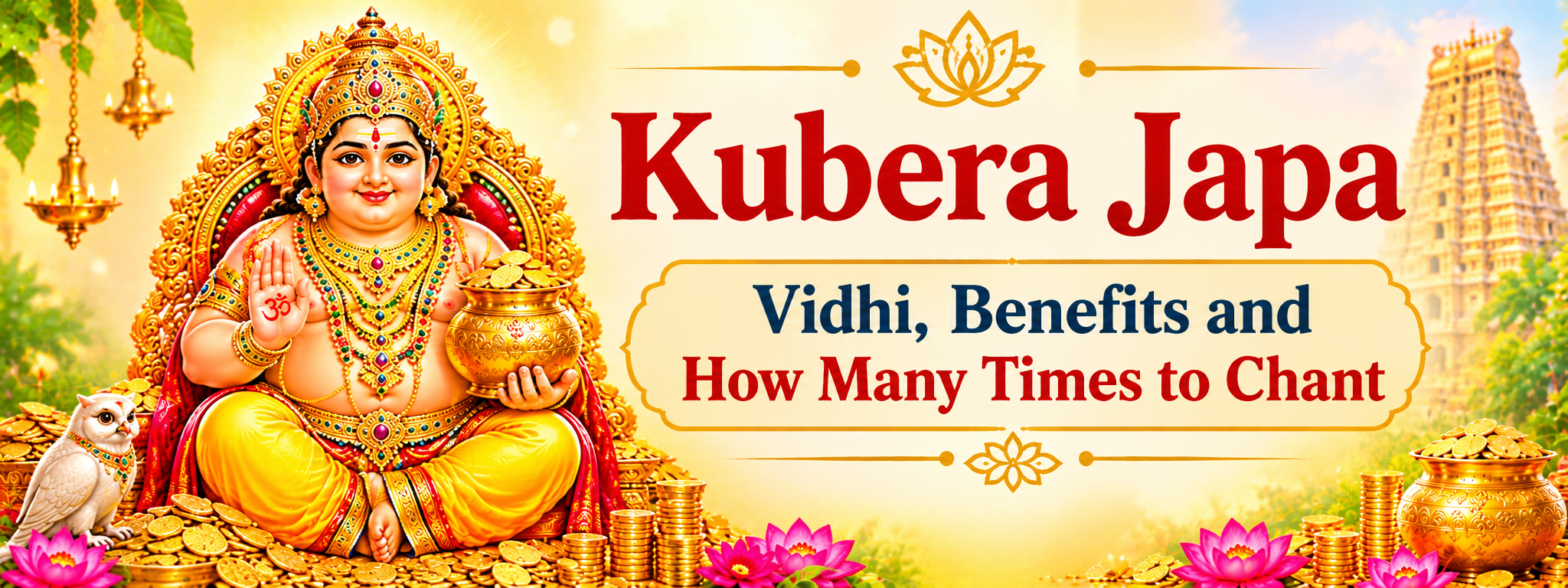
 16 November 2026
Kubera japa is the disciplined repetition of a Kubera mantra, most commonly the moola mantra, performed 108 times daily facing north, usually begun on a Thursday or on Dhanteras and sustained for a fixed period declared at the outset. It is undertaken for stability of income, clearance of debt, business growth and the removal of obstruction in matters of wealth. This guide gives the complete vidhi, the counts, the duration, and what the practice traditionally addresses.
Last reviewed: November 2026
What Is Kubera Japa?
Japa is the repetition of a mantra with a fixed count, held as a continuous practice rather than a single act. Kubera japa applies this to the mantras of Kubera, the treasurer of the gods and lord of the yakshas, who is the custodian of wealth in the Vedic tradition.
The distinction between japa and a one-time puja matters. A puja is performed on an occasion. Japa is a discipline held across days or months, and the tradition attributes its effect to the consistency rather than to any single sitting.
Kubera Japa Vidhi: Step by Step
Step 1: Choose the day to begin
Thursdays are the usual choice, being associated with wealth and with Guru. Fridays, associated with Lakshmi, are also favoured. Dhanteras is the most auspicious day of the year to begin, and Akshaya Tritiya is traditionally favourable for commencing any wealth practice.
Step 2: Prepare the space
Clean the area and set it in the north of the room, the direction Kubera governs. Place an image of Kubera, or a Kubera yantra where one is kept, facing south so that you face north while seated. Many households place Lakshmi alongside, since the two are worshipped together.
Step 3: Bathe and take your seat
Bathe before the practice and wear clean clothes. Sit on an asana of wool or kusha grass rather than directly on the floor. Light a ghee lamp and incense.
Step 4: Invoke Ganesha
As with every undertaking in the tradition, begin with Lord Ganesha, chanting Om Gan Ganapataye Namah before proceeding.
Step 5: Take the sankalpa
This is the step most often skipped and the one that defines the practice. Take water in your right hand, state your name, gotra and nakshatra, declare the mantra you will chant, the daily count, and the number of days you commit to, and release the water. A japa without a sankalpa is recitation. A japa with one is a vow.
Step 6: Perform the japa
Chant the Kubera moola mantra 108 times using a mala, keeping the count rather than estimating it:
Om Yakshaya Kuberaya Vaishravanaya Dhanadhanyadhipataye Dhanadhanyasamriddhim Me Dehi Dapaya Svaha
Chant aloud or in a murmur. Do not cross the meru, the head bead of the mala, when turning for a second round; reverse direction instead.
Step 7: Offer naivedyam and close
Offer a simple naivedyam, traditionally something sweet, along with the lamp and incense. Conclude by dedicating the merit of the practice rather than claiming it, which is the traditional closing of any japa.
How Many Times to Chant
| Practice | Count | Duration |
| Daily practice | 108 times | Ongoing |
| Fixed vow (standard) | 108 daily | 41 days, or one mandala |
| Dhanteras | 1008 times | Single day |
| Intensive vow | 1,25,000 total | Completed over a declared period |
| Business mantra | 21 times | Before significant dealings |
The 41 day mandala is the most commonly kept form for a householder. It is long enough to establish the discipline and short enough to complete without the vow lapsing, which matters because an abandoned sankalpa is treated seriously in the tradition.
What Kubera Japa Is Traditionally Undertaken For
- Stability of income, particularly where earnings are irregular
- Clearance of debt and relief from recurring financial obligation
- Growth in business and trade, and success in new ventures
- Removal of obstruction in matters of wealth, where effort is not translating into return
- Protection of accumulated wealth, Kubera being custodian rather than only giver
- Support before a significant financial undertaking, such as a property purchase or business launch
Kubera Japa and Lakshmi: Why Both
A question that comes up constantly, and the answer clarifies what Kubera japa actually does.
Lakshmi is wealth itself, the goddess who is prosperity in its living form. Kubera is the treasurer, the custodian who holds, guards and distributes what exists. The tradition treats these as distinct functions, which is why Diwali Lakshmi Puja includes Kubera and why wealth practice generally addresses both.
The practical reading many practitioners give is this: Lakshmi worship concerns the arrival of wealth, and Kubera worship concerns its retention and management. Someone whose income is adequate but who cannot hold on to it is traditionally pointed toward Kubera rather than Lakshmi alone.
A Note on Expectations
The tradition is clear that japa is a discipline, not a transaction. Kubera japa performed sincerely over a mandala is held to steady the conditions around wealth, and devotees who sustain it most often describe clarity in financial decisions and the easing of specific obstructions, rather than sudden gain.
Anyone promising a specific financial outcome from a japa is not describing the tradition accurately, and a practice undertaken with that expectation usually ends in disappointment.
Frequently Asked Questions
What is Kubera japa?
Kubera japa is the disciplined repetition of a Kubera mantra with a fixed count, most commonly 108 times daily facing north, held across a declared period rather than performed as a single act. It is undertaken for income stability, debt clearance, business growth and the removal of obstruction in wealth matters.
How many times should Kubera japa be done?
108 times daily is standard. A fixed vow is usually kept for 41 days, one mandala. On Dhanteras the count is raised to 1008, and an intensive vow may run to 1,25,000 repetitions over a declared period.
Which direction should Kubera japa be performed facing?
North, the direction Kubera governs as guardian among the Ashta Dikpalas. The image or yantra is placed facing south so that the practitioner faces north while seated.
Which day should Kubera japa begin?
Thursdays are the usual choice, with Fridays also favoured. Dhanteras is the most auspicious day of the year to begin, and Akshaya Tritiya is traditionally favourable for commencing any wealth practice.
What is the difference between Kubera japa and Lakshmi puja?
Lakshmi is wealth itself and her worship concerns its arrival. Kubera is the treasurer and custodian, and his worship concerns the holding, guarding and management of wealth. The two are complementary, which is why Diwali Lakshmi Puja includes Kubera.
Do I need a priest for Kubera japa?
No. Japa is a personal practice and has always been performed by the devotee. A priest is engaged for the more elaborate Kubera homa or for a formal puja, not for daily japa.
What happens if I miss a day during a 41 day vow?
The tradition treats a lapsed sankalpa seriously. The usual counsel is to offer a prayer of apology, resume, and complete the committed count rather than abandoning the vow. This is also why the daily count should be set at a level that can realistically be sustained.
Building the Practice Properly
Kubera japa is simple in structure and easy to perform badly. Pronunciation drifts, the count slips, the sankalpa is skipped, and what began as a vow becomes an occasional recitation.
The Mantra and Shloka Chanting course at Poojas.in covers Sanskrit pronunciation, chanting technique, mantra energetics and the structure of sustained daily practice, which is precisely what a japa vow requires. Find it at courses.poojas.in/courses.