

 12 November 2026
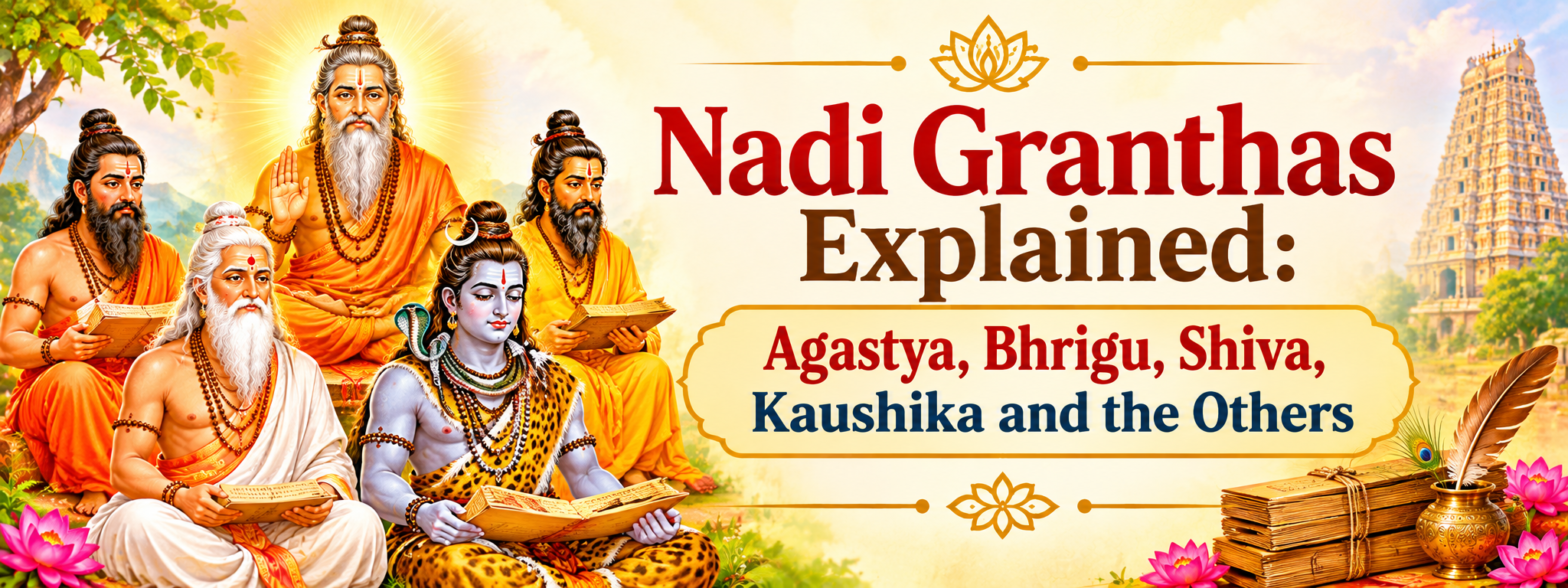
The Nadi granthas are collections of palm leaf manuscripts, each attributed to a different rishi, which are held to record the lives of individuals who would one day come to consult them. The best known are Agastya Nadi, Bhrigu Nadi, Shiva Nadi, Brahma Nadi and Kaushika Nadi, with several more preserved in smaller traditions. They differ in the sage credited, the region where the leaves are held, and the structure and emphasis of the reading. This guide explains each of the major granthas and what distinguishes them
What Is a Nadi Grantha?
Nadi means a channel or flow, referring to the stream of an individual’s destiny. A grantha is a text or manuscript collection. A Nadi grantha is therefore a body of palm leaf writing in which, by tradition, a rishi recorded the lives of specific individuals in advance of their birth.
The leaves are typically written in old Tamil verse, preserved in bundles, and read by practitioners trained in that script and language. Different collections are attributed to different sages, and it is this attribution that gives each grantha its name.
The Major Nadi Granthas
| Grantha | Attributed to | Known for |
| Agastya Nadi | Sage Agastya | The most widely consulted; held at Vaitheeswaran Koil |
| Bhrigu Nadi | Sage Bhrigu | Associated with Bhrigu Samhita; strong North Indian presence |
| Shiva Nadi | Lord Shiva, through the sages | Emphasis on spiritual trajectory and liberation |
| Brahma Nadi | Lord Brahma | Concerned with creation and the broad arc of destiny |
| Kaushika Nadi | Sage Vishwamitra (Kaushika) | Associated with transformation and the attainment of status |
| Shuka Nadi | Sage Shuka | Noted for detail on past births |
| Saptarishi Nadi | The seven great sages | Composite tradition drawing on all seven |
| Chandrakala Nadi | Also called Deva Keralam | Highly technical; used by astrologers rather than lay seekers |
| Dhruva Nadi | Sage Dhruva | Smaller tradition, regionally held |
| Nandi Nadi | Nandi, through tradition | Basis of the Bhrigu Nandi Nadi system of astrology |
| Skanda Nadi | Lord Skanda, Murugan | The rarest; held in family lineages; extends into spiritual chapters |
The Four Most Consulted
Agastya Nadi
The most widely consulted of all the granthas, and the one most people mean when they say Nadi astrology. Sage Agastya is counted among the Saptarishis and is the rishi of the south, credited in Tamil tradition with the systematisation of the language itself and with the origins of Siddha medicine. The leaves are held by astrologer families at Vaitheeswaran Koil in Mayiladuthurai district, Tamil Nadu.
A reading proceeds by thumb impression, followed by a sequence of yes or no confirmations to locate the correct leaf, and then through kandams, or chapters, each dealing with one area of life.
Bhrigu Nadi
Associated with Sage Bhrigu, who is credited with the Bhrigu Samhita, one of the oldest astrological compilations in the tradition. Bhrigu Nadi has a stronger presence in North India than the Tamil granthas, and the related Bhrigu Nandi Nadi has developed into a distinct system of astrological analysis used by practitioners rather than a palm leaf reading tradition alone.
Shiva Nadi
Attributed to Lord Shiva and transmitted through the sages. The emphasis in the Shiva Nadi tradition falls on spiritual trajectory, the seeker’s path, and matters relating to liberation, rather than on worldly specifics alone. Seekers drawn to it are often those with a sadhana practice rather than a presenting problem.
Kaushika Nadi
Attributed to Sage Vishwamitra, known by the patronymic Kaushika. Vishwamitra’s own story, of a king who through enormous effort attained the status of brahmarishi, gives this grantha its association with transformation, striving and the attainment of status against the odds.
Skanda Nadi
Skanda Nadi is the rarest of the granthas. Very few families hold these bundles, and they pass strictly through family lineage rather than being available at any established centre. This scarcity is the first thing to understand about it, and it is why the tradition is so thinly documented in general literature on Nadi astrology compared with Agastya or Bhrigu Nadi.
What distinguishes it structurally is who is asking. In the Agastya tradition, the sage records what he perceives. In Skanda Nadi, Skanda Maharishi, Lord Subramanya himself, petitions Lord Shiva and Goddess Parvati to reveal the details of the native. The reading proceeds from that revelation. It is a different devotional architecture, and the tradition holds that it yields a more detailed account than an Agastya Nadi reading of the same person.
Skanda Nadi also extends further than the chapters usually listed. Beyond the fourteen standard kandams covering the areas of worldly life, it carries additional and more intense chapters, among them the Gnana Kandam, the chapter of spiritual knowledge. These are consulted by seekers who are serious about the spiritual path and want guidance on it, rather than by those approaching with a worldly problem. It is this extension, more than anything else, that marks Skanda Nadi out from the other granthas.
Poojas.in has access to the Skanda Nadi resource and conducts consultations from it.
The association is fitting. Murugan holds a particular place in the Tamil tradition as the deity of wisdom, bearer of the Vel which represents discriminating knowledge, and as the teacher who expounded the meaning of the Pranava to Shiva himself at Swamimalai. A Nadi tradition carried under his name, and extending into chapters on spiritual knowledge, sits squarely within that lineage of transmitted wisdom.
How the Granthas Differ in Practice
Three things vary between the traditions, and they are worth understanding before choosing one.
- The structure of the reading. Most follow a kandam or chapter structure corresponding broadly to the twelve houses, but the number of chapters and the emphasis within them varies.
- Where the leaves are held. Agastya Nadi is concentrated at Vaitheeswaran Koil. Others are held in different regions by different families and institutions, which affects access.
- The character of the reading. Some granthas are oriented toward worldly specifics, others toward spiritual trajectory. Shuka Nadi is noted for detail on past births; Shiva Nadi for the path toward liberation.
A Note on Chandrakala Nadi
Chandrakala Nadi, also known as Deva Keralam, deserves separate mention because it is often confused with the palm leaf reading traditions. It is a highly technical astrological text used by practising astrologers for chart analysis, rather than a collection of individual leaves consulted by seekers. Someone searching for a Nadi reading will not consult Chandrakala Nadi in the way they would consult Agastya Nadi.
Frequently Asked Questions
What are the Nadi granthas?
They are collections of palm leaf manuscripts, each attributed to a different rishi, held to record the lives of individuals who would come to consult them. The major ones are Agastya, Bhrigu, Shiva, Brahma and Kaushika Nadi, with Shuka, Saptarishi, Dhruva, Nandi and Skanda Nadi among the others.
How many Nadi granthas are there?
There is no single agreed count. Mainstream sources usually name five principal granthas, Agastya, Bhrigu, Brahma, Shiva and Kaushika, while broader listings include Shuka, Saptarishi, Chandrakala, Dhruva, Nandi and Skanda Nadi among others.
Which Nadi grantha is the most popular?
Agastya Nadi, by a wide margin. It is the tradition most people mean when they refer to Nadi astrology, and its leaves are held by astrologer families at Vaitheeswaran Koil in Tamil Nadu.
What is the difference between Agastya Nadi and Bhrigu Nadi?
Agastya Nadi is attributed to Sage Agastya, is read from palm leaves in old Tamil, and is concentrated at Vaitheeswaran Koil. Bhrigu Nadi is attributed to Sage Bhrigu, has a stronger North Indian presence, and is linked to the Bhrigu Samhita and the Bhrigu Nandi Nadi system of chart analysis.
What is Skanda Nadi?
Skanda Nadi is the Nadi tradition associated with Lord Skanda, worshipped as Murugan. It is the rarest of the granthas, held by very few families and passed through lineage. In it, Skanda Maharishi petitions Shiva and Parvati to reveal the native’s details, and the reading extends beyond the fourteen standard chapters into spiritual chapters such as the Gnana Kandam.
How is Skanda Nadi different from Agastya Nadi?
Three things. Skanda Nadi is far rarer, held by very few families through lineage rather than at an established centre. Its structure differs: Skanda Maharishi petitions Shiva and Parvati to reveal the native’s details, rather than a sage recording what he perceives. And it extends beyond the fourteen standard chapters into more intense spiritual chapters, including the Gnana Kandam, for seekers on the spiritual path.
Is Chandrakala Nadi a palm leaf reading tradition?
No. Chandrakala Nadi, also called Deva Keralam, is a technical astrological text used by practising astrologers for chart analysis rather than a collection of individual leaves consulted by seekers.
Understanding the Karma Behind the Reading
Every Nadi tradition rests on the same premise: that what a person meets in this life carries forward from what came before. Understanding that premise properly changes how a reading is received.
Poojas.in offers Karma Rahasya, taught by Raman Swathi Prasad, which examines how actions accumulate karmic merit and shape destiny. It is the natural companion to any Nadi consultation. Find it at courses.poojas.in/courses.