

 11 November 2026
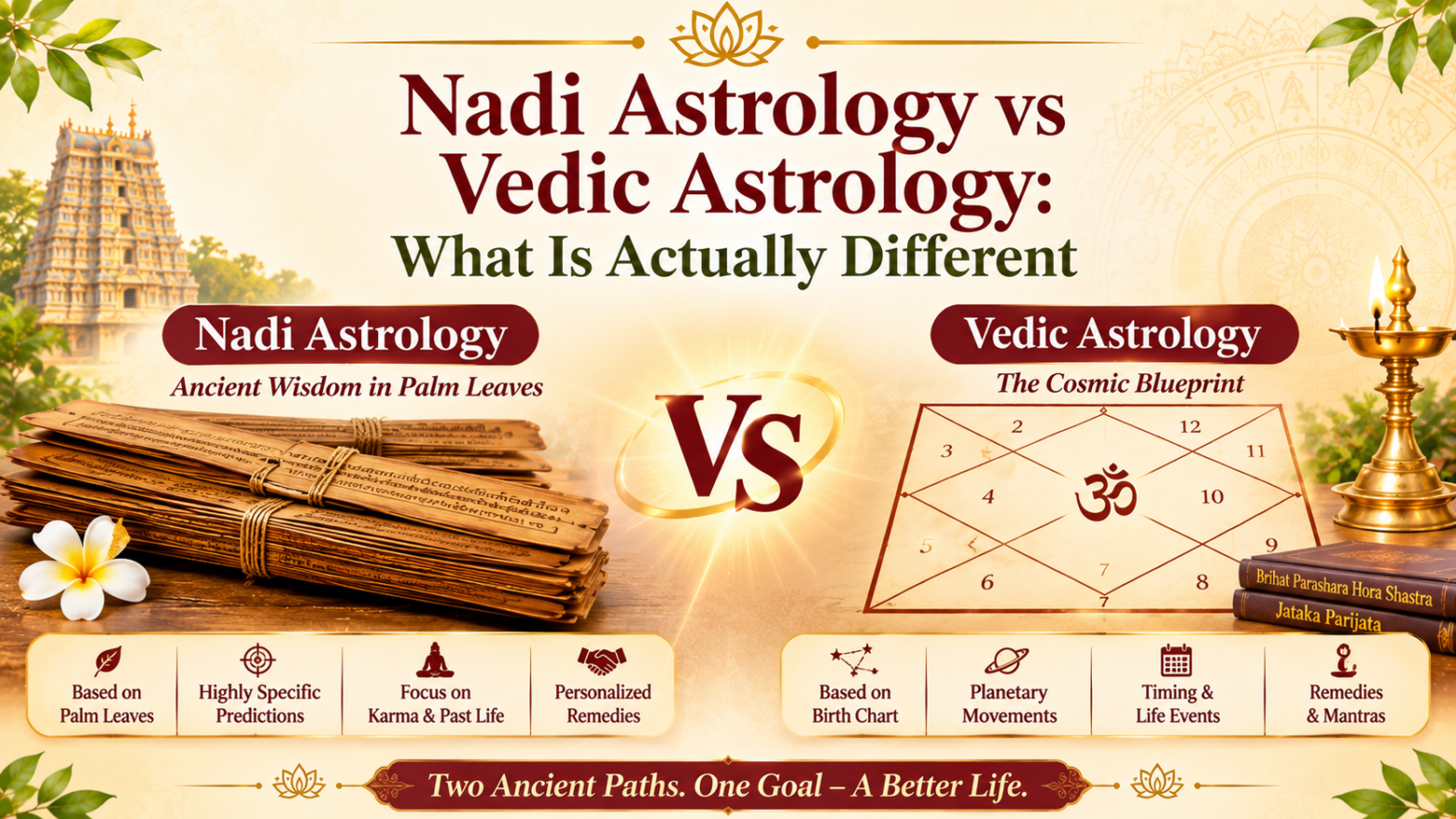
The core difference is this: Vedic astrology calculates a horoscope from your birth date, time and place at the moment of consultation, while Nadi astrology locates a pre-written palm leaf said to already contain your life, identified through a thumb impression. One is a calculation. The other is a retrieval. Everything else that distinguishes them follows from that single distinction.
The Fundamental Difference
In Vedic astrology, nothing exists until it is computed. The astrologer takes your birth details, casts the chart, and interprets the planetary positions at that moment. Two competent astrologers working from the same birth data will produce the same chart, though their interpretations may differ.
In Nadi astrology, the reading is held to exist already. The premise is that sages recorded the lives of those who would come to seek them, on palm leaves, long ago. The reader’s task is not to calculate but to find the right leaf and read what is on it. No chart is cast at the consultation.
Side by Side Comparison
| Vedic astrology | Nadi astrology | |
| Basis | Birth date, time and place | Thumb impression |
| Method | The chart is calculated at consultation | The leaf is located, then astrological principles are applied to it |
| Birth time needed | Yes, and accuracy matters greatly | No |
| Language | Sanskrit and regional traditions | Old Tamil verse |
| Structure | Twelve houses, nine grahas, dashas | Kandams, or chapters, one per life area |
| Can it fail | No, a chart can always be cast | Yes, a matching leaf may not be found |
| Practitioner skill | Calculation and interpretation | Reading old Tamil and locating the leaf |
| Verification | The chart can be checked by another astrologer | The leaf is verified by the seeker’s own yes or no answers |
Why Birth Time Matters in One and Not the Other
This is the most practical difference for most people. Vedic astrology depends heavily on an accurate birth time, because the ascendant changes roughly every two hours, and an error of even twenty minutes can shift the entire chart. Many Indians born before hospital records were routine do not have an accurate time, which limits what a Vedic reading can say.
Nadi astrology has no such requirement. The thumb impression is the identifier, which is why people with no recorded birth time often turn to it. This single practical fact accounts for a large share of Nadi consultations.
How Each One Is Structured
Vedic astrology
The chart is read through twelve houses, each governing an area of life, with the nine grahas placed across them. Timing comes from the dasha system, principally the Vimshottari dasha, which divides life into planetary periods. Predictions emerge from the interaction of placement, aspect, strength and the running dasha.
Nadi astrology
The reading is divided into kandams, or chapters, which broadly correspond to the twelve houses. A seeker may consult only the chapters relevant to their concern. Beyond the twelve, additional chapters deal with remedies (Shanti Kandam), past births, and in some traditions deeksha and liberation.
What Each Is Better Suited To
Neither replaces the other, and practitioners of both will usually say so.
Vedic astrology is better suited to timing specific periods through dasha analysis, assessing compatibility between two people, selecting muhurta for an undertaking, understanding the mechanics of why a difficulty is occurring, and ongoing consultation as circumstances change.
Nadi astrology is better suited to situations where birth time is unknown, seekers wanting a narrative account rather than a technical analysis, questions about past-birth causes of a present difficulty, and those seeking specific prescribed remedies rather than an interpretation they must act on themselves.
Can the Two Be Used Together?
Yes, and many families do. A common pattern is to obtain a Nadi reading for the broad karmic picture and the prescribed remedies, and to consult a Vedic astrologer for ongoing timing questions, muhurta selection and horoscope matching, which Nadi astrology does not perform.
There is no conflict between them in traditional practice. Both derive from the same underlying framework of karma, the grahas and the houses. They differ in method of access, not in worldview.
Are Both Systems Accurate?
Both traditions are held to be accurate, and both rest on the same foundation. The positions of the grahas used in either system are not arbitrary. They are computed from astronomical calculation, through the panchang and the ephemeris, with the same precision an astronomer would use to locate a planet on a given date. That computational base is shared.
There is a common misunderstanding about Nadi astrology worth correcting here. It is often described as pure retrieval, as though the reader simply reads out a text and stops. That is not how a reading actually proceeds. Once the leaf is identified through the thumb impression, the reader applies astrological principles to what is written: planetary positions, dasha periods and the timing of events are worked through much as a Vedic astrologer would work through a chart. The leaf provides the record. The astrology is still applied on top of it.
So the two are not a calculation system set against a non-calculation system. They are two routes into the same body of principle, differing in how the individual’s information is obtained rather than in what is done with it afterwards.
What a seeker can reasonably assess is the practitioner rather than the system. With a Vedic astrologer, judge whether the reasoning is explained and internally consistent. With a Nadi reader, judge the specificity and correctness of the checkable identifying details at the identification stage. In both cases, be cautious of anyone who moves quickly from reading to prescribing costly remedies under pressure, which is a mark of commerce rather than tradition.
Frequently Asked Questions
What is the difference between Nadi and Vedic astrology?
Vedic astrology calculates a horoscope from your birth date, time and place at the time of consultation. Nadi astrology locates a pre-written palm leaf, identified by thumb impression, said to already contain your life. One computes, the other retrieves.
Which is more accurate, Nadi or Vedic astrology?
Both are held to be accurate within the tradition, and both rest on the same astronomically computed planetary positions. Nadi astrology is not pure retrieval: once the leaf is identified, the reader applies planetary and dasha analysis to it as a Vedic astrologer would. They differ in how your information is obtained rather than in the principles applied afterwards, so they answer different kinds of questions rather than competing on accuracy.
Do I need my birth time for Nadi astrology?
No. Nadi astrology uses a thumb impression as the identifier, traditionally the right thumb for men and the left for women. This is why it is often sought by people whose birth time was never recorded accurately.
Can I do both Nadi and Vedic astrology?
Yes, and many families do. A Nadi reading is often taken for the broad karmic picture and prescribed remedies, with a Vedic astrologer consulted for timing, muhurta and horoscope matching, which Nadi astrology does not perform.
Is Nadi astrology part of Vedic astrology?
They share the same underlying framework of karma, the grahas and the twelve houses, and the Nadi kandams correspond broadly to the houses. They differ in method of access rather than in worldview, so Nadi is best understood as a distinct tradition within the same system rather than a separate one.
Which should I choose for my situation?
Choose Vedic astrology if you need timing analysis, compatibility matching or muhurta, and have an accurate birth time. Choose Nadi astrology if your birth time is unknown, or if you want a narrative reading with specific prescribed remedies rather than a technical analysis.
Learning to Read a Chart Yourself
Understanding the difference between these systems is one thing. Being able to open your own chart and see what an astrologer is describing is another, and it changes the nature of every consultation you have afterwards.
Poojas.in runs a structured Predictive Astrology track across four levels, starting with Astrology Decoded, a beginner’s course covering chart fundamentals and planetary influence, and moving into advanced prediction methods. See the full track at courses.poojas.in/courses.