

 21 October 2026
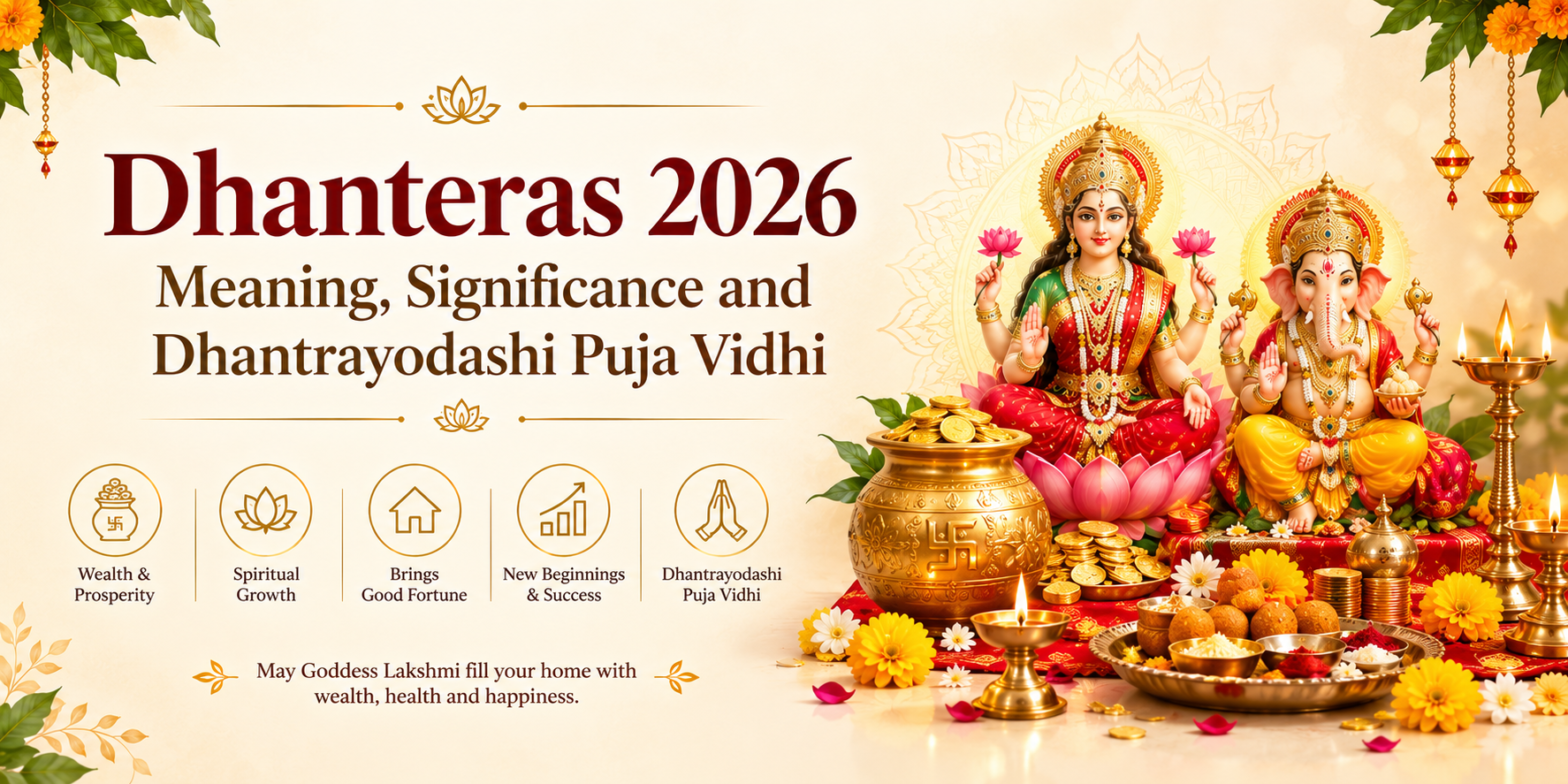
Dhanteras 2026 falls on Friday, 6 November, and marks the first day of the five day Diwali festival. The name combines dhan, meaning wealth, and teras, the thirteenth day of the lunar fortnight, and the day is dedicated to Lord Dhanvantari, Goddess Lakshmi and Kubera. It is considered auspicious to clean the home, light lamps and buy gold, silver or new utensils. This guide covers the meaning of Dhanteras, why it is celebrated, the Dhantrayodashi puja vidhi, and what to buy and avoid on the day.
Dhanteras Meaning
The word breaks into two parts. Dhan means wealth, and teras refers to Trayodashi, the thirteenth tithi of the Krishna Paksha in the month of Kartik. Put together, Dhanteras means the thirteenth day dedicated to wealth.
It is important to understand what wealth means here. The tradition does not treat Dhanteras as a festival of money alone. Lord Dhanvantari, who is central to the day, is the physician of the gods and the deity of Ayurveda, which places health at the heart of the observance. The prosperity sought on Dhanteras is the combination of health, wellbeing and material sufficiency, in that order.
What Is Dhanteras Festival?
Dhanteras, also called Dhanatrayodashi or Dhanvantari Trayodashi, is the opening day of the Diwali festival. Homes are cleaned and decorated, rangoli is drawn at the entrance, lamps are lit at the doorway in the evening, and the household performs a puja to Lakshmi, Kubera and Dhanvantari. Buying metal, particularly gold, silver or new utensils, is the custom most associated with the day.
Dhanteras day in 2026 opens a sequence that runs as follows:
| Day | Festival | Date 2026 |
| 1 | Dhanteras | Friday 6 November |
| 2 | Naraka Chaturdashi, Choti Diwali | Saturday 7 November |
| 3 | Diwali, Lakshmi Puja | Sunday 8 November |
| 4 | Govardhan Puja | Monday 9 November |
| 5 | Bhai Dooj | Tuesday 10 November |
Why Dhanteras Is Celebrated
Two accounts sit behind the day, and both are told.
The first concerns Lord Dhanvantari. During the Samudra Manthan, the churning of the ocean, Dhanvantari is said to have risen from the waters carrying the pot of amrita, the nectar of immortality. He emerged on Trayodashi, and the day is observed as his appearance. This is why Dhanteras is also kept as Ayurveda Day and why health is as much a part of the prayer as wealth.
The second is the story of King Hima’s son. Astrologers had predicted the young prince would die of snakebite on the fourth day after his wedding. On that night his wife refused to let him sleep. She piled her gold and silver ornaments at the door of the chamber, lit lamps everywhere, and told stories and sang through the night to keep him awake. When Yama arrived in the form of a serpent, he was dazzled by the blaze of lamps and metal and could not enter. He sat on the heap of ornaments listening to her songs until morning, and left without taking the prince. From this comes the custom of lighting lamps through Dhanteras night and of buying metal on the day.
Dhantrayodashi Puja Vidhi
The Dhantrayodashi puja is performed in the evening, during Pradosh Kaal, the period that begins after sunset. Confirm the exact window for your city from the panchang.
- Clean and prepare. Clean the house thoroughly, especially the entrance and the puja space. Draw a rangoli at the doorway and place lamps on either side.
- Set the puja place. Spread a red cloth on a raised platform. Place images or idols of Lakshmi, Ganesha and Dhanvantari on it, facing east or north.
- Light the lamps. Light a ghee lamp before the deities. A separate thirteen wick lamp, or thirteen small lamps, is lit in many households in keeping with Trayodashi.
- Invoke Ganesha first. As with every auspicious undertaking, begin with the worship of Lord Ganesha.
- Perform the Shodashopachara puja. Offer water, sandalwood paste, kumkum and haldi, akshata, flowers, incense and lamp to Lakshmi, Kubera and Dhanvantari in turn.
- Offer naivedyam. Sweets, fruits, batasha and dry fruits are the usual offerings. Many households offer kheer.
- Place the new purchase in the puja. Whatever metal has been bought that day, whether a coin, ornament or utensil, is placed before the deities, washed, marked with kumkum and worshipped.
- Yama Deepam at the doorway. After the puja, a lamp with four wicks is lit and placed facing south at the entrance of the house, offered to Yama for the protection and longevity of the family. This is traditionally lit by a woman of the household.
- Aarti and prasad. Complete with the Lakshmi aarti and distribute prasad.
Dhantrayodashi Pujan Samagri
- Idols or images of Lakshmi, Ganesha and Dhanvantari
- Red cloth and a raised platform
- Ghee lamps, cotton wicks, mustard oil for the Yama Deepam
- Haldi, kumkum, chandan, akshata
- Flowers and a garland, preferably lotus for Lakshmi
- Incense sticks, camphor, a bell
- Batasha, kheer, sweets, fruits and dry fruits
- Coins, cowrie shells and the metal bought that day
- Kalash with water, mango leaves and a coconut
What to Buy on Dhanteras
Gold and silver are the traditional purchases, bought as coins, small ornaments or bars. New utensils, particularly brass, copper and steel, are bought in nearly every household, and in many families this is the main purchase rather than gold. Brooms are bought in several regions and treated as a form of Lakshmi entering the house. Electronics, vehicles and property are modern additions to the list, and the tradition has absorbed them comfortably.
The customary avoidance is of iron, glass and sharp objects, along with black coloured items, on this particular day. Borrowing or lending money on Dhanteras is also traditionally avoided.
Frequently Asked Questions
What is the meaning of Dhanteras?
Dhanteras combines dhan, meaning wealth, with teras, the thirteenth tithi of the lunar fortnight. It means the thirteenth day dedicated to wealth, and it honours Lord Dhanvantari, the deity of Ayurveda, so health is as central to the day as prosperity.
When is Dhanteras in 2026?
Dhanteras 2026 falls on Friday, 6 November, opening the five day Diwali festival that concludes with Bhai Dooj.
What is Dhantrayodashi?
Dhantrayodashi is the formal name for Dhanteras, combining dhan with Trayodashi, the thirteenth tithi. It is also called Dhanvantari Trayodashi after the deity whose appearance the day marks.
How is the Dhantrayodashi puja performed?
The puja is performed in the evening during Pradosh Kaal. Clean the house, set images of Lakshmi, Ganesha and Dhanvantari on a red cloth, light lamps, invoke Ganesha, perform the sixteen offerings, place the day’s metal purchase before the deities, and light the Yama Deepam facing south at the doorway afterwards.
Why do people buy gold on Dhanteras?
The custom traces to the story of King Hima’s son, whose wife heaped gold and silver at the door and lit lamps through the night, dazzling Yama so that he could not enter. Buying metal on the day is held to invite prosperity and protection into the home.
What should not be bought on Dhanteras?
Iron, glass, sharp objects and black coloured items are traditionally avoided on this day, as is borrowing or lending money.