

 6 August 2026
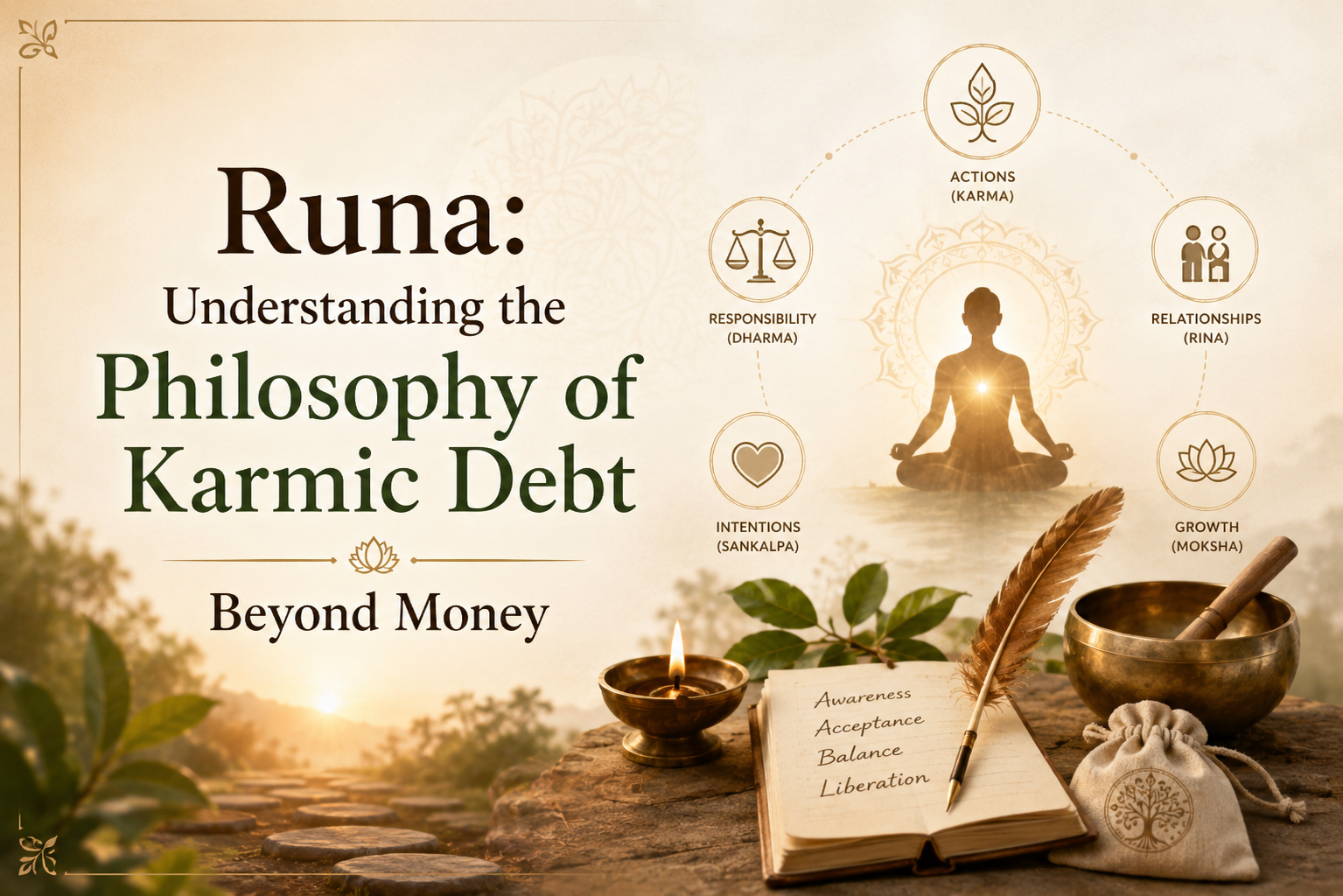
Runa is one of the most profound and misunderstood concepts in Vedic thought. Most people hear the word and think only of financial debt, but runa (ऋण) is a far broader term that means obligation, that which is owed, a binding. It stretches across every relationship we hold, every family we are born into, and every action we perform through thought, word, and deed. Before financial runa can be truly understood, the wider philosophical vision of runa must first be grasped. This article shares that taatvika drishtikona, the philosophical perspective on runa, drawn from classical scripture and the Vedic astrological tradition, as a foundation for understanding why some lives feel bound by debt of every kind and how the tradition views release from it.
What Is Runa? A Word Broader Than Debt
The literal meaning of runa is obligation, or that which one owes. In many Indian households, elders have always spoken of runa in everyday terms, the debt of salt, of oil, of the countless small things we receive and owe in the course of a life. This alone tells us that runa was never restricted to money. It is a term describing the entire web of what binds us to others and to the world.
The tradition broadly categorises runa into three kinds: Bhoutika runa (material and elemental obligation), Daiveeka runa (divine obligation), and Adhyatmika runa (spiritual obligation). From these three roots, many further branches of runa extend into every area of life.
We Are Born Into Runa
Reflect for a moment on the simple fact of birth. That we are born into a particular family, bloodline, place, vamsha, jaati, and form is itself the sign of a karmic connection, an obligation we already carry to the ancestors of that lineage. The moment we enter this world, our runas extend outward: to our parents, our immediate family, our gotra rishis, our kula devata, and our pitrus (ancestors).
As we move through the stages of life, the balya (childhood), kaumara (boyhood), yauvana (youth), and vriddha (old age) avasthas, different runas arise to be fulfilled at each stage. Some are added and some fall away as we pass from infancy to school, to college, to marriage, to work. Runa is not static; it is the changing ledger of a lifetime.
The Padma Purana states this with great clarity:
Runanubandha rupena pashu patni sutalaya, Runakshaye kshayanti tatra parivedana.
This means that every relationship a person passes through, spouse, children, dependents, home, is the result of a bondage carried from previous births. When the runa is exhausted, the relationship too dissolves, Attachment to runa gives rise to grief. People often quote this in the context of marriage alone, yet we become runatmaka (bound by runa) through all three instruments: kaayika (action), vaachika (speech), and maanasika (thought).
The Nine Faces of Suffering: Runa and the Navagrahas
As long as a human being suffers from the troubles born of these karmic causes, it is difficult to exit the loop of karma and punarjanma (rebirth). This is why the sacred suktas invoke the Divine Mother for relief. The well-known prayer reads:
Runa-rogadi-daridrya-papa-kshud-apamrityavah, Bhaya-shoka-manastapa nashyantu mama sarvada.
Salutations to Mother Lakshmi. O Mother, please remove my debts, illness, poverty, sins, hunger, and the danger of untimely death; remove also my fear, sorrow, and mental anguish, O Mother, remove them always.
This prayer is not a random list. It names nine forms of taapa (affliction), and in the Vedic astrological understanding each corresponds to a graha, one of the nine planets, which acts as the indicator (soochaka) of that particular suffering:
- Runa (debt), indicated by Mars (Kuja)
- Roga (illness)
- Daridrya (poverty)
- Papa (past-life sins), read through the 5th bhava
- Kshudha (hunger, lack of nourishment), indicated by the Moon
- Apamrityu (untimely death)
- Bhaya (fear), indicated by Kuja (Mars)
- Shoka (sorrow), indicated by Shani (Saturn)
- Manastapa (mental anguish, envy), indicated by Shukra (Venus)
The nine planets, sitting in different combinations across the twelve bhavas, reflect and indicate these afflictions, producing nine varieties of dosha. The tradition offers a beautiful image for how one root multiplies into many: guava seeds from a single fruit grow into many separate trees. That is nisarga lakshana, the nature of things, forever branching and changing.
Buddhi and Runa: The Role of the Intellect
Here is a subtle and powerful teaching. On one hand we arrive in this life to fulfil the karma of past births; on the other, through our samskaras, vasanas, upbringing, and patterns of thought, we ceaselessly create fresh karma. And the key instrument in this is the buddhi, the intellect, which prompts us (does prachodana) to become runatmaka (bound by obligation), dhanatmaka (yielding prosperity), or thatastha (neutral, stagnant).
The essential function of buddhi is to connect two things: two people, two objects, two activities, even two organs. When the ear can hear, there is scope for speech; where there is no hearing, speech has no ground. Because the intellect’s nature is to connect, the astrologer must examine what is being connected in a chart. If the connection is runatmaka, it yields ashubha phala (inauspicious results) and is mostly painful. If it is dhanatmaka, it yields shubha phala (auspicious results). If it is thatastha, the result is stagnation, a status quo. The Mahabharata offers living illustrations of the three states of intellect. Dhritarashtra is the classic example of runatmaka buddhi: unable to see, he acted always by his own whims and selfish motives, and reaped the consequences of that karmically bound way of living. Kunti represents dhanatmaka buddhi: through her selfless service to Rishi Durvasa she earned the boon of invoking any deity to beget a son, a divine and auspicious fruit. Vidura embodies thatastha: a jnani full of wisdom and intellect, he channelled it neither for the Pandavas nor Dhritarashtra, holding his insight without directing it to anyone’s benefit.
The lesson is direct: to clear away karmic or financial debt, the intellect must play its part. If the native’s buddhi is itself runatmaka, deeply coloured by runa badha, it becomes almost impossible for that person to free themselves from debt of any kind. It is said, Buddhir balam yasho dhairyam nirbhayatvam arogata, intellect, strength, fame, courage, fearlessness, and health belong together. Anjaneya (Hanuman), a mukta jeevi (liberated soul), possessed all of them: the ashta siddhi, nava nidhi, strength of intellect, fame, and fearlessness.
Nadi Shastra beautifully narrates, in shanti kandam – chapter 13 what karmas we have commited, where we were born, to whom and other Karmic details relevant and that are impacting our present life. Each of the kandams reveal in detail about life and runas of an individual. It can be noted that if it is the last life of an individual, the maharshis advise such natives through nadi readings to serve every part of creation including animals and nurturing plants.
Jyotish Shastra through birth chart analysis identifies the runas and suggests pariharas through Parihara jyothisa by giving remedies to problems caused due to karmic debts or runas.
The Three Dharmas We Are Born to Fulfil
Our rishis and ancestors taught that there are three karmic obligations or dharmas we must work towards, each corresponding to one of the three great categories of runa.
1. Adi Bhoutika Dharma
The protection of the environment and nature, and the avoidance of pollution (malinya). The pancha bhootas, the five elements, are indicative of bhoutika runa. This dharma is fulfilled by worshipping the divine through abhisheka, homa, dhoopa, deepa, and aarti, by planting and honouring trees (vriksha), and through prakriti aradhana, the worship of nature itself.
2. Adi Daiveeka Dharma
Living a dharmic life aligned with dharma, artha, kama, and moksha: pursuing knowledge along the path of dharma, and upholding one’s saamajika dharma (social duty), koutambika dharma (family duty), and maatru-pitru dharma (duty to mother and father).
3. Adhyatmika Dharma
It is taught that if we become dharma-brashta (fallen from dharma), we inevitably become karma-brashta. Desires must be kept within the boundaries of dharma, held within the four walls of righteousness. We are to fulfil our worldly responsibilities and then turn towards moksha, conquering the six inner vices. Where we fail in this, we ourselves generate adhyatmika doshas.
How the Three Dharmas Reflect in the Rashis
This philosophy maps directly onto the zodiac. The tradition reads the twelve rashis in three groups, mirroring the three dharmas, and when planets are afflicted (dooshita) in a rashi, they indicate a dosha of the tattva that rashi represents:
- Mesha, Rishabha, Mithuna, Kataka, the first four rashis, indicate the adi bhoutika jagat. Afflictions here point to elemental and material dharma doshas.
- Simha through Vrischika are the adi daiveeka rashis, indicating social, familial, and transactional (vyavaharika) dharma. Tula indicates vyavaharika dharma dosha, while Kanya and Vrischika indicate koutambika (family) dharma doshas.
- Dhanus through Meena are the rashis that indicate adhyatmika dharma.
Among the bhavas, the 1st, 5th, and 9th indicate swadharma, putra dharma, and pitru dharma respectively. An affliction to the lagna makes the native swadharma-brashta. Affliction to the 5th house may mean children are not born or lack direction. When malefics occupy these bhavas, the native becomes dharma-brashta, and an afflicted 9th house indicates unfulfilled runa to the pitrus, whose dharma doshas then affect the native.
Runa in the Scriptures: Living Examples
The epics are, at one level, a study of runa. Shravana Kumara in the Ramayana is the very image of pitru runa, a son who devoted his life to the service of his parents. This reminds us of an important correction: there is a misconception that runa to parents is cleared only through shradha after they die. In truth, the affinity to serve, help, and care for parents, siblings, and friends while they live is itself the working out of runa.
The story of Saint Pundalik carries this further. After a period of ill-treating his parents, he became the very model of devotion to them. So absorbed was he in their service that when Lord Krishna came to bless him, Pundalik tossed a brick (vit in Marathi) outside for the Lord to stand upon and wait, unwilling to interrupt his duty. Pleased by this supreme devotion, Krishna stood upon the brick, hands on hips, and waited, and from this he is known as Vitthala, the one who stands on a brick, at Pandharpur. The deeper teaching is in the turning: while Pundalik’s mind was runatmaka he ill-treated his parents and gathered sin like a bunch of flowers gathered on a stem; the moment his mind became dhanatmaka, the Lord himself manifested before him. Note too that while he neglected them, his parents had no praapta, no deservedness, of receiving comfort or service from their child.
When Lord Rama accepts exile in obedience to his stepmother Kaikeyi, we see her runatmaka buddhi at work, and how Rama’s own obligations led him to surrender the kingdom for the forest. He would not even be present to perform his father’s antima samskara (final rites), a sign of the runa between father and son that had to play out in that way. Dasharatha, for his part, was not blessed to have his son perform his last rites, which is how the tradition reads whether one has the praapta for a thing. Very often, when we ourselves are ready to fulfil a karma or runa, the other person does not have the praapta to receive it.
Contentment: The Key to Breaking the Cycle
Because desire itself gives rise to further births, aase is said to be the cause of sorrow, the tradition points to contentment as the way out. In the Skanda Purana, Lord Shiva tells the Divine Mother Parvati that a spiritual seeker should always be trupta, content with what he has, for only then can he break the karmic cycle of birth and death, the cycle of runanubandha. The shloka reads:
Labdham va tannalabdham va svalpam va bahulam tatha, Nishkamenaiva bhoktavyam sada santushta chetasa.
A spiritual aspirant should be content with whatever he receives, little or much, and should perform his duties without expectation (nishkama). Serve one’s parents without expecting inheritance; do it purely as dharma. Only then can one be sada santushta, ever content. This is how Lord Rama lived, ever content with or without the kingdom. The poets observe that his face showed no change when he gave up the throne for the forest; he appeared as serene in exile as at his coronation, and so he personally passed through no pain. His ichcha shakti, jnana shakti, and kriya shakti (the powers of will, wisdom, and action) stood in perfect balance, and it is from this state of mind alone that one may easily exit the loop of runanubandha.
This same spirit is captured in a prayer for a life and death of grace:
Anayasena maranam vina dainyena jivanam, Dehante tava sannidhyam dehi me parameshvara.
O Supreme Lord, grant me a death without suffering and a life without helplessness or degradation; grant me a dignified and meaningful life, and at the end of this body, grant me your divine presence.
Why Runa Is Not a Negative Word
Runa reflects itself as pain, happiness, stress, and praapta, and for this reason it is not, in itself, a negative word. Runa carries both positive and negative connotations; there are good runas and difficult runas, and both shape the quality of our lives. Caring lovingly for pets at home is a positive runa. A person locked in thankless service that is never valued, or one caught in a debt trap, carries a negative one. We see runa everywhere: in those born in one city who settle in another through their bhoomi runa, and in the woman born in one family who marries into another. All of it is the working out of obligation.
We also see it starkly in families where parents give everything and children give nothing in return, or the reverse, and especially in the case of children with lifelong dependency, where the bond of care is unbroken across an entire life. These are among the clearest expressions of runa at work.
Financial Runa: Where the Philosophy Meets the Chart
Extending these ideas to aarthika runa (financial debt), we begin to see why some fall into it while others do not. People enter financial runa badha for many reasons rooted in this larger picture: a runatmaka buddhi driven by greed or overconfidence; a thatastha, tamasic mind clouded by fear; borrowing to buy a home (is that dhanatmaka? it is worth pondering); an imbalance of the elements, excess water bringing emotional decisions, excess air bringing overthinking, a lack of earth bringing impracticality, a lack of fire bringing failure to implement; poorva janma karma; the need to balance a runa-praapta equation carried from before; health crises requiring borrowing for surgeries; shatru badha (affliction from enemies); ruinous habits; business losses; money lent and never recovered; an unsuccessful career; expenses exceeding income; and sometimes sheer accident, valuables lost to fire or mishap.
In Vedic astrology, financial runa is governed by the 6th bhava from the lagna. For the Kala Purusha, the natural 6th house is Kanya rashi and its lord Budha (Mercury) is the natural 6th lord. Mars and Saturn are the natural runa karakas. The 6th house depicts roga, ripu, and runa, illness, enemies, and debt, and among enemies there are two kinds, internal and external. When the intellect is firm yet drawn into such entanglements, the result reflects as illness, enmity, and debt, all traceable to poorva janma krutam papam (sins committed in past births).
This is why the state of the buddhi must be judged carefully to read the horoscope well. When Budha, the karaka of intellect, is blemished and afflicted in the chart, the native’s communicative abilities may be hampered, causing karmic troubles: poor memory and recall, weak absorption and processing of information, and vaag doshas born of false or broken commitments. Failure to keep one’s word creates runa badha, leading to troubles in communication, health, finances, enmity, and misunderstanding. Even Raja Satya Harishchandra, renowned for his truthful speech, was bound by his commitments, and struggled greatly to fulfil them, a point worth reflecting upon.
How an Astrologer Studies Financial Runa
Just as Mercury is studied for the runas of the intellect, Mars governs financial debts and the troubles of shatru badha, including harm from thieves and low-level adversaries. Working systematically, an astrologer can examine:
- Whether the native is afflicted by financial runa badha, loans, debts, or heavy financial commitments
- The root cause of the debt, whether poorva punya, career factors, wealth potential, family responsibilities, or accumulated obligations
- The planetary and bhava influences that cause debts to persist
- The presence of supportive combinations that enable repayment or relief from runa
- The timelines, and the degree of ease or struggle, involved in clearing financial liabilities
A learned astrologer can also throw light on whether a native carries an akasmika dhana yoga (sudden-wealth combination) or is prone to losses through speculation such as lottery and share trading. For karma is not the whole story; alongside it stands mukta ichcha, free will. Through arivu (awareness), prudence, and right decision-making, a person may alter the present, or through a high risk appetite and durase (greed) may plunge into loss and the loop of debt. Both forces, karma and free will, meet in the runa bhava of the chart.
Release: From Darkness Towards Light
Once the karmic debt is fully exhausted, no relationship or karmic balance remains, and our accounts in this samsara are closed. Until then, our condition is rebirth, which is why Adi Shankaracharya wrote, punarapi jananam punarapi maranam, again birth, again death. To exit this loop, the tradition holds that the presence of a Guru (guru sannidhi) is what leads a seeker from darkness towards light. Without it, our plight resembles one who climbs the tree of samsara only to fall into the ocean of naraka, and it is the Guru who lifts us from that fall, tasmai shree gurave namaha.
This is the deeper purpose behind so much emphasis on runa and karma: runa reflects as our pain and our joy, our stress and our deservedness. To understand it is to begin to understand the shape of one’s own life, and to see that release lies not only in clearing accounts but in cultivating the contentment, the discernment, and the grace that quiet the cycle of runanubandha itself.
Frequently Asked Questions About Runa
What is runa in Vedic philosophy?
Runa means obligation, or that which is owed, a binding carried across relationships and lifetimes. It is far wider than financial debt, encompassing what we owe to our parents, ancestors, gotra rishis, kula devata, nature, and the divine. The tradition classifies it into Bhoutika (material), Daiveeka (divine), and Adhyatmika (spiritual) runa.
Are all runas negative?
No. Runa carries both positive and negative connotations. Caring lovingly for a pet or serving one’s parents with devotion is a positive runa, while a thankless, unvalued burden or a debt trap is a negative one. Both shape the quality of a life, which is why runa is not, in itself, a negative word.
How is financial runa read in a horoscope?
Financial runa is governed by the 6th bhava from the lagna, which depicts roga, ripu, and runa (illness, enemies, and debt). Mars and Saturn are the natural runa karakas, and Mercury, as karaka of the intellect, is studied because a blemished buddhi often underlies debt. An astrologer examines these factors to understand the cause, persistence, and possible relief of financial debt.
Can runa be cleared, and how?
The tradition teaches that runa is worked out by fulfilling one’s dharmas, serving without expectation (nishkama), and cultivating contentment (santushti), since desire itself perpetuates the cycle. It also emphasises the grace of a Guru in leading the seeker from darkness to light. Alongside karma, free will (mukta ichcha) exercised through awareness and prudence can reshape the present.
Why do the nine planets relate to runa?
The suktas describe nine forms of suffering, debt, illness, poverty, sin, hunger, untimely death, fear, sorrow, and mental anguish, and in the Vedic astrological view each is indicated by a graha among the nine planets. Their combinations across the bhavas produce many varieties of dosha, which is how a single karmic root branches into diverse afflictions in a life.
A Note on This Article
This article shares the philosophical and traditional astrological understanding of runa as taught in classical scripture and the lineage of Vedic astrology. It is offered to illuminate a profound concept, not as a prediction or a remedy for any individual’s circumstances. Anyone facing serious financial or emotional distress is encouraged to seek both trusted guidance and appropriate professional support.