
 27 July 2026
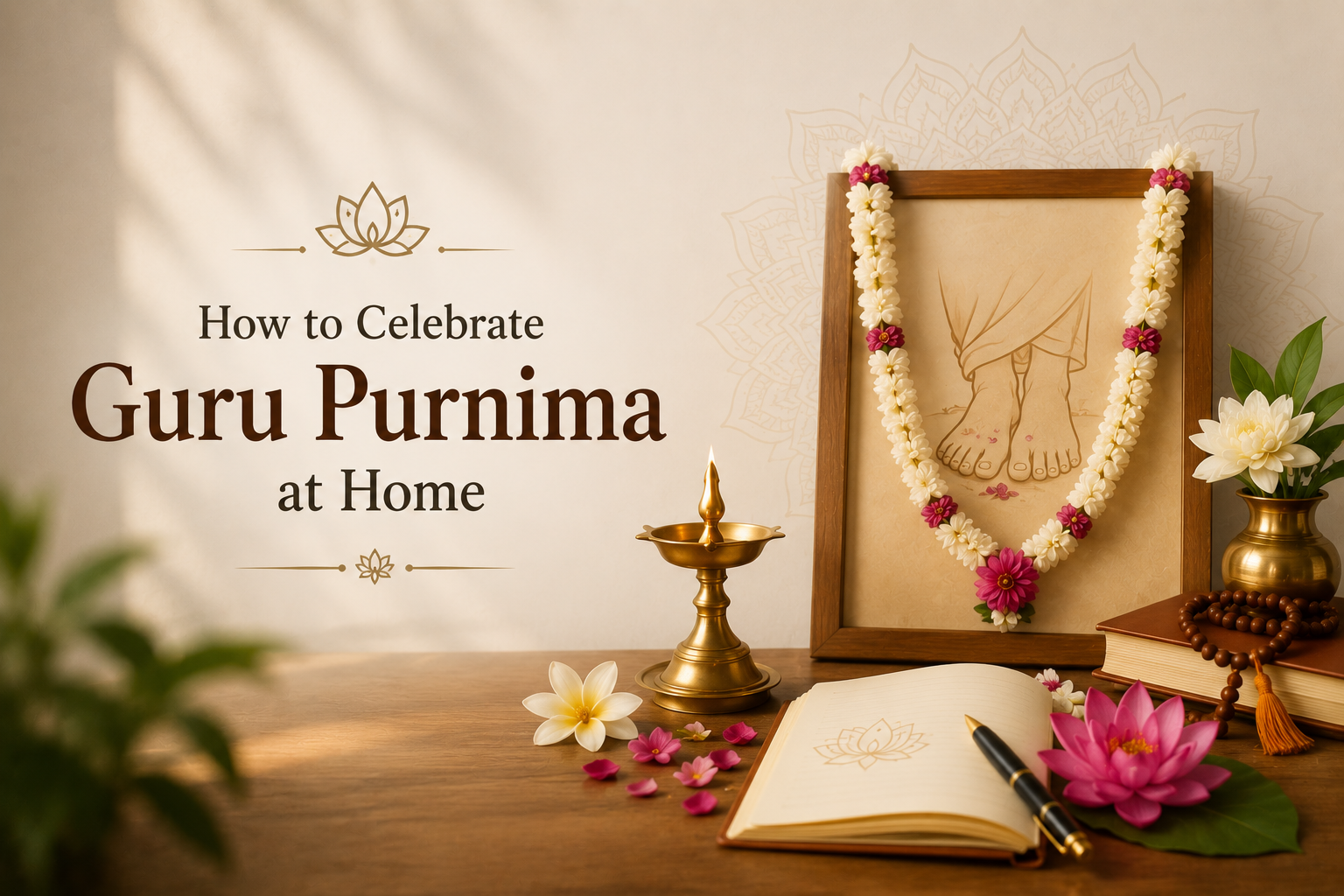
You can celebrate Guru Poornima at home in about twenty minutes of sincere devotion, with nothing more than a lamp, a few flowers, and a grateful heart. Guru Poornima is one of the most sacred days of the year, dedicated to expressing gratitude to the Guru Parampara, the eternal lineage of Gurus who lead us from ignorance to wisdom. It falls on the full moon (Poornima) of the month of Ashadha. This guide walks you through a simple, meaningful way to observe the day at home, without elaborate arrangements, because Guru Poornima has never been about grandeur. It is about devotion, humility, and reconnecting with the Guru Tattva that dispels the darkness within.
What Is Guru Poornima and Why We Celebrate It
The word itself carries the meaning of the day. Gu signifies darkness, and ru signifies the one who removes it. The Guru is the remover of darkness, the light that guides a seeker from not-knowing to knowing. Guru Poornima is the day set aside to honour that light in all its forms: our own Guru, the lineage of teachers before them, and the divine embodiments of wisdom itself.
The day is also known as Vyasa Poornima, in honour of Sage Vyasa, the compiler of the Vedas and author of the Mahabharata and the Puranas, regarded as the Adi Guru, the original teacher of the sacred sciences. Across traditions, the full moon of Ashadha is held to be the most auspicious time to turn inward and offer thanks to those who have shown us the path.
Importantly, you do not need a temple, a priest, or an elaborate setup to observe it. A quiet corner of your home and a settled mind are enough.
Simple Steps to Celebrate Guru Poornima at Home
Here is a gentle six-step way to observe the day. Move through it slowly and with attention; the sincerity of the offering matters far more than its scale.
Step 1: Light a lamp
Begin by lighting a lamp before your Guru, your Ishta Devata, or images of the divine embodiments of wisdom: Lord Dakshinamurthy, Lord Hayagriva, Maharshi Agastya, Lord Subramanya (Swaminatha Swamy), or your own revered Guru. The flame represents the light of knowledge that the Guru kindles within us, and lighting it is the traditional way to open the observance.
Step 2: Offer flowers, fruits, and gratitude
Offer flowers, fruits, or even a simple heartfelt prayer of gratitude. As you do, mentally offer your pranams to the eighteen Jyotisha Shastra Pravartakas, the eighteen great propounders of the sacred science of astrology, whose timeless wisdom continues to guide seekers to this day. The offering need not be lavish; a single flower given with devotion carries the whole of your gratitude.
Step 3: Chant your Guru Mantra
Spend ten to fifteen minutes in chanting. You may recite your Guru Mantra, the Guru Gita, the Guru Stotram, the simple and complete “Om Gurave Namah,” or any mantra into which you have been initiated. Let the repetition settle the mind and turn your attention fully toward the Guru Tattva. This quiet japa is the heart of the observance.
Step 4: Offer special prayers to the embodiments of wisdom
Offer your special prayers and pranams to the great sources of sacred knowledge:
- The eighteen Jyotisha Shastra Pravartakas, the founders of the science of astrology
- Maharshi Agastya, the great Rishi of wisdom and the tradition of Nadi Shastra
- Lord Subramanya, known as Skanda Maharshi or Swaminatha Swamy, the Supreme Guru who is said to have imparted the Pranava, the sacred Omkara, to Lord Shiva himself
- Lord Dakshinamurthy, Lord Hayagriva, and Guru Dattatreya, the eternal embodiments of divine wisdom and knowledge
Step 5: Read and reflect
Read a few verses from the Guru Gita, from a spiritual scripture close to your heart, or reflect upon a single teaching of your own Guru. Then take one small resolve: choose one teaching and commit to living by it in the days ahead. Guru Poornima is not only remembrance; it is renewal. A teaching honoured in action is the truest offering a student can make.
Step 6: Perform an act of seva or daana
If you are able, complete the observance with an act of Guru Seva, of daana (giving), or a contribution toward the preservation of Dharma, Vedic knowledge, or the Guru Parampara. Service offered in the Guru’s name, however modest, expresses gratitude in the most enduring form: by helping the light pass onward to others.
The Spirit Behind the Day
It bears repeating, because it is easy to forget in the search for the “right” way to observe a festival: Guru Poornima is not about elaborate rituals. It is about devotion, humility, and gratitude, and about reconnecting with the Guru Tattva that dispels the darkness of ignorance. A person with only a lamp and a sincere heart observes the day as completely as one with the most elaborate arrangements. The measure is inward, never outward.
Frequently Asked Questions About Guru Poornima
What is Guru Poornima?
Guru Poornima is the sacred full-moon day dedicated to expressing gratitude to the Guru and the Guru Parampara, the lineage of teachers who guide seekers from ignorance to wisdom. It falls on the Poornima of the month of Ashadha and is also known as Vyasa Poornima in honour of Sage Vyasa, the Adi Guru.
How can I celebrate Guru Poornima at home?
You can celebrate Guru Poornima at home in about twenty minutes: light a lamp before your Guru or chosen deity, offer flowers, fruits, and gratitude, chant your Guru Mantra or the Guru Gita for ten to fifteen minutes, offer special prayers to the embodiments of wisdom, read and reflect on a teaching, and, if possible, perform an act of seva or daana.
Which mantra should I chant on Guru Poornima?
You may chant your own initiated Guru Mantra, the Guru Gita, the Guru Stotram, or the simple “Om Gurave Namah.” Any of these, recited sincerely for ten to fifteen minutes, is a complete offering. What matters most is the devotion behind the chanting rather than the choice of verse.
Do I need elaborate arrangements to observe Guru Poornima?
No. Guru Poornima is centred on devotion, humility, and gratitude, not on scale. A lamp, a flower, a few minutes of chanting, and a grateful heart are enough to observe the day fully at home.
Who is honoured on Guru Poornima?
Devotees honour their own Guru and the entire Guru Parampara, along with the divine embodiments of wisdom such as Lord Dakshinamurthy, Lord Hayagriva, Guru Dattatreya, Lord Subramanya, and Maharshi Agastya. Those devoted to the science of astrology also honour the eighteen Jyotisha Shastra Pravartakas, the great founders of Jyotisha.
Why is Guru Poornima also called Vyasa Poornima?
It is called Vyasa Poornima in honour of Sage Vyasa, the compiler of the Vedas and author of the Mahabharata and the Puranas. Regarded as the Adi Guru, the original teacher of the sacred sciences, he is remembered on this day as the source of the lineage of wisdom.
May the Guru Parampara Guide You
Guru Poornima is a day to pause, to remember with gratitude those who have carried the light of knowledge to us, and to resolve to walk a little further along the path they have shown. May the blessings of the Guru Parampara, the eighteen Jyotisha Shastra Pravartakas, Maharshi Agastya, Lord Subramanya, Lord Dakshinamurthy, Lord Hayagriva, Guru Dattatreya, and your own revered Guru guide you toward wisdom, righteous living, and liberation.
Jai Gurudev.